Perfect barbecue: what to put on the grill first to ensure everything is cooked to perfection
When grilling a variety of different items, the challenge isn't usually knowing how to cook each food separately, but rather ensuring that none of them arrive late, cold, or dry.
The most practical way to plan a perfect barbecue is to think in reverse: not from the moment you light the fire, but from the time you want to start eating. From there, you organize the cuts of meat by thickness, presence of bone, type of food, heat intensity, and the amount of time they can rest without losing quality. This is much more useful than memorizing a table of cooking times that changes as soon as the size of the cut, the amount of coals, or the height of the grill changes.
Furthermore, there's a second idea that avoids a lot of trouble: cooking order and serving order are not the same thing. A large piece of meat can be the first to go in, yet come out after some chorizo or blood sausage served as a starter. And meat that needs to rest gives us a few precious minutes to finish cooking fish, seafood, or quick-cooking vegetables.
Before we put food on, we need more than one fire.
Grilling becomes much easier when the heat isn't uniform across the entire surface. It's a good idea to set up one area with intense heat and another with moderate or indirect heat. This way, you can quickly sear a piece of meat where the coals are pressing down and then move it to a cooler area, or do the opposite: cook a thick piece slowly and give it the final sear at the end.
With charcoal, this is achieved by distributing the embers unevenly instead of spreading them out like an identical carpet. In a barbecue with a lid, the area without charcoal directly under the food allows for indirect heat. This arrangement also leaves a small safety margin to move something that's browning too quickly. Knowing how to control the embers is far more valuable than constantly checking the timer every thirty seconds.
There's a useful rule, though it shouldn't be taken too literally: the thicker and more delicate the interior, the less beneficial it is to subject the piece to constant, direct heat. Conversely, thin or small foods can be cooked quickly near the coals because the heat reaches the center in a short time.
First things first: large, thick pieces with bone
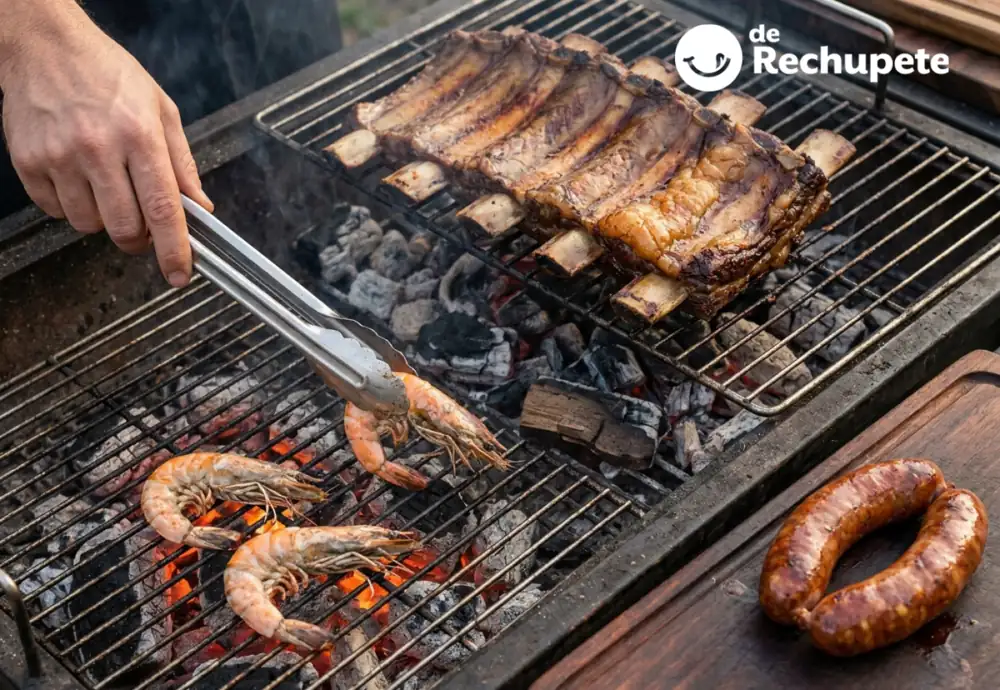
If there's a rack of ribs, a wide strip of short ribs, a thick ribeye, or any cut that needs a long cooking time on the grill, that's the one that should start cooking first. The bone and, above all, the thickness lengthen the distance the heat has to travel to reach the center. With a large rack of ribs, it's also important that the fat renders without charring the outside prematurely.
In Argentine barbecue, it's common to start grilling the ribs bone-side down and to work with a steady, steady fire, not a blazing flame. Cooking times can be long, but it's not worth making 70, 80, or 90 minutes a universal guarantee: they vary depending on the thickness of the ribs, their distance from the coals, the outside temperature, the wind, and the intensity of the fire itself.
With a very thick ribeye or entrecote, we can apply the same general logic with a different technique: a gentler sear to cook the inside to the desired doneness, followed by a more intense sear to achieve a good crust. The important thing is to understand what the cut needs, not to decide that everything large should remain motionless over the hottest part of the cut.
Second shift: chicken, sausages and medium-cooked pieces
Once the longer pieces have finished cooking, it's time to introduce foods that need thorough cooking but not an eternity. This includes chicken thighs or drumsticks, fresh sausages, medium cuts of pork or beef, and similar items.
Chicken benefits from controlled heat because its surface can brown long before the center is cooked. If you have two cooking zones, you can cook it on the moderate zone and then switch to the hot zone to adjust the browning as needed. Something similar happens with fresh chorizo: we want a golden-brown casing and a fully cooked interior, not a dark casing with a raw center.
Black pudding deserves its own section. Not all black puddings are the same. If we use pre-cooked black pudding, which is common with many commercial varieties, the grill should heat it and brown the skin without holding it on so long that it bursts and loses its filling. If the product we've bought requires thorough cooking, its specific characteristics and labeling dictate the cooking method, not a generic rule learned for another type of black pudding.
This second shift also allows you to start serving. In many barbecues, sausages and blood sausages can be served as appetizers while the larger cuts continue cooking. That's precisely the difference between organizing a barbecue and simply waiting for absolutely everything to be finished at once.
In the end: fish, seafood and vegetables that cook quickly
A sardine, a prawn, or a slice of zucchini has nothing to gain by sitting on a tray for half an hour while the ribs finish cooking. Fast food should be served close to the time of service so it comes out hot and retains its moisture, texture, and perfect doneness.
Sardines need a very hot grill so the skin cooks quickly without drying out the flesh. Something similar happens with prawns: once the flesh is cooked, prolonging the cooking time only makes them drier. And with vegetables, it's best to differentiate between types. A whole potato or a thick ear of corn requires much more planning than strips of pepper, slices of eggplant, or zucchini slices.
That's why "vegetables" isn't a single grilling stage. Dense cuts can start much earlier or be partially cooked using another method; thin, tender pieces go in at the end. The useful question isn't whether a food is meat or vegetables, but how thick it is, how much water it contains, and what texture we want to preserve.
Cooking first doesn't mean serving first
Here's the part that usually makes a barbecue truly special. Imagine a menu with ribs, chorizo, blood sausage, sardines, and vegetables. The ribs can go on first and continue cooking while the chorizo is ready to kick things off. The blood sausage can be heated later and served alongside it. The sardines and tender vegetables don't even need to touch the grill until the first bite is already on the table.
This avoids attempting an impossible synchronization. We don't need all the food to reach its exact point at the same second. We need each group to have a logical order, and for items that need to be eaten immediately not to wait for a slower-cooking piece.
Large cuts of meat also have an advantage because they usually benefit from a short rest before being sliced. This interval allows you to finish a quick batch, rearrange the coals, or prepare for the next service. Instead of considering this rest time as downtime, we can use it as part of the schedule.
The thermometer is more important than the clock.
Estimated cooking times are useful for planning, but they don't guarantee that the center of a piece is cooked. Two chickens of the same weight can behave differently; a thicker sausage takes longer; embers lose heat; a piece that was very cold starts at a disadvantage. The clock tells us when to start checking, not when to stop thinking.
For foods where thorough cooking is essential, a kitchen thermometer provides much more useful information than the exterior color. As a simple guideline, the Community of Madrid recommends reaching 70ºC in the center of the product for 30 seconds. They also remind us of something especially important when barbecuing: meat can brown very quickly on the outside and remain undercooked inside.
The probe is inserted into the thickest part, avoiding measuring close to the bone or in a pocket of fat. In very thin cuts, it's necessary to insert it laterally so that the thermometer's sensitive area is truly in the center. And when looking for a specific temperature in a piece of beef, it's important to distinguish between that culinary objective and the safety requirements for foods like chicken or ground meat products.
A practical order for a mixed barbecue
You don't need a spreadsheet by the fire. Just organize the work into blocks and adjust according to what's in front of you.
First, we prepare the fire and the heat sources. We don't take all the meat out of the refrigerator and leave it waiting while the charcoal decides to get going. For a safe barbecue, perishable foods should be kept refrigerated until we actually need them.
Next come the slower-cooking pieces. Ribs, thick cuts with bones, and cuts that will be cooked at moderate heat need some leeway. These are the ones that determine the start time.
Next, we add the medium-cooked items. Chicken, fresh sausages, and medium-sized cuts are added once the longer cut has already cooked through some of its cooking time. This isn't because there's a magic minute, but because their cooking window is smaller.
Then we start serving what's already cooked. If the chorizo or blood sausage is properly heated, there's no point in waiting until the ribs are done. They come off the grill and are eaten.
The final stage involves quick-cooking foods. Fish, seafood, and delicate vegetables are cooked just before serving. This way, they don't need to be kept warm for too long.
Finally, we take advantage of the resting periods. While a large piece rests before being cut, we finish the last batch. It's a simple organizational trick that solves many barbecue problems without needing to rush.
Mistakes that ruin the whole barbecue
The first is to put everything on at once. It seems like the easiest way to avoid forgetting anything, but it forces you to take food out ahead of time, keep other items waiting, and chase incompatible cooking points in a single heat zone.
The second is to have a consistent heat level. If the entire grill is overheated, a thick piece of meat might burn on the outside before cooking through. If the heat is too low, fast-cooking food will lose the desired golden-brown color, and service will take forever.
Another common mistake is cooking with constant flames touching the meat. A flame is not the same as good embers. The dripping fat can cause flare-ups; if we keep the meat in the heat, charring the outside doesn't guarantee that the center is cooked properly.
There's also a less obvious but far more serious problem: using the same tray or tongs that have been in contact with raw food to serve it. You need to keep raw and cooked food separate, keep perishables cold until they go on the grill, and have a clean platter ready for what comes off the grill.
And finally, it's best not to try to save everything for a grand finale. A mixed grill works best when each item is cooked at its peak. The slowest-cooked piece marks the beginning; the medium-cooked pieces build the course; the quicker ones finish each round. Grilling ceases to be a race against time and becomes a sequence that's quite easy to manage.