Spirulina: what it is, real benefits, how to take it, and when to be careful
A spirulina label can be quite impressive when you read it per 100 grams: lots of protein, minerals, and a bluish-green color that seems to promise something extraordinary. The problem is that nobody consumes 100 grams of spirulina as a normal serving.
This is where much of the confusion surrounding spirulina lies. It has an interesting composition and has been researched for decades, but claims have accumulated around it that go far beyond what has been proven. It's sold as "algae," as a superfood, as a source of vitamin B12, as a weight-loss aid, as a boost for athletes, and even as a detox product. Some of these ideas have a partial basis; others require much more nuance, and some should simply be dismissed.
The helpful way to look at it isn't to decide whether spirulina is wonderful or useless. It's to know what it actually is, how much it provides in a normal amount, what effects are scientifically supported, how it can be used in cooking, and what controls should be in place for the product we buy.
First: Spirulina is not exactly an algae
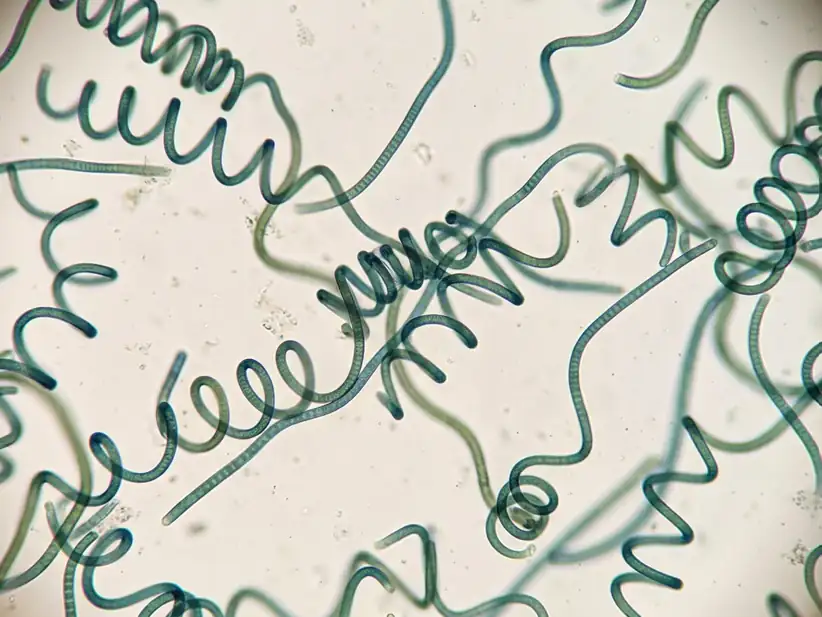
Although it's still commonly called "blue-green algae" or microalgae, biologically it's a photosynthetic cyanobacterium. The trade name spirulina has been applied for years to organisms classified as Arthrospira, and with the most recent taxonomic revisions, many of the strains used industrially are now placed in the genus Limnospira. You don't need to learn the entire family tree to buy or cook with it, but it's worth clarifying that it's not a marine algae like nori or wakame.
Its consumption didn't begin with Instagram either. Historical sources compiled by the FAO describe techuitlatl, which was harvested in the area of Lake Texcoco, Mexico, and dihé, traditionally produced around Lake Chad. Long before it became green powder in a jar, it was already a food source.
Today it is cultivated under controlled conditions, harvested, dried, and sold primarily in powder, tablet, or capsule form. It is also used as a food ingredient and as a source of pigments, especially phycocyanin, which is responsible for much of its characteristic blue hue.
What's important is not what it provides per 100 grams, but what your actual dose provides.
Dried spirulina can have a high protein content, although the amount varies depending on the strain, culture, and processing. Precisely because of this variability, it's best to check the label of the specific product rather than copying a universal nutrition facts table.
Furthermore, there's a second, even more important correction: the amount we consume is usually small. Spirulina, with 60g of protein per 100g serving, provides 3g of protein in 5g of product. That might add up, but it doesn't make a teaspoon equivalent to a serving of legumes, eggs, fish, meat, dairy, or tofu. If we truly want to assess the role of protein in our diet, what matters more is how much we need throughout the day and where our overall food intake comes from.
It can also provide iron, carotenoids, and other micronutrients, but its concentration isn't identical across all brands, and a high number on the nutrition label doesn't automatically correct a deficiency. A deficiency in iron, vitamin B12, or any other nutrient is diagnosed and treated as such; it's not solved by choosing the green powder with the most eye-catching label.
So, what is spirulina good for?
Its simplest use is also the least noticeable: it serves as a concentrated food or as a dietary supplement. It can add a small amount of protein, pigments, and certain micronutrients; it can be used as a culinary ingredient; and it is useful for coloring preparations green or blue-green without resorting to synthetic dyes.
That aligns better with what a food supplement is: something that complements the diet, not a medicine or a substitute for eating well. AESAN itself reminds us that these products are not intended to prevent or treat diseases and should not replace a balanced diet.
In cooking, it also has a very distinct personality. Its flavor is intense, vegetal, and somewhat earthy, so it usually works best in small quantities and paired with ingredients that soften it. Shakes and smoothies are the most obvious use, but it can also be mixed with yogurt, kefir, hummus, chilled soups, sauces, dressings, or doughs where its color is desired.
What benefits are being studied and how far does the evidence go?
It's important to distinguish between two things that are often confused: that spirulina contains interesting compounds and that taking it has been shown to produce a significant clinical benefit. These are not the same thing.
Human research has found promising signs in some cardiometabolic parameters. Reviews and meta-analyses of clinical trials have observed small average reductions in body weight, and other studies have found improvements in some cholesterol, triglyceride, or blood pressure levels in certain groups. This justifies further research; it does not justify presenting spirulina as a treatment for obesity, hypertension, diabetes, or high cholesterol.
In 2025, a meta-analysis of randomized controlled trials on body composition found an average weight loss of just over one kilogram and small changes in BMI and body fat percentage. This is an interesting result, but a small average effect in controlled studies does not make spirulina a weight-loss product. A person's overall diet, physical activity, rest, and individual circumstances play a much larger role.
Phycocyanin and other compounds in spirulina also show antioxidant and anti-inflammatory activity in experimental research. The leap we must avoid is going from "this compound has biological activity" to "taking spirulina prevents disease." Clinical evidence does not yet support such a conclusion.
The great vitamin B12 trap
This is probably the most important point of the article for anyone following a vegan or vegetarian diet. Spirulina should not be used as a reliable source of vitamin B12.
For years, analyses circulated that appeared to show high levels of B12. The problem is that many of these molecules are analogs or pseudovitamin B12, chemically similar compounds that the human body does not use as active vitamin B12. Specific studies on spirulina tablets have already shown that the predominant form was precisely this pseudovitamin.
Therefore, if someone needs to ensure adequate vitamin B12 intake, they should do so with appropriate sources and supplements, not relying on spirulina. Whether a product is green, natural, or rich in other nutrients does not change this point.
How to take spirulina without turning it into a punishment
With tablets or capsules, there's little culinary choice: you simply follow the manufacturer's instructions. Powder is a different story. Its flavor can overpower a dish if used excessively, so it usually works better when blended into a mixture with fruit, yogurt, cocoa, mild citrus fruits, or creamy ingredients rather than used as the main ingredient.
In a smoothie, for example, it's wiser to start with a small amount per flavor and adjust later than to add a generous spoonful just because an online recipe says so. The same applies to a green smoothie, a bowl of yogurt, or a cold soup: more spirulina doesn't automatically mean more benefits and can actually result in a much more difficult flavor.
If you want to preserve the blue hue of the phycocyanin, cold or gently heated preparations are best. This pigment loses stability at high temperatures and is also sensitive to pH and light. Cooking spirulina doesn't make it dangerous, but it can alter the color and degrade some of the pigment, so there's not much point in paying for an intense blue only to subject it to vigorous cooking.
Is there a best time to take spirulina? There is no universally proven optimal time. If you are taking it as a supplement, it is reasonable to follow the product instructions and choose the time that is most convenient and best tolerated, rather than attributing special effects to taking it on an empty stomach or before bed.
How much spirulina can you take per day?
There is no single, universal dose of spirulina that is appropriate for everyone and for every purpose. Clinical trials have used very different amounts, but a dose used in one study does not automatically become a recommended intake.
AESAN advises taking supplements at the daily dose indicated on the label and not exceeding it. ANSES, after reviewing the safety of spirulina, also noted that the available data did not allow for establishing a general maximum amount suitable for all situations.
This also answers another common question: taking twice the amount doesn't mean getting twice the benefit. If the product is sold as a supplement, the practical reference is the dosage on its label; and if the goal is to correct a deficiency, improve a condition, or combine it with medication, then we're in a situation that warrants professional evaluation.
Before buying, control is more important than color.
Spirulina itself is not the only issue. The quality of the cultivation and processing matters a great deal because poorly controlled biomass can become contaminated with other cyanobacteria, microcystins, microorganisms, or metals and other environmental pollutants.
ANSES has specifically emphasized purchasing these products through reliable and well-controlled supply channels. AESAN makes a similar recommendation for supplements in general: use authorized channels, be wary of unknown sources, and check the labeling.
When choosing, it's more helpful to check the manufacturer, batch number, traceability, ingredients, and usage information than to be swayed by claims like "detox," "fat burner," "immunity booster," or "instant energy." Spirulina may be included in so-called "supergreen" powders, but a mixture with twenty ingredients isn't necessarily better than a simple, well-identified product.
Who should take special precautions
Most available studies describe good tolerance at usual doses, but that doesn't mean adverse effects are impossible. Digestive discomfort, headaches, and allergic reactions, among other events, have been reported, and ANSES itself warns that studies are not always large enough to detect rare effects.
People with phenylketonuria should avoid it because it contains phenylalanine. ANSES also advises against its use in people with allergies. And, as with other supplements, if there is an underlying medical condition, if medication is being taken, if there is pregnancy or breastfeeding, or if it is being considered for a child, AESAN recommends consulting a healthcare professional.
There's no need to panic, but neither should we treat a supplement like it's water. Natural doesn't automatically mean harmless, necessary, or suitable for everyone.
Is spirulina worth buying?
It depends on what you want it for. If you like its flavor, want to use it as an ingredient, are interested in its color, or are looking to incorporate a small amount of a concentrated food, it can certainly have a place in your kitchen. There is also reasonable research that justifies further study of some of its metabolic effects.
If you buy it expecting to replace vegetables, cover vitamin B12, correct anemia, lose weight without changing anything else, or prevent diseases, the answer changes: spirulina does not do that job.
Perhaps that's the fairest way to describe it. Neither magic powder nor food fraud. It's an edible cyanobacterium with a peculiar composition, a history considerably older than the superfood craze, and some interesting uses. The sensible thing to do is to take advantage of what it does offer without asking it for what the evidence cannot yet promise.