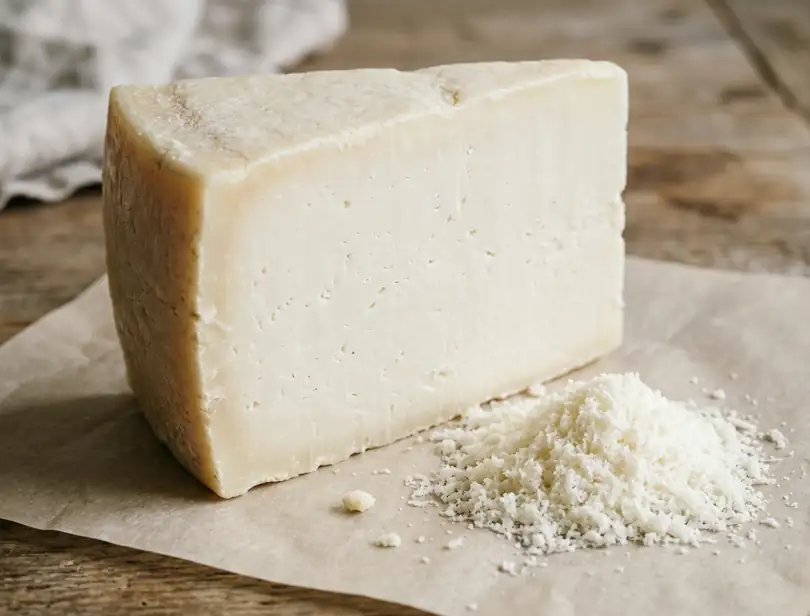
Pecorino, Grana Padano and Parmigiano Reggiano: differences and which one to use in each recipe
At first glance, they look similar enough to be easily confused: they are all hard, light-colored Italian cheeses that grate easily and appear time and again in Italian cuisine. But Pecorino Romano, Grana Padano, and Parmigiano Reggiano are not three names for the same thing.
There is also an important clarification to be made. Pecorino is not a single cheese, but a family of cheeses made from sheep's milk. These include, among others, Pecorino Toscano, Pecorino Sardo, and Pecorino Romano. To compare it with Grana Padano and Parmigiano Reggiano, we will focus here on Pecorino Romano DOP, which is the one that typically appears in Roman recipes such as carbonara or cacio e pepe.
Differences between Pecorino Romano, Grana Padano and Parmigiano Reggiano at a glance
The table is a useful guide, but it's best not to rely solely on it. The age of the cheese significantly alters the experience. Comparing a 9-month-old Grana Padano with a 36-month-old Parmigiano Reggiano exaggerates the differences: part of what we perceive comes from the aging process, not just the designation of origin.
Pecorino Romano: sheep's milk and a flavor that stands out
Pecorino Romano is made with whole sheep's milk. This clearly distinguishes it from the other two, which are made with cow's milk. Its paste is usually more compact, and its flavor is saltier, more direct, and spicier, especially when it is well-aged and intended for grating.
It's the cheese that best stands up to recipes with strong flavors because it doesn't disappear into the sauce. In a Roman carbonara, it adds saltiness and character; in a cacio e pepe, its flavor becomes part of the dish's very identity. If you substitute it with a cow's milk cheese, the pasta may still be tasty, but it won't taste the same or have the same balance.
It's also important to distinguish it from other pecorino cheeses. A young Pecorino Toscano can be considerably milder. Therefore, when a recipe simply says "pecorino," we shouldn't assume that all Italian sheep's milk cheeses are interchangeable.
Parmigiano Reggiano: longer maturation time and a more complex profile
Parmigiano Reggiano DOP is made with raw cow's milk, salt, and rennet, with no additives. The milk from the afternoon is left to settle so that some of the cream separates and is then combined with whole milk from the morning. Its minimum aging is 12 months, and there is no maximum age limit.
Over time, deeper aromas and a more crumbly texture emerge. In mature pieces, it's common to find small crystals that enhance the crunch. Its flavor can be reminiscent of nuts, broth, butter, or ripe fruit depending on the aging process, but the most useful thing to understand in cooking is that it offers plenty of umami without being as salty or sharp as Pecorino Romano.
It's especially good when the cheese isn't just meant to add salt, but to contribute layers of flavor. It works well in a rich risotto, with pasta, over vegetables, or served in shavings. In simple dishes, like a tomato salad with Parmesan and pesto, the difference of using a well-aged cheese is particularly noticeable.
Grana Padano: similar to Parmigiano, but it's not "another Parmesan"
Grana Padano DOP is also made with cow's milk and has a hard, granular paste, which is why it can visually resemble Parmigiano Reggiano. However, they are two distinct DOPs, with their own production areas and sheets. To define Grana Padano as a variety of Parmesan is an oversimplification and, strictly speaking, incorrect.
Its minimum maturation period is 9 months, three less than that of Parmigiano Reggiano. Younger cheeses tend to offer a more delicate, milky, and less sharp profile, while with longer aging they gain intensity and complexity. This makes them a very versatile cheese for everyday cooking: they add flavor without overpowering the other ingredients.
It works very well in pasta, fillings, vegetables, gratins, and rice dishes. It can also be used in sauces like green pesto, where the cheese is part of a blend with basil, oil, and nuts, and it's not always desirable for a single flavor to overpower all the others.
Can they be substituted for each other? Yes, but the dish changes.
Grana Padano and Parmigiano Reggiano are the two cheeses that best substitute for each other in a home kitchen. If a recipe calls for one and you have the other, you can usually proceed without any technical difficulties. The difference will mainly be in the flavor: younger Grana is usually milder; a well-aged Parmigiano will be deeper and more persistent.
With Pecorino Romano, the substitution is less neutral. Because it's made with sheep's milk and has a more pronounced saltiness, it can significantly alter the dish. Replacing Parmigiano with Pecorino in a risotto will make the cheese more prominent; doing the opposite in a carbonara will make it milder. It's not that one option is automatically worse, but rather that the substitution is no longer seamless.
The amount of salt you add also matters. If you're substituting one cheese for another, it's not a good idea to copy the recipe's salt quantity without tasting it first. A mature Pecorino Romano can provide enough salt on its own. The sensible thing to do is grate it, mix it, taste it, and adjust the seasoning at the end.
Which cheese to choose depending on what we are going to cook
For carbonara, cacio e pepe, and other Roman pasta dishes, Pecorino Romano is the most characteristic choice. Its strength is designed to work well with pepper, guanciale, fat, and cooking water without being overpowered.
For risottos, Parmigiano Reggiano and Grana Padano are excellent choices. If you're looking for a deeper flavor and want the cheese to be prominent, go for Parmigiano; if you prefer a milder finish or the other ingredients already have a strong character, choose Grana Padano. In both cases, the cheese is finely grated and usually added off the heat or with very controlled heat to help emulsify without forming clumps.
In pesto and other blended sauces, the result depends on the specific recipe. Combining a mature cow's milk cheese with a sheep's milk cheese adds depth and a touch more saltiness. Here, it makes more sense to seek balance than to advocate using a single cheese for everything.
To eat in slivers or small pieces, the choice is pure preference: Parmigiano Reggiano if we want complexity and maturation crystals, Grana Padano if we prefer something more rounded, and Pecorino Romano if we like sheep's milk cheeses with plenty of character.
How to recognize what we are buying
The simplest way is to stop just looking at the word "parmesan" and look for the full PDO name. Parmigiano Reggiano, Grana Padano, and Pecorino Romano have protected designations of origin and their own trademarks on the wheels and on the labels of packaged portions.
If you're buying cheese by the slice, it's worth asking about the aging period. This information can reveal more about the flavor than a comparison based solely on brand. A 12-month Parmigiano and a 36-month Parmigiano are the same PDO cheese, but they don't offer the same texture or intensity.
In summary: Pecorino Romano is the most distinct of the three because it's made from sheep's milk and has a saltier, more robust profile. Grana Padano and Parmigiano Reggiano are cow's milk cheeses related in style, but they don't share the same Protected Designation of Origin (PDO). Grana Padano is generally milder when young; Parmigiano Reggiano undergoes a longer minimum maturation period and can develop a particularly complex flavor profile. Choosing one over the other isn't a question of which is "better," but rather what kind of flavor you want the cheese to impart to the recipe.