Tian: the plant as a declaration of excellence
In the heart of Vienna, a city traditionally devoted to stews, sausages, and opulent pastries, Tian stands as a declaration of principles: here, gastronomic excellence is achieved without meat, yet without sacrificing sophistication, technique, or emotion.
In the heart of Vienna, a city traditionally devoted to stews, sausages, and opulent pastries, Tian stands as a declaration of principles: here, gastronomic excellence is achieved without meat, yet without sacrificing sophistication, technique, or emotion. In a contemporary, elegant, and comfortable space, where soft lighting at night creates intimacy and focuses attention on the food, chef Paul Ivić offers a tasting menu that rewrites the narrative of haute cuisine: vegetables, roots, flowers, and seeds, often rare or forgotten varieties, take center stage.
Tian's rise was no accident. It was a response to a profound transformation in the international gastronomic landscape: the consolidation of plant-based fine dining. For decades, vegetarian cuisine occupied a marginal position in haute cuisine, associated more with sacrifice than pleasure. However, the green revolution reached the very heart of gastronomy, and chefs like Paul Ivić demonstrated that it is possible to thrill, surprise, and challenge diners with a menu based on humble ingredients prepared with creativity, sensitivity, and impeccable technique.
Paul Ivić: the chef who champions the power of nature
Born in Tyrol in 1978 and of Croatian descent, Paul Ivić is one of the most recognized voices in the new European plant-based cuisine. Interestingly, he is not a vegetarian: he follows a diet in which 80% of what he consumes is plant-based, but he still cooks with meat or fish at home if he knows its origin and quality. His interest stems not from dogma, but from an ethical conviction: to value the true flavor of nature without the need to imitate anything.
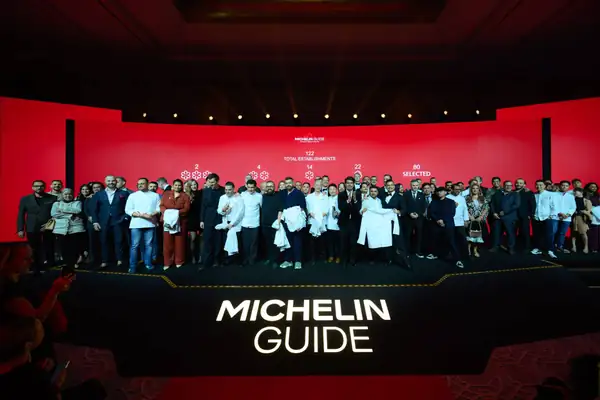
After training in Austria, Germany, and Switzerland, he joined the Tian project in 2011, drawn precisely by the radical limitation of cooking exclusively with plant-based ingredients. For him, this restriction was a form of freedom. Since then, he has transformed Tian into the first vegetarian restaurant in Austria to receive a Michelin star, a Green Star for its sustainability, and four Gault & Millau Touches. It has also been recognized by Falstaff, Rolling Pin, 50 Best Discovery, and The Best Chef Awards for its innovation and commitment.
For this chef, each dish is also a way to honor those who make it possible: the people who care for the soil, experiment with the harvest time, or transport the produce daily. “Cooking” he says, “is about taking responsibility. Not only for what is served, but for everything that goes into it.”
Hours before sitting down to eat, I had the opportunity to visit one of the places where it all begins: the Krautwerk farm, just an hour from Vienna. There, Robert Brodnjak lovingly cultivates many of the vegetables that later feature prominently on Tian's menu. Robert was a chef before turning to agriculture, and it shows; he perfectly understands what Paul Ivić is looking for and cultivates with a sensitivity that transcends mere technique. I was able to see up close the lettuces that would arrive at the restaurant that very afternoon. Although the romaine lettuce dish wasn't the one that moved me the most, it did allow me to appreciate that direct connection between field and kitchen: the respect for the produce, the care taken at the point of harvest, the desire to enhance it without over-intervening.
That same approach is evident in other menu items, such as fermented foods. Paul collaborates with Wiener Miso, a local project that produces misos and tamaris with organic ingredients, following Japanese recipes and Viennese sensibilities. This combination of technique, local produce, and a global vision defines the essence of the restaurant: each flavor is rooted in a story, a person, a place.
When the menu becomes a journey of sensitivity and coherence
It was Wednesday, and yet the restaurant didn't have a single free table. The atmosphere was relaxed, yet with the focused energy of a place where something important is about to happen. The experience unfolded as a journey through botanical landscapes that not only nourish but also tell a story. Each course, carefully structured, explored a different facet of the product and made it the center of attention without any superfluous artifice.
The appetizers revolved around black salsify root, explored in four forms ranging from crispy to creamy: a filled fritter, a candied stick with mustard and shiitake creams, and a chip with buckwheat "bacon." A composition of nuances, densities, and contrasts opened the menu with technical precision and a playful touch. Each bite's flavor intensified exponentially.
Next came a dish of radish, sorrel, and chard where acidity and freshness set the tone. The savory dressing and elegant presentation reinforced the idea of precise yet unpretentious cuisine. Tschida's natural Chardonnay complemented the dish without overpowering it.
The slow-cooked egg with wild garlic and yeast cream was a nod to comforting cuisine: vegetal umami, richness, a hint of butter without using a single drop of animal fat. The 1996 Riesling that accompanied it added a patina of maturity that underscored the character of the course.
Halfway through the meal, the focus shifted to introspection: a selection of "pantry" dishes, featuring sourdough bread, rye crisps, farm butter, traditional soup, and preserved vegetables. A warm and distinctly Austrian pause, connecting the restaurant's present with its cultural roots.
Next, a romaine lettuce treated with absolute respect, on a background of dried mushrooms and a subtly citrusy vegetable foam.
The next course featured peeled citrus fruits (blood orange, navel orange, pink grapefruit, kumquat) marinated with cherrywood oil and fleur de sel. A palate cleanser that felt not like an interlude, but rather a central act of sensory beauty.
A dish not on the menu, steamed asparagus with stellaria purée and coffee oil, played with the balance between delicacy and depth. It was one of the most moving dishes of the evening for its clarity, its controlled tension, and its ability to say so much with so little. The wine, a surprising Trebbiano from Valentini, elevated it to another level.
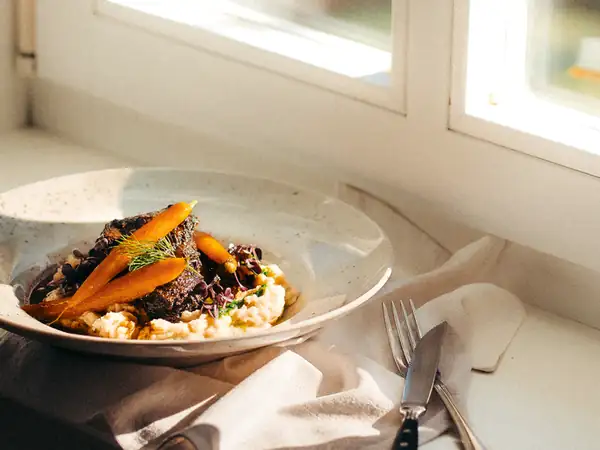
The final course before dessert: pointed cabbage cooked for three hours, stuffed with Tibetan tsampa, and served with kale juice and yuzu vinegar. As surprising as it was unforgettable. For its flavor, yes, but also for its symbolism: cooking at that level without animal protein and still managing to move you.
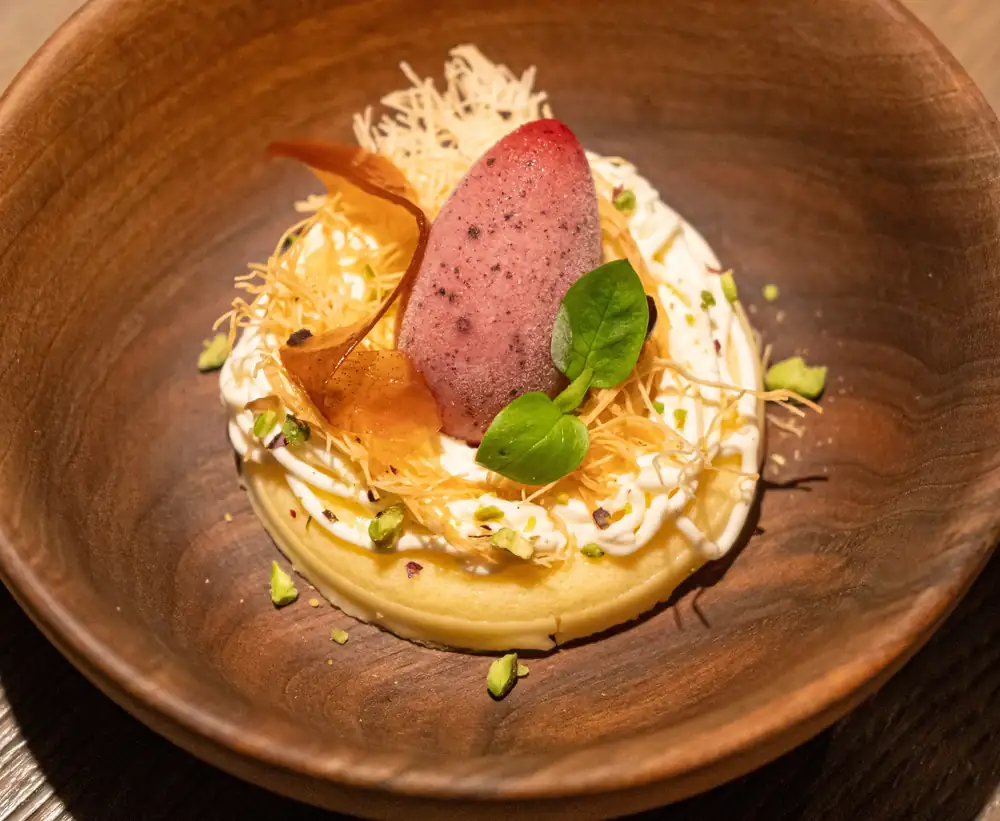
To close, a small cheesecake dessert with blackcurrant and pickled magnolia preceded the grand finale: a cream strudel with white poppy seeds, buckwheat, and rhubarb in two textures, crowned with a crisp, tangy, and delicate sorbet. An elegant, precise ending, without the need for sugar or artifice. Like everything at Tian.