Loin of Manx Loaghtan Lamb, Salt-Baked Celeriac and Garden Chard Recipe
medium
- 1l water
- 100g of table salt
- 100g of caster sugar
- 2 bay leaves
- 3 sprigs of lemon thyme
- 3 sprigs of rosemary
- 5 lamb neck, boned
- 1l veal stock
- 500ml of chicken stock
- 2 large carrots, sliced
- 50g of thyme
- 50g of rosemary
- 4 garlic cloves, crushed
- 5g of coriander seeds
- 2 star anise
- 1 pinch of pink peppercorns
- 100g of dried apricots, finely diced
- 1 small celeriac
- 25g of finely chopped chives
- 15ml of lemon juice
- 50ml of extra virgin olive oil
- 25ml of truffle oil
- 5g of salt
- 200g of mixed herbs, such as parsley, sorrel, nasturtium and chives
- 100ml of rapeseed oil
- 3kg lamb trimmings
- 2kg lamb bones
- vegetable oil, for frying
- 2 white onions, diced
- 2 large carrots, diced
- 2 celery sticks, diced
- 3 sprigs of rosemary
- 3 sprigs of thyme
- 5 garlic cloves, crushed
- 500g of chopped tomatoes
- 400ml of Madeira
- 400ml of dry white wine
- 1.5l lamb stock
- 1l veal stock
- 1l chicken stock
- To make the brine, fill a saucepan with the water. Place on a high heat, then add the salt and sugar
- Stir, using a whisk, then add the bay leaves, lemon thyme and rosemary. Stir them in and bring to the boil
- Once boiling, remove from the heat and allow to cool to room temperature
- When the brine has cooled, place the lamb necks into the brine, ensuring they are fully immersed in the liquid. Cover and refrigerate for 12 hours
- For the celeriac pickle, peel the raw celeriac. Cut into strips and then into 2–3mm thick julienne. Cook in boiling salted water for 2–3 minutes until soft (but not overcooked!). Using a sieve, remove from the pan and run under cold water to cool quickly
- Now empty onto kitchen paper to dry. Once dried, put the celeriac into a bowl with the chives. Pour over the lemon juice, olive oil and truffle oil and salt. Mix well and taste
- Season to your liking and add a little more oil or lemon juice if needed. Transfer to a storage container and refrigerate until required, or at least 3 hours. It will keep for up to 3 days in the fridge
- Once brined, wash the lamb necks under cold running water and pat dry
- Pour both stocks into a large saucepan. Place on a high heat, bring to the boil, then remove from the heat. In another large saucepan on high heat, add the lamb necks and sear them
- Add the carrots, herbs, garlic, coriander seeds, star anise and pink peppercorns to the pan with the lamb in. Now pour in the stock mixture and bring to the boil. Turn down the heat to low and simmer for 4–5 hours. The liquid should reduce by half during this time. Once reduced, add the dried apricots and stir them through the mixture. Reduce further until the liquid coats the back of a spoon and is rich and glossy. This can take anywhere from 30 minutes to 1 hour
- While the lamb neck simmers, make the herb oil and lamb sauce. Fill a large pan three-quarters full with water, set on a high heat and bring to the boil. While the water is boiling, half-fill a mixing bowl with ice cubes and cover with water. You will need this later to refresh the herbs
- Add your chosen herbs to the boiling water, then cook for about 15 seconds. Once the stems are bright green, quickly transfer the herbs into the bowl of iced water and allow to cool completely
- Once cool, remove from the iced water and place the herbs on a J cloth (or kitchen towel) and squeeze out as much excess water as you can. Be sure to get all the water out, otherwise it will dilute your oil
- Line a fine sieve with a piece of muslin. Pour the oil into a blender and then add the drained herbs. Blend on a high speed for at least 1 minute until you have a smooth oil
- If it looks a little too thick, add a drop or two more oil, but not water. Pour the blended oil into the sieve set over a bowl, and let it sit for a few hours. Stir occasionally while the oil is draining through. Do not press the oil through, as any impurities could be pushed through and ruin the clear, pure oil you are looking for
- Once thoroughly drained, transfer the oil to a squeezy bottle and store in the fridge. It will keep well for 48 hours
- To make the lamb sauce, preheat the oven to 180°C
- Put the lamb trim and bones in an oven tray and roast for 30–45 minutes
- While the bones are roasting, place a large saucepan on a medium heat. Add the oil, onions, carrots and celery, then allow them to sweat for 5 minutes. Now add the rosemary, thyme and garlic. Stir and continue the sweating process for another 2 minutes. You want the vegetables to become soft and nicely caramelised
- Next, add the tomatoes and continue to cook on a medium heat, stirring occasionally, until you have a jammy consistency
- Finally, add the alcohol and reduce the liquid by half. By the time the liquid has reduced, the bones will be roasted
- Add them to the saucepan, followed by the stocks. Turn up the heat and bring to the boil. Once boiling, reduce the heat to low and simmer for 3 hours. Check every 30 minutes and skim the top of impurities. After 3 hours of simmering, no more impurities should be rising to the surface
- Now pass the liquid through a chinois or fine sieve and then a muslin or cheesecloth. Use a large length of muslin, hold two corners in each hand and gently pull from side to side by lifting your hands alternately. Allow the liquid to naturally pass though. Do not squeeze or press through the liquid, as any impurities that remain will also pass through. Cover with cling film and set aside ready to reduce when needed. This can be kept in the fridge for at least 3 days
- To make the salt-baked celeriac fondants, preheat the oven to 200°C. In a large mixing bowl, add the flour, salt, rosemary and egg whites. Mix well with your hands, mixing the egg whites through with your fingers
- Once well mixed, slowly add the tepid water (it makes it easier to work the ingredients than cold water) until you have a dough. The dough should be firm but workable
- Once you are happy with the consistency of the dough, remove it from the bowl and transfer to a lightly floured surface
- Roll the dough out to about 1cm thick and place the celeriac in the centre. Wrap the celeriac in the dough, peel off any excess and roll with your hands into a ball, ensuring you have an even thickness all the way around. Any leftover salt bake dough can be wrapped tightly in cling film (or vacuum packed), then kept for 3 days in the fridge. You can salt-bake practically any sturdy vegetable
- Place the dough-wrapped celeriac on an oven tray and bake for 45 minutes–1 hour 15 minutes
- After 45 minutes, check the celeriac by poking with a wooden skewer or temperature probe. Once the skewer slides easily through, the celeriac is cooked. If you use a probe, you are looking for the centre to reach 64°C
- Remove from the oven and leave to cool for 2–3 hours until room temperature. Once cooled, remove the celeriac from the salt-bake shell and cut into 1.5cm-thick slices
6 hours plus 12 hours for brining, 6 hours for simmering and 3 hours for cooling
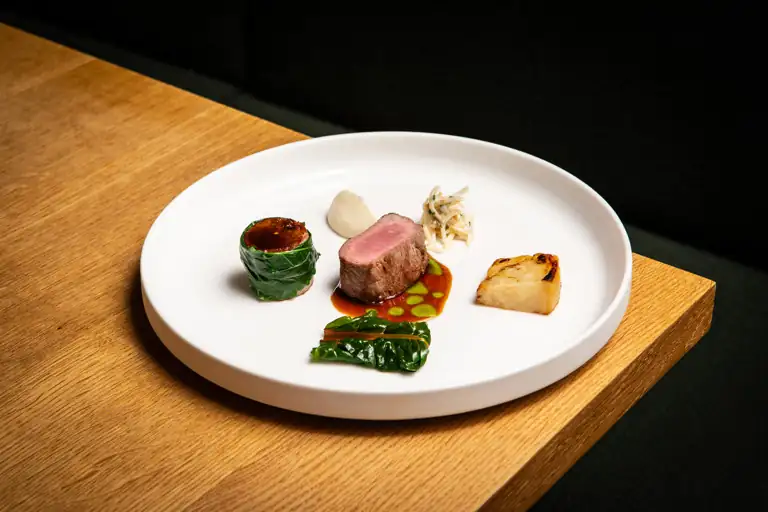
A knockout main that celebrates celeriac as much as it does the meat in the centre of the plate, Elly Wentworth's lamb dish is a masterclass in technique. The celeriac is enjoyed three ways – as a silky purée, raw and crunchy and soft and salt-baked – with lightly cooked chard from the farm garden adding colour and freshness. The lamb loin is cooked to perfection with a sous vide machine, with a rich, sticky braise of lamb neck offering a decadent ying to the loin's yang.
Elly says: 'This dish showcases Manx Loaghtan lamb from the farm; a rare breed known for its smaller size. We raise them slowly to regenerative principles, grazing on diverse herbal pasture, which gives the meat the most incredible depth of flavour. This recipe is a great example of how we use the whole animal, with nothing ever wasted, pairing roasted loin with braised neck and a lamb sauce made with the trim. Salt-baked celeriac harvested from the garden brings earthy sweetness and garden chard adds colour.'.
Brine
Braised lamb necks
Celeriac pickle
Herb oil
Lamb sauce
Salt-baked celeriac fondants
370g of plain flour, plus extra for dusting
14g of table salt
2 sprigs of rosemary, needles picked and finely chopped
2 egg whites
4 tbsp of water
1 celeriac
Sous vide equipment
Vacuum bag and machine
Muslin cloth
Squeezy bottle
14g of table salt
2 egg whites
4 tbsp of water
Transfer your celeriac fondants to a tub, cover and refrigerate. These will keep well for 3 days.
For the celeriac purée, peel the celeriac and cut it into small pieces. Add to a large saucepan and cover with the milk and cream. Add a good pinch of salt, and the butter and thyme. Bring to a simmer and cook for 15 minutes until the root is tender.
650g of celeriac
200ml of whole milk
200ml of double cream
100g of unsalted butter
2 sprigs of thyme, leaves picked
Once cooked, pass through a colander and transfer to a blender. Blend until smooth, adding more salt if needed, and pass through a fine sieve. This can be kept in the fridge for 3 days.
To make the lamb loin, take the lamb saddle and score the fat on the top, then vacuum pack with the herbs. Cook in a water bath at 58°C for 35 minutes. Once cooked, remove the lamb from the bag and season all over with salt and pepper.
Let the butter foam and then begin to baste the lamb with the butter.
To make the garden chard, bring the butter and a dash of water to a simmer, add the chard and a pinch of salt. This won't take long to cook. Squeeze out any excess liquid, and it’s ready.
To assemble, warm up some celeriac purée and spoon onto each plate. Next to this add some pickled celeriac, a wedge of salt-baked celeriac, and a piece of the chard. Wrap a portion of the braised lamb neck in a piece of chard, and serve between the chard and the purée. Serve with some of the braising liquid. Carve the saddle into portions and put a portion in the centre of each plate. Pour over some of the lamb sauce, and garnish it with the herb oil.
Farm-to-fork cooking isn’t anything new in the British food scene. It’s a phrase that gets thrown around quite a bit; often with little substance behind it. But for Elly Wentworth, it’s a calling; the abundance and limitations of working with produce grown on-site at Fowlescombe Farm is a dream come true.