Coque's ode to traditional Spanishness
Eight years have passed since brothers Mario (chef), Juan Diego (head waiter), and Rafael (sommelier) Sandoval moved their two-Michelin-starred Coque restaurant from Humanes to Madrid.
With the help of a group of illustrious gastronomic figures (chefs, historians, journalists…), Mario has delved into and researched all sorts of books, from ancient gastronomic treatises to novels like Don Quixote itself, to compile recipes and representative bites of the things eaten in Madrid from its founding by the Arabs in the 9th century to the raging contemporary cosmopolitanism, passing through the Middle Ages, the times when it was barely a small Manchegan village where Christians, Jews and Muslims lived together or its proclamation by Philip II as the capital of the kingdom in 1561, which made it the Villa and Court that it is today.
A few bites and recipes that the chef filters through the sieve of his creativity and cutting-edge techniques to compose a menu of more than twenty courses, which unfolds over at least four hours and, like all of Coque's menus since he arrived in Madrid, consists of several stages. Six, to be precise.
The welcome takes place in the basement cocktail bar with two refreshing snacks that embody the essence of a Madrid summer: tender almond ice cream with pine nut vinegar and a worldly corn and black sesame crystal with chickpea miso, avocado, and foie gras shavings. In the adjoining room, named Onyx after its bar, a total sublimation of a timeless staple, ham, unfolds with a sugarcane jelly and a matured bone marrow with Osetra caviar and sea urchin, awakening the first taste of flavor.
The third stage takes place in that stunning wine cellar, which holds more treasure than some bank vaults. The Chanfaina de duelos y quebrantos on blini is dedicated to the picaresque tales of the 16th century; it's no coincidence that this dish already appeared in Lazarillo de Tormes. Alongside it, a prominent display of technique with the Pedro Ximénez grape, crisp, liquid, and tangy.
From the wine cellar, one moves to the sacristy, dedicated to fine wines and fighting bulls (the Sandoval family owns their own fighting bull ranch, and Rafael was a matador). Accompanied by a generous, properly poured wine, the outstanding canapés are a salpicón of beef from the Sierra de Guadarrama mountains with aged vinegar—a 13th-century recipe referenced by Cervantes and Quevedo—and a psyllium leaf with fighting bull steak tartare and whole-grain mustard.
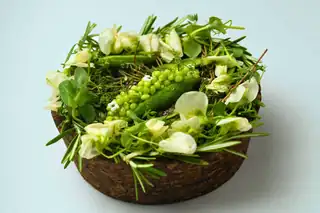
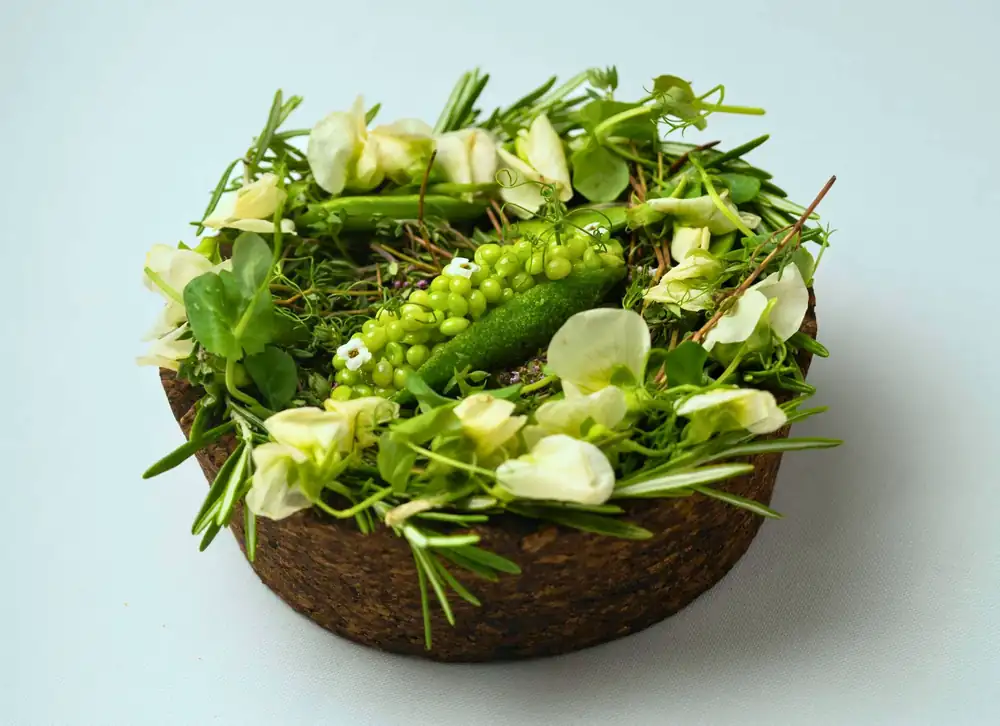
Taking the elevator back down to the basement, we returned to the main floor to visit Mario and his team hard at work in the open kitchen. There, in a show-cooking style, they prepared a Crispy Pod with teardrop pea and caramelized pea purée, and a Pheasant Tartlet in pepitoria sauce with toasted almonds. A wonderful conclusion to the introductory journey before moving to the dining room for the main menu. Once seated, we were treated to two final appetizers that were nothing short of dazzling: a translucent pink tomato gazpacho with mint foam (made using the decanting method) and an airy, truffled fritter with Manchego cheese essence, both vying for attention in delicacy, creaminess, and depth of flavor.
And now, the journey begins, which, between flashbacks and flashforwards, takes us to the 15th century with the Sephardic Soup with Pedrosillano chickpeas and suckling lamb adafina with romaine lettuce, of Jewish origin; to the 16th century with the Brouet de Madame with organic vegetables grown in our garden at Jaral de la Mira (near El Escorial) that vindicates the Madrid orchard, or to the 17th century with the smoked Motril Prawn with toasted corn soup with chili, trout roe, green curry shots and crab soup granita, in which the overseas colonies meet with the fish and crustaceans that until not long ago were treasured by the Tagus, Tajuña and Jarama rivers… and with the added, improving touch of the prawn.
To demonstrate that Madrid is not only a seaport but one of the most important in the world and that fusion is almost an everyday thing here, we find the Atlantic scarlet prawn salad with mustard, bottarga roe and pickles, poblano green mole and egg dressed with Jerez vinegar and the matured wild sea bass with spicy hook-caught squid sauce, yucca velvet and cumin, crispy corn and flying fish roe.
Hunting has always been very popular in the capital, and since the first half of summer isn't exactly the best hunting season, it's represented by a cold cut: El Pardo's poultry galantine with demi-glace, walnut purée, and Chinchón garlic, served with a rich almond and saffron sauce. Inspired by a 16th-century recipe that was made with all kinds of birds (including peacocks!), Mario updates it with quail, partridge, pigeon, and capon. Rustic charm cloaked in subtlety and elegance.
If there are two things that can never, ever be missing at Coque, they are the escabeches, a legacy of the beloved matriarch of the family, Teresa Huertas, and that suckling pig that for decades was the hallmark of the Humanes inn. Of course, this is all within the framework of the menu's philosophy. Thus, the traditional escabeche of rock sea bream, seasoned in the Madrid style, recalls—and significantly improves upon—the bygone days when this technique allowed for the consumption of fish of, shall we say, questionable freshness, and pays well-deserved tribute to a species that has always been among the favorites of the capital's locals. As for the suckling pig, Sandoval has adapted it to the Renaissance, drawing on the manual "Arte Cisoria" by the Marquis of Villena, cutting, roasting, and lacquering it in the style of the period and giving it cosmopolitan touches that are very much of the 21st century. The result is succulent suckling pig with crispy skin, crackling with Sichuan pepper, and molasses sauce. Samm de manita with lemongrass and sour fruit, an unbeatable and supposedly unsurpassable closing to the savory part of the menu.
Four desserts to finish. The first sets the bar incredibly high, oozing Madrid spirit from every pore: Pickled and flambéed strawberries from Aranjuez with champagne ice cream, Guadarrama goat cheese cream, and anise-flavored doughnut foam. The Ginestada of nuts rises to the challenge and triumphs: a creamy rice pudding, harking back to the 16th century. To finish, a refreshing crispy puffed and caramelized rice with lemon and a nod to the 19th-century Matías López Chocolate Factory in El Escorial with the Chocolate Cream. Well, a nod to the factory and to the vast majority of Madrid diners who, if they don't end a meal with chocolate, are capable of raising a ruckus. In addition to ensuring that the Russian-style dining room service (with a strong emphasis on the gueridon) runs like clockwork, Juan Diego Sandoval highlights Mario's dishes with La Cartuja and Limoges tableware and silver cutlery and trays.
And Rafael has taken it upon himself to design two truly exceptional wine pairings, Armonía (€360) and Premium (€660), brimming with national and international treasures, hidden gems, world-renowned gems, rare finds, and even the occasional unicorn. But don't let the prices scare you off; you can also opt for a more affordable choice and choose from one of the bottles in his almost endless cellar.
As the eighties slogan said, thanks to the Sandoval family, "From Madrid to heaven."