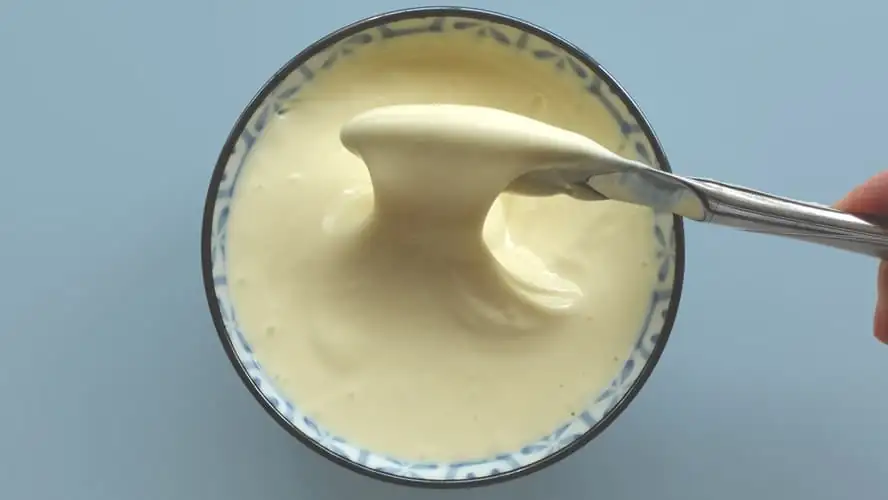
Cream cheese
Requeijão is a processed cheese, widely used in Brazil for breakfast. Like processed cheese, Brazilian requeijão is an emulsion – a mixture of liquids that don't normally mix, in this case water and fat. This is possible through the use of melting salts, an ingredient that makes the requeijão homogeneous and creamy.
- 300 ml of whole/fat milk
- 120 grams of grated mozzarella cheese
- 3 grams of baking soda (1/2 level teaspoon)
- 50 ml of lemon juice (about 1 to 1 1/2 units)
- 90 grams of unsalted butter
- Separate ingredients (mise en place): Measure and separate all ingredients. Preparing the cream cheese will be quick, and it's important to add the ingredients at the right time.
- Baking soda: place the baking soda in a tall container.
- Lemon: Add the lemon juice. The amount of lemon juice may vary depending on the amount of citric acid in the lemon. Ideally, lemon juice should be added gradually until the reaction with the bicarbonate (gas release) stops.
- Shake well. The reaction of the citric acid in the lemon with the baking soda will form a lot of foam (carbon dioxide). Stir until the foam disappears.
- Melting salt: the combination of sodium bicarbonate and lemon (citric acid) results in carbon dioxide, water, and sodium citrate, which is a type of melting salt that will make the cream cheese creamier. If you taste the mixture, you will find it slightly sour and quite salty.
- Mix cheese and melting salt: Mix the grated cheese and melting salt (a mixture of lemon and baking soda) well. Set aside.
- Heat: Heat the milk and butter in a small saucepan over very low heat.
- Add the cheese: once the butter has melted, add the cheese.
- Stirring: Stir constantly, and always scrape the bottom and sides of the pan so that the cheese doesn't burn. Continue stirring for about 30 minutes, until it thickens.
- Beating: When the cream cheese begins to thicken, beat it with a mixer (PT: magic wand). This will help eliminate lumps of cheese.
- Stirring: continue stirring until the cream cheese begins to thicken and has a texture similar to fresh cream (somewhat thick, but much less so than store-bought cream cheese).
- Refrigerate: Transfer to a sealed container and refrigerate for 24 hours.
- Use: After this period, the cottage cheese will become firmer and very creamy. Use within 1 week. As we do not add preservatives, the cottage cheese will not have a long shelf life.
Important: This article discusses Brazilian requeijão (processed cheese). In Portugal, requeijão is a cheese made from whey. Portuguese requeijão is very similar to Italian ricotta.
Fusion Salts
Cheese, in simplified terms, is a tangle of proteins, fat, and calcium. Calcium acts as a glue that binds the protein molecules together, and the fat molecules are trapped within this chain. When we heat cheese, the protein structure weakens and the fat leaks out. Instead of forming a creamy melted cheese, we have a clump of proteins floating in fat. This often happens, for example, when preparing cacio e pepe pasta.
To solve this problem, cottage cheese manufacturers use melting salts. Melting salts, such as sodium citrate, make the cheese proteins more soluble without lowering the pH of the mixture, creating a smooth emulsion without lumps and without an acidic taste.
An industrially produced cream cheese, such as Poços de Caldas, uses up to 3 types of melting salts: sodium citrate, sodium polyphosphate, and sodium phosphate.
It is possible to buy melting salts in stores and websites specializing in cheese production, but in our recipe below we use a homemade solution to produce a simple (weaker) melting salt, but sufficient for a good homemade result.
Homemade Cream Cheese Recipe
To prepare homemade cream cheese, we use a mild-tasting cheese (grated mozzarella) and prepare a weak melting salt from a mixture of lemon juice and baking soda.
Lemon juice contains citric acid. The citric acid in lemon juice will react with sodium bicarbonate, resulting in the release of carbon dioxide and the production of monosodium citrate.
Formula: NaHCO3 + C6H8O7 → NaC6H7O7 + CO2 + H2O. The cream cheese industry uses sodium citrate, or trisodium citrate, a salt with a stronger melting point than the one we use in our recipe. But, even so, we achieve a great result with the addition of butter and a cheese (mozzarella) that melts easily.
The end result is so good that it can be used on toasted bread and will have a golden crust identical to that of toasted bread with store-bought cream cheese.
small saucepan