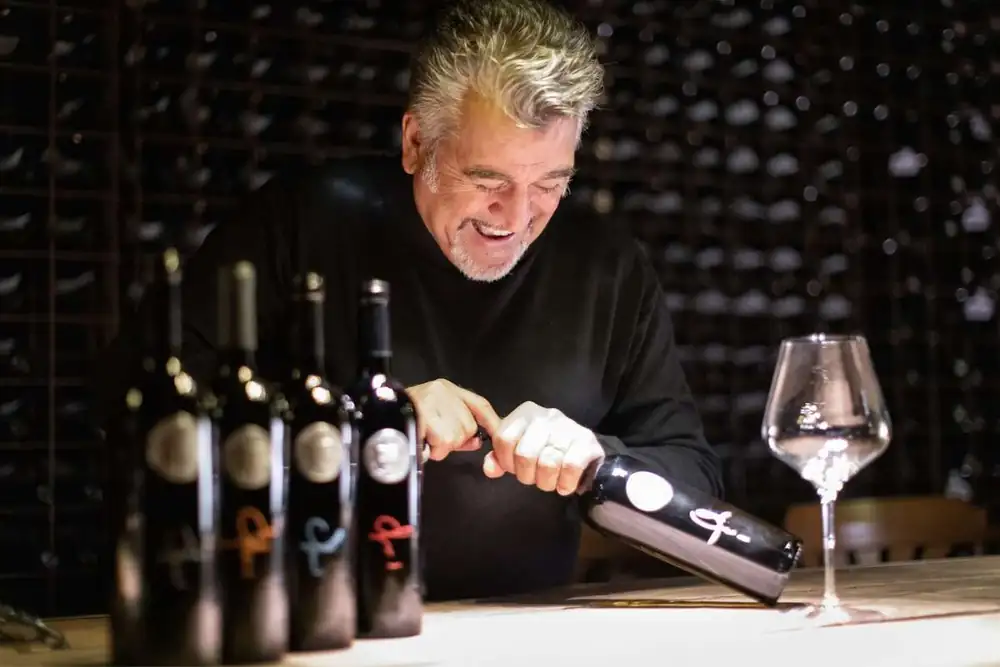
Interview with Roberto Cipresso: the winemaker who pursues emotion
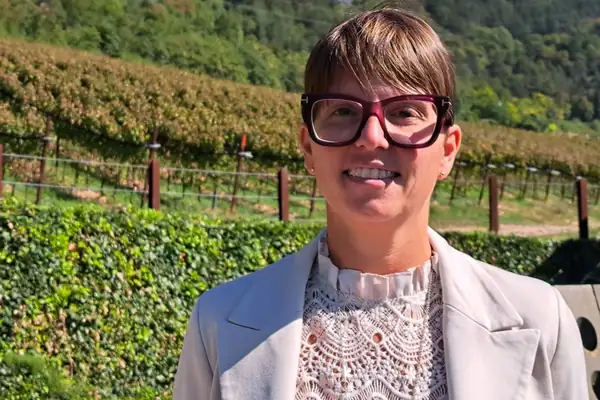
Roberto Cipresso is a winemaker and oenologist, producing wine at his Montalcino estate and in various corners of the world, seeking emotion: the kind we find not only in his bottles but also in his projects, his books, and his podcasts.
We invited him to our microphones to share with our readers his experience, which ranges from winemaking to research, from entrepreneurship to wine promotion, and to tell us his unconventional vision of the world of wine.
Whether it's telling visitors about wine at the winery or building a winning branding strategy, what characteristics must effective storytelling have today?
There's a first great commandment: to be able to move, trying to capture our listener in their comfort zone. This concept is best explained by discussing the language our communication should use. Every form of communication must take into account the audience it's addressed to, and must be flexible enough to touch, in different ways, the emotions of each individual. I believe language shouldn't be too complex, too disciplined; the product we're describing is open to interpretation, like any art form. For example, if you're speaking to a pianist, wine should be explained like a musical composition.
Is there anything you would add to the tasting notes, beyond the technical-production and sensory aspects?
I call it "the acid test": I believe that even a critically acclaimed wine should be subjected to a review of its organoleptic characteristics nine years later, to determine, in a sense, whether it has the ability to survive the historical moment in which it was produced. I would also include a judgment on the wine's "digestibility," which is an aspect of its palatability, which is never considered as such. Today, the health aspect of wine is at the forefront of all debates, and I believe something can and should be done about it. Last but not least, I think the weight of the bottle should be emphasized, as it reflects the company's attention to sustainability.
What personal interpretation can you give of the consumer trends that are emerging at the moment?
What we're all seeing is happening: whites and sparkling wines are enjoying greater success, rosés are trendy and dynamic, reds need to find new expression; sweet wines, especially high-alcohol ones, are struggling. Where will all this lead us? I believe consumers must, in a sense, retrace their steps, starting with more immediate and primary sensations and gradually returning, and discounting so much fake news, to terroir and fine wines, which aren't the expensive ones, but those capable of moving us. Naturally, mass-produced wines follow different logics, and I'm not referring to them.
What characteristics should a contemporary wine have today? Are some grape varieties more contemporary than others?
Today, wine must be able to surprise because the market is fully mature. It must be able to adopt the "blue ocean strategy," to use another expression: winning without competing, seeking different paths to build a competitive advantage, with originality and the ability to "draw you in," like a great actor. Wine that excites you takes you to places and their secrets, making you travel through time like the wardrobe in the Chronicles of Narnia, to quote another.
There are grape varieties that have the ability to interpret different territories, like international ones; there are native grape varieties that only make sense where they are grown. We must be careful about generalizing: native doesn't mean guaranteed success worldwide. There are native grape varieties that have great personality in their own territory but lack the ability to express universal values outside of it: not all of them make sense served in a wine bar in Singapore. But this doesn't just concern our grape varieties. And the French know this well: there are some very local varieties that are excellent with foie gras, but they don't pretend to become a global staple. I believe it can help to clarify these concepts, otherwise we're stuck with clichés.
To what extent is it right to follow consumer trends, and where does the risk of losing our identity begin—a risk deeply felt by Italy, given its diversity and richness?
It's a fundamental value issue: follow the market or try to direct it? I believe we need to distinguish between small producers and large companies. The strength of small businesses, and the only way to stand out, is to focus on the monumentality of small things; by that I mean, being able to take customers to the pinnacle of their geography, to evoke emotion once again, to hold firm to their identity. Uniformity condemns small producers to invisibility.
The situation is different for large manufacturers, who today struggle to the point that they often choose not to compete but to merge with other large companies. They bear the burden of enormous production costs and must stay on track with the demands of the mass market.
What's the current state of research in the field of winemaking? What direction should it take, in your opinion?
Today, several fronts are open, all very important, both in the vineyard and in the winery. Research into less vigorous rootstocks, next-generation vines, and varieties that allow for less thinning and therefore lower vineyard management costs is essential; experimentation with Piwi is instrumental in the quest for lower environmental and economic impact on production. Mechanization is reaching truly astonishing levels of precision: today, harvesting machines are available that can produce results even better than manual harvesting. As for the winery, today a laboratory measuring just a few square meters can study every aspect of the product, starting from a single drop of wine, a progress that was previously unimaginable.
However, I believe it's important to always clarify concepts to avoid generalizations. In terms of winery architecture, for example, some systems blend perfectly into the landscape, but this doesn't necessarily reflect a focus on the environment. I believe sustainability is truly the goal we should all strive for. Everyone's dream, I believe, is to have wineries powered entirely by renewable energy.
And what's the status of your personal research? What projects are you working on?
I like both old and new things, and my work moves along these two apparently divergent tracks.
In the past, I've been involved in the Venissa project, which aims to revive the Dorona, a Venetian variety, and bring it back to Venice, where it once represented the grape of the Doges. In the same spirit, I'm working on a project dedicated to the Bassanese grape, which hails from Bassano del Grappa, my hometown. In the Lazio region, I'm studying six ancient local grape varieties in depth, and during excavations, we were thrilled to discover an ancient Roman road. I believe that only curiosity and a desire to learn can bring you such things.
I'm currently very involved in a personal project dedicated to the 43rd Parallel, which stems from the observation that along this parallel, which touches places of great interest and spirituality around the world, such as Santiago de Compostela and Medjugorje, native grape varieties with a strong identity grow and produce wines with great personality, such as some Super Tuscans.
Oria Toscana is another very recent project that's very close to my heart: it's a form of sharing with wine enthusiasts, involving a 40-hectare property in the Val d'Orcia where 140 different Sangiovese clones will be planted. Each member will be assigned 200 square meters of land and guaranteed ownership of the bottles produced on that land. It's a sharing model that transcends traditional distribution and sales mechanisms.
Wine "travels" in every sense: some grape varieties are genetically linked, and some wines have been produced outside their native regions. What does the "migrant" soul of wine teach us?
It may seem paradoxical that wine, born in contact with the earth, teaches us the ability to soar, transcending business and convenience. Wine speaks to our moods and teaches us to appreciate things not only with reason, but also with the ability to be surprised.
And this is the only journey worth taking.