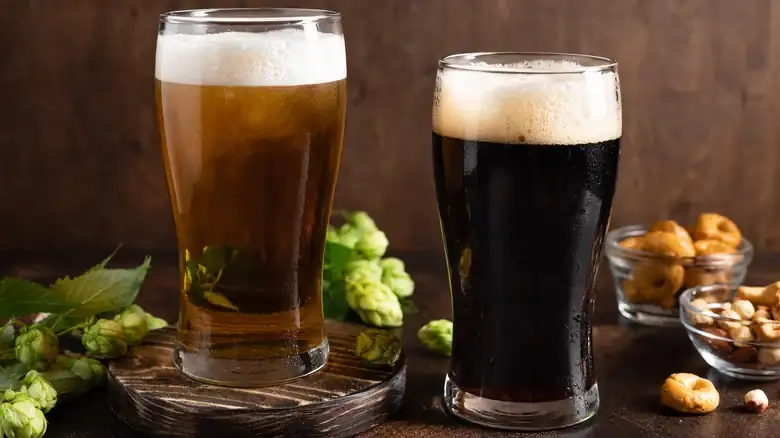
Lager and stout are separated by fermentation, roasting, and temperature.
Lager ferments at a low temperature, with yeast settling at the bottom, while stout, a top-fermented ale, is served warmer.
There are many beer styles, but they all fall into two basic categories: ale and lager. The difference lies in the fermentation process, and the proportions of malt and hops, alcohol content, and serving temperature also vary. Lager is a cornerstone of brewing, while stout is a significant subcategory of ale that encompasses several styles. In the United States, locally brewed stout has been named the flagship beer of Oklahoma, South Carolina, Utah, and Virginia, although pale lagers still dominate the market.
Stout is brewed with top-fermenting yeast (Saccharomyces cerevisiae) at temperatures between 18 and 20 degrees Celsius (64 and 68 degrees Fahrenheit). Lager uses bottom-fermenting yeast (Saccharomyces pastorianus) at near-freezing temperatures, between 0 and 2 degrees Celsius (32 and 36 degrees Fahrenheit). Warmer temperatures give ales fruitier, spicier, and more robust flavors, while the longer, bottom fermentation results in lagers with a lighter, cleaner, and fresher taste.
The intense color and flavor of stout have another cause: roasted malt, which is roasted at high temperatures after drying. The roasted grains, malted or unmalted, give the beer its dark brown, almost black color and contribute notes of dark chocolate, coffee, and caramel. Many stouts, like the iconic Guinness, one of the ten best-selling beers in the United States, get their dark notes from roasted unmalted barley. Oat stouts incorporate oats for a more earthy and nutty flavor.
Dark lagers, like German bock, use more malt than other lagers, giving them a richer color and more intense flavors without sacrificing the style's crispness. Generally, the darker the beer, the higher its alcohol content, with the notable exception of Munich Dunkel, a dark lager with an ABV between 4.5% and 5.6%. Most lagers fall between 4.5% and 6% ABV, with enough alcohol to be noticeable but not so much that you can't have more than one.
The serving temperature also differs. Rich and robust stouts are best enjoyed between 10 and 16 degrees Celsius (50 and 60 degrees Fahrenheit), where their velvety texture and flavors like espresso and dark chocolate truly shine. If taken from the refrigerator, they should be left to rest for 15 to 20 minutes, as a standard refrigerator, just below 4 degrees Celsius (40 degrees Fahrenheit), dulls their flavors. Lagers, on the other hand, are best served straight from the refrigerator, between 4 and 7 degrees Celsius (39 and 45 degrees Fahrenheit), and dark lagers are also best enjoyed chilled.
Higher-proof stouts, like imperial stouts, typically exceed 10% alcohol, with a more intense flavor and a denser consistency that encourages slow sipping. Others, with flavors as complex as bourbon, are best enjoyed at a leisurely pace.