A day spent making homemade tomato sauce: a summer ritual that has been repeated for generations in Irpinia
In Irpinia, tomato sauce is homemade in the summer and is still prepared the same way it used to be: an entire day dedicated to cooking and preserving, with family-run traditions, tomatoes ordered from trusted producers, and a plate of spaghetti with freshly made sauce.
In Irpinia, summer still has its rituals. One of these begins when the tomatoes arrive, although today, compared to a few decades ago, the calendar has changed. Once upon a time, the sauce was prepared between the end of August and the beginning of September. Today, it starts earlier: "The heat has changed and so has the timing of the tomatoes," my mother-in-law tells me, whose family has carried on this tradition for generations.
Salsa has been made here since time immemorial, when living in the countryside meant growing, harvesting, and preserving whatever the land offered for the winter. Today, the ritual continues, with smaller quantities than in the past but with the same procedures. Once upon a time, tomatoes could be processed by the yard, reaching a couple of quintals. Today, that's down to about one. And that's still a lot, especially when just one person takes care of everything. "Living in the countryside, I've had a trusted farm for years that I turn to for tomatoes for salsa," my mother-in-law explains. "We agree on a date; I go pick them up the evening before, and the next day, I schedule a day off from other commitments to dedicate myself to the salsa."
How Homemade Tomato Sauce Day Goes
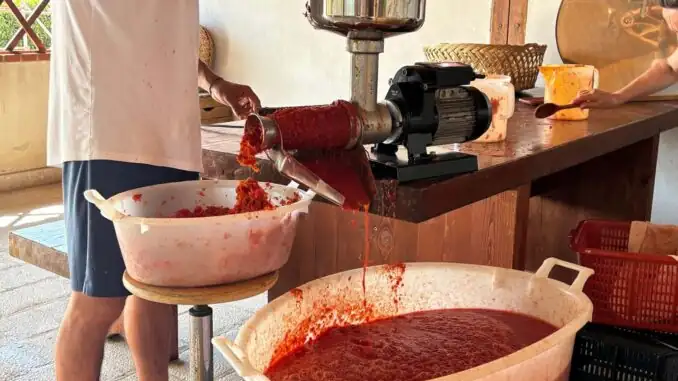
The sauce-making day begins early in the morning, "even around four o'clock, when the heat is still bearable. The tomatoes are washed several times, at least two or three, before being placed in the large copper cauldron." They aren't all added at once: they are added little by little, leaving them to cook slowly for at least two to two and a half hours. While the tomatoes cook, the work continues. The jars are washed, the fresh datterini tomatoes that will end up in some of the preserves are prepared, and everything else needed for the next phase is arranged.
Because even the sauce, like many traditional peasant dishes, is above all a question of organization. "When there are no children or family members to lend a hand, we do everything alone. But when we all manage to get together during the summer, the work becomes collective." Everyone does a little bit of everything, and a day that would otherwise be long and tiring also becomes an opportunity to spend time together.
There's no single recipe for tomato sauce. "Every family has its own method, its own quantities, and its own little tricks. Here, for example, some of the jars are prepared with the classic sauce, while in others, cherry tomatoes are added, to obtain a different, sweeter and more intense flavor." And there's also a step that isn't necessarily part of the most common sauce preparation, but which in this house has always been done for a matter of taste. "Once cooked, the tomato is transferred to a large sheet and squeezed to eliminate some of the excess water. The result is a thicker, less watery sauce." It's one of those gestures that clearly demonstrates how traditions are never static recipes: everyone modifies them and makes them their own.
A tradition passed down through generations
There's a very simple reason why, despite the effort, making salsa at home is still worth it. "I'm sure of what I eat. And the flavor of homemade salsa is different." Today, we constantly talk about supply chain, awareness, quality, traceability. In this family, however, all this doesn't need a name. It's simply the normal way of doing things: "Knowing where the tomatoes come from, choosing who grows them, processing them at home, and preserving them for the following months." The tradition was born out of necessity, but it has also become a choice.
At midday, of course, there's a break. A small portion of the freshly prepared sauce is set aside and goes directly to the table for a spaghetti dinner. Perhaps the easiest way to understand why all this work continues is to taste the result as soon as it's made. The rest is bottled. The jars are sealed and placed in a large pot filled with water to complete the preservation process.
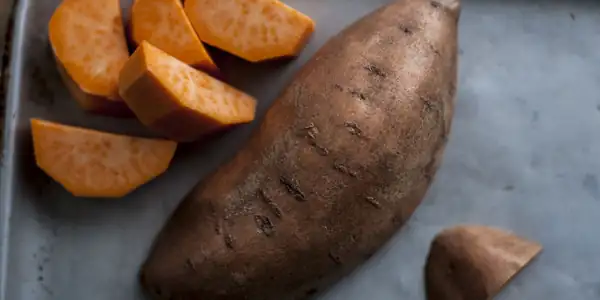
Here too, there's a little family ritual: "To know when they're ready, use a potato. When the potato is cooked, you can turn off the heat." An empirical method, passed down through time, that's almost as good as a written recipe. At the end of the day, the jars are lined up, ready to be put away. A quintal of tomatoes has become a reserve for the winter. And so, while the climate, harvest times, and quantities change, one thing remains the same: in this Irpinia family, when summer arrives, tomato sauce continues to be made. Not because it's easier. But simply because, this is how it's always been done.