The Taste of Passion: French Gastronomy and Love
The story takes place in 1889 and follows the love affair between a cook, Eugénie, and a gourmet/chef, Dodin Bouffant. After twenty years together, their professional and romantic relationship slowly develops into an engagement.
Sensual scenes of the cooking process
The minimalist story bears the distinct signature of the Vietnamese director, telling the passion between two people through the language of unconditional admiration and love for food.
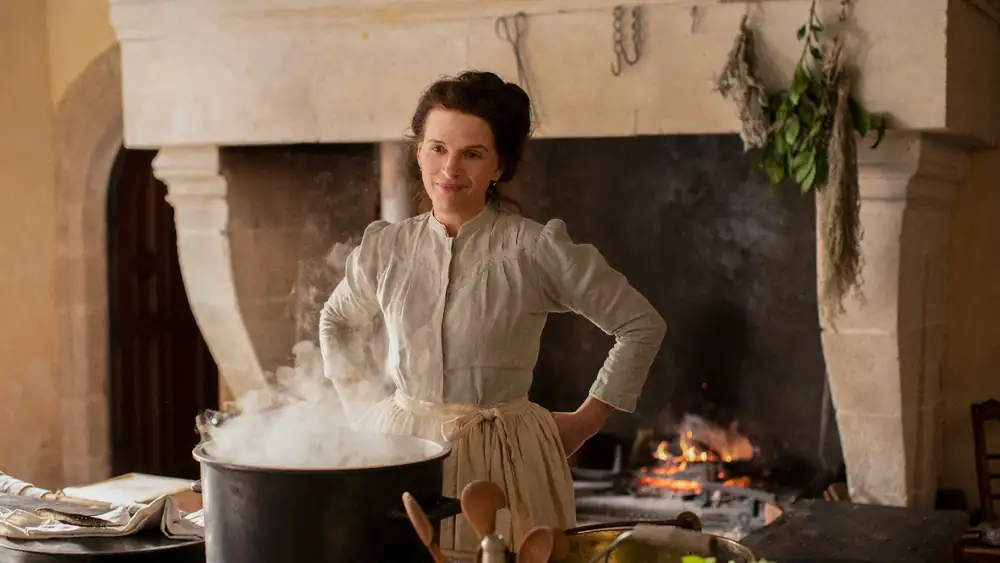
The film takes place almost entirely on the estate of Dodin Bouffant, mostly in the kitchen. Long and admirable lines of narration bravely linger on the cooking process, the first twenty-minute scene of the film follows Eugénie, limited to one or two sentences of dialogue, as she cooks a complete classic French menu, accompanied by a few specialties: soup, Vol-au-vent (a basket made of puff pastry filled with creamy seafood and vegetables), Omelette norvégienne (a cake filled with ice cream, wrapped in egg mousse, baked, then poured with alcohol and lit. Thanks to the special thermal insulation of egg white, the ice cream stays cold inside the cake). The latter is so well done that the ten-year-old girl studying in the kitchen almost cries with joy.
The series of images meticulously represent the cooking process, demonstrating such a sincere curiosity and desire for knowledge that it's hard not to wish we could be there, touch the food, smell the aromas, and taste the best French wines.
Auguste Escoffier and Antonin Carême
Trần Anh Hùng moved to France after the Vietnam War, at the age of twelve. His passion for gastronomy is not only reflected in his food, but also in his deep historical knowledge. The characters often mention one of the most prominent figures in French cuisine, Antonin Carême, who wrote the book Le Cuisinier parisien, among other things. The king of chefs was the most important figure in haute cuisine, and as we learn from The Taste of Passion, he also reformed chef hats, which at the time looked like sleeping caps.
At the end of the 19th century, Auguste Escoffier played the leading role. Following in Carême's footsteps, the chef aimed to simplify the great master's style and mannerisms. In addition to his own recipes, he invented a serious systematization, and we can also thank him for the mise en place technique.
Although Carême is no longer alive at the time of the story, Bouffant speaks with excitement about the chef's influence and how he symbolically passed the baton to his successor, Escoffier, who in turn was a huge sensation in 1889.
Food and identity
Eugénie and Dodin Bouffant communicate through food. Their shared cooking is the language of love. One of the most beautiful and quiet scenes in the film is when Dodin Bouffant cooks a complete menu for his love, then hides his engagement ring in the dessert. Their relationship is based on a deep, sincere respect for each other, they have been talking to each other in the language of food for twenty years, they know each other's movements, seasonings, recipes, nothing but death can separate the harmony between them. After Eugénie's death, no one else can prepare the dishes the way she did.
Class struggle and honest cooking
In the first half of the story, Dodin Bouffant is invited to a prince's dinner. The dinner menu is read out for long minutes upon the invitation's arrival.
At the beginning of the twentieth century, this kind of exaggeration was typical of the upper classes in all areas, but behind the impressive-sounding dishes there was usually no thought, no definite concept, and no coherence.
Dodin Bouffant's friends explain to Eugénie in detail what was wrong with the prince's menu, beyond the grandeur: the flavors that came one after the other did not harmonize with each other, the wine pairing did not emphasize but rather suppressed the flavors, the approximately eight-hour meal included at least forty types of dishes that could not offer the same quality, and they could not be evaluated in this form.
When Bouffant thinks about inviting the prince back to his own house, he wants to serve the simplest and most honest dish possible, the famous pot-au-feu. Although unfortunately this does not happen due to Eugénie’s illness and sudden death, the mention of the dish itself is a minor scandal. But Dodin Bouffant believes in the power of French cuisine, and the choice of a dish that can be interpreted as impudence conveys his own gastronomic vision. He believes in high-quality ingredients and accessible food classics that tell everything about a country’s culture.
In his own way, Dodin Bouffant is like Paul Bocuse, only a hundred years later: he creates elegant, sensual, simple and refined dishes that go against the grain of showmanship.
Brioche, vol-au-vent, truffle chicken and the three-star Pierre Gagnaire restaurant.
The food was prepared by Pierre Gagnaire, chef of the Pierre Gagnaire restaurant in the three-Michelin-starred Hotel Balzac, among others. Gagnaire was present as a consultant, helping the actors throughout. In collaboration with chef Michel Nave, they cooked all the dishes in the film, the process was recorded on video, and Juliette Binoche and Benoît Magimel studied and practiced the movements live and then from the recording.
In a cooking film, it is essential that the scenes in which food is handled be authentic and very believable, which is why in certain frames Gagnaire insisted that Magimel's hands, which are less practical than Binoche's, be replaced with the hands of a chef, who expertly cuts open the poultry, pulls out the entrails, and wraps the truffle-stuffed chicken in muslin.
Trần Anh Hùng also worked with a gastronomic historian who helped with the authenticity of the dishes and utensils from a hundred years ago. They created dozens of dishes, complemented by the expertise of Gagnaire, who deeply understood the complexity of Dodin Bouffant’s character. Bouffant is both creative, innovative and respectful of the time and place in which he lives and creates.
Gaignare's gastronomic approach is quite similar to Bouffant's: it includes all the fascinating traditional elements of French cuisine, but his approach is still fresh, new and groundbreakingly creative.
Cruel, delicious, forbidden: the legendary bunting
In one scene in the film, Dodin Bouffant and his friends visit an acquaintance, where, huddled together almost like a sect, they eat the famous and infamous bunting bird in a small, airless room.
Eating a songbird is considered the most sinful thing in the world, so it must be eaten hidden from God's eyes, hidden under a cloth napkin. The French delicacy is now such a luxury item that it is essentially inaccessible to everyone, and it is also illegal, which can be attributed to the drastic nature of the process.
After being captured, the buntings were blinded or placed in a dark room where they ate until they were fat. The animals were then drowned in brandy before being roasted, and then roasted for just eight minutes.
In the days of the Taste of Passion, eating the bunting was already considered a sinful custom, but the procedure itself is not mentioned. The small bird is eaten whole, with bones, with only the beak usually left.
An ode to love and cooking
In Trần Anh Hùng's film, the passion for French gastronomy takes precedence over the story. Asian art cinema is characterized by a slower pace, character- and atmosphere-focused storytelling, in which a slightly more sketchy, less classical storyline proves sufficient.
But when we slow down, we have time to pay attention to the little things, and Trần Anh Hùng invites us to do the same. We listen to the birds chirping, feel the sun's rays on us, almost smell the scents, taste the food.
The pairing of Binoche and Magimel is infinitely natural and heartbreaking, thanks to them and the sight of freshly baked brioche we never get bored. The Taste of Passion is a gentle psychological journey, a goosebumps-inducing ode to cuisine and love, which is impossible to watch without excitement and transformation.
The Taste of Passion was released in cinemas in January, and it is worth buying a ticket to experience the full experience.