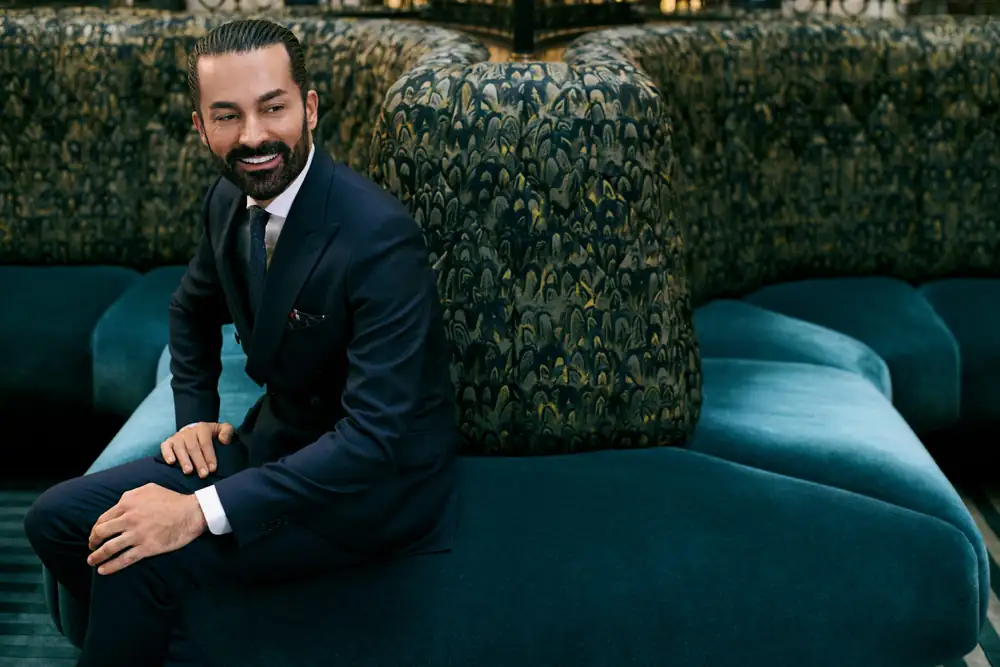
A global citizen has arrived at Gresham Palace: Alejandro Lopez is the new F&B Director of Four Seasons
The new Food and Beverage Director of Four Seasons Hotel Gresham Palace, Alejandro Lopez, arrives in the Hungarian capital with nearly two decades of international experience. For him, luxury means personalized attention and maintaining a strong local character.
Alejandro Lopez began his career in London, joining the team that helped to reopen the Four Seasons Hotel London at Park Lane. In Paris, he contributed to the success of the Four Seasons Hotel George V, including opening L'Orangerie and earning the property its first Michelin star. Returning to Spain, he was responsible for the opening of the Four Seasons Hotel Madrid as Food and Beverage Director, working closely with Chef Dani García to grow the popularity of Dani Brasserie, and also working at the Four Seasons in Lisbon. Driven by his refined taste and passion for wine, his work is always focused on creating memorable experiences for international travelers and local guests alike.
You have been working in the hospitality industry for eighteen years. How did your journey lead you to Budapest?
I arrived in Budapest about five months ago, in November. Over the past few years, I have worked in two London hotels: I started in Canary Wharf and later participated in the reopening of the Four Seasons Hotel Park Lane, which was the first Four Seasons in Europe. From there, my journey led me to the George V in Paris, then to Madrid, Lisbon and finally to Budapest. I have had an eventful career, but I believe that travel is essential in this profession.
The more we see of the world, the more refined our taste and the more experience we gain. We get to know other markets, other guest needs, cultural codes and operating patterns. Today, when services are becoming standardized in the hospitality industry, it is especially important to be able to offer our guests something unique. Not only in terms of what we offer, but also in the way they feel at our place.
What was your first impression of Budapest?
I consider Budapest to be an extremely elegant city. For me, it is a meeting of Paris, Istanbul and Venice. It has the sophistication of Paris, the atmosphere of Venice due to the Danube, but in certain architectural details and interiors, the Ottoman, oriental influence is also strongly felt. I walk around the city a lot, and this helps me understand the spirit of the place. Budapest has a calm but very exciting aura at the same time, especially in terms of the way the gastronomic and bar culture is taking shape.
It is a great privilege to work in such an iconic building as Gresham Palace. In many ways it reminds me of George V in Paris, as it is also one of the jewels of the city. A sight in itself, especially for those who are visiting Budapest for the first time. At the same time, I think it is important that the residents of the city also feel: this is a place where it is worth coming for breakfast, lunch, dinner, a cake or a cocktail every day of the week.
You arrived during a very intense period, in the midst of holiday preparations. What were the first months like?
Busy, but incredibly inspiring! I arrived in the middle of the holiday season, so I essentially had to jump on a train that was already moving at full speed. Since then, life has been practically non-stop: New Year's Eve brunch, the introduction of new menus at Kollázs and Múzsa, and many small but important tweaks to improve the guest experience.
I was welcomed by a strong and committed team, but my job is to help them develop further and create even more memorable moments. I think it is important to highlight the fact that a significant part of our staff are local professionals. For a house of this caliber, this is an invaluable asset. Guests return not only for the service, but also for the people – because they are welcomed here with understanding attention.
Which of your Spanish roots and professional experiences would you like to apply in Budapest?
I wouldn’t say that I owe everything to my Spanish heritage. After all these years of international experience, I feel more like a citizen of the world. I want to bring here what I have seen best in different countries: fresh ideas, modern solutions, consistently high quality of services and a strong emotional connection with the guests. Luxury for me is not a rigid concept, but a living, constantly changing quality: you have to adapt to people, cultures, different life situations. The important thing is to be able to read the habits of the guests.
What is the first thing you notice when you discover a new restaurant – for example in the Hungarian capital?
Of course, the kitchen, the concept and the team – but for me, the wine list also says a lot. While many people are first interested in the reviews, I can already draw many conclusions about the place based on the wine list. After all, a wine list can reveal the philosophy of the place, its taste, and the relationship between food and drinks.
So the world of wine is particularly close to you. Where does this interest come from?
As a Spaniard, I come from a culture where wine is a part of everyday life. However, it was my time in London that really deepened my understanding of it. London – alongside Hong Kong – is one of the world’s largest wine trading centres, partly because it is not a wine-producing region itself, so it has access to the majority of the world’s wines. During my years there, I studied for my WSET qualification, tasted a lot and this significantly shaped my taste and relationship with wine.
What is your opinion about Hungarian wines?
I hold Hungarian wines in high regard. Years ago, I started discovering Tokaj as a tourist. I visited Oremus, Szepsy and Zoltán Demeter, for example. Of course, the name Tokaj was familiar to me before, but what really surprised me was not only the excellence of the sweet wines, but also the quality of the dry wines and the reds. For me, Tokaj is one of the great wine regions of the world. Unfortunately, international attention is still heavily focused on Burgundy, Champagne or Bordeaux, and sometimes even locals tend to underestimate everything that is their own. That is why sommeliers and hospitality professionals play a big role, as we are the ones who can direct real attention to them through international guests. I see that guests are delighted when they taste Hungarian wine for the first time.
At Gresham Palace, head sommelier Gábor Becker has a deep and sophisticated knowledge of Hungarian wine regions – to which I contribute my international perspective. Together we work to create an offering that is strongly rooted in showcasing the values of local wineries.
In addition to the wine list, what other ways can you convey experience and knowledge to guests?
Our sommelier team has put together various tasting experiences with champagne, white wines, red wines and Tokaj. We also organize visits to Tokaj, including a cellar tour and lunch or dinner on site. Since it is only a few hours away, I think it is our duty to show it to our guests.
The bar at Kollázs Brasserie & Bar is particularly close to his heart.
Yes, because Kollázs is one of the heart of the hotel. In summer, the bar comes to life with the terrace. The view from here is beautiful, as you can see the Chain Bridge and the Basilica at the same time. The cocktails are elegant, light and very strong in terms of their visual appearance. Compared to Múzsa, the direction is more playful and seasonal in terms of the spritz offering, but at the same time it is very sophisticated. What is particularly important to me is the consistent quality even when the terrace is operating at full speed.
A few months ago, at your initiative, the Taste of France series was launched in Kollázs. What is the essence of this?
Kollázs has a seasonally changing menu, but as part of Taste of France, the focus is on the gastronomy of a featured French region for two weeks every month. We started with Alsace, then came Jura, then Provence, and we will continue with other regions, such as the French Basque Country. Each theme also has its own wine selection, so guests will always find something new here. This brings freshness to the offer while the concept of Kollázs, i.e. the French brasserie atmosphere interwoven with Hungarian classics, remains unchanged.
Based on your experiences, how would you define luxury?
Luxury, to me, is the kind of personalized attention that goes beyond service. A knowledgeable Four Seasons guest comes with high expectations, and we need to understand that. But true luxury goes much deeper than that: it means that the guest feels attentive and cared for in a way that feels natural, every moment. This experience is not mechanical and over-composed, but rather something elegant and instinctive. In a hotel, this requires the collaboration of every department – from the rooms to the concierge and spa to the bars and restaurants.
For me, the most important thing is to serve from the heart. Standards and consistency are of course essential, but service should never become mechanical. Every guest matters. Every guest should feel that we see them, understand their needs, and are truly attentive to them. If we can create that, then we are doing our job well.