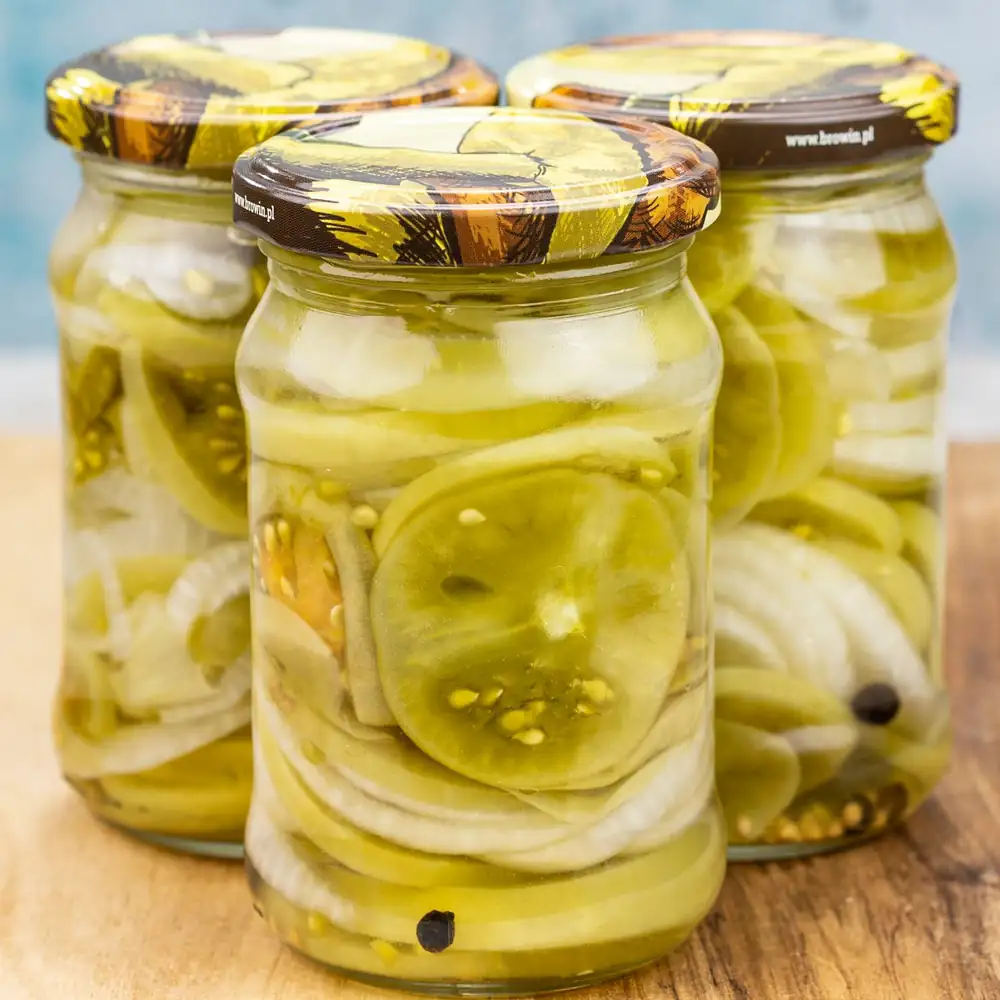
Green tomato salad
This jarred green tomato salad is a very interesting way to use up unripe tomatoes in a tasty way. The recipe is simple and tried and true, so give it a try.
- a great addition to dinner - detailed instructions with photos - a basic salad of green tomatoes and onions
Preparation time: 1 hour Time of keeping tomatoes in salt: 12 hours Jar pasteurization time: 20 minutes Number of servings: 5 jars of 350 ml Energy value 36 kcal Carbohydrates 8 g - Including sugars 7 g Protein 1 g Fat 0 g Diet: gluten-free, low-calorie, low-fat, vegan, vegetarian.
- about 1kg of green tomatoes
- a full spoon of salt - for chopped tomatoes
- 350 g onions, e.g. sweet onions - 3 medium pieces
- less than 3 cups of water - 720 ml
- less than half a glass of 10% spirit vinegar - 100 ml
- 100 g of sugar - 6 full tablespoons of fine sugar
- spices and herbs: 5 allspice grains, 10 peppercorns, a teaspoon of mustard seeds, 2-3 bay leaves
Green tomato salad
My glass holds 250 ml. For the given amount of ingredients, I used five 350 ml jars. You can also use jars of other sizes. Their total capacity should be approximately 1750 ml (approximately).
The vegetables were weighed before any peeling or preparation. I always provide the weight of the vegetables or fruit I use. However, you don't have to follow the gram guidelines. The weights are provided to help you understand the approximate amount needed to prepare a given dish.
Before preparing your green tomato salad for jars, I encourage you to read the entire post first. It includes some interesting tips on ingredients and their substitutes. You might want to add a different type of onion to your salad, or even some bell peppers or carrots.
Green tomato salad recipe
Prepare about 1000 grams of green (unripe), healthy, and undamaged tomatoes. Wash and dry them.
Remove the stems from the tomatoes and cut off the hard part under the stem. Cut each tomato into slices about 3-4 mm thick. You can slice the tomatoes however you like (lengthwise or widthwise). Place all the tomato slices in a large glass bowl. Add a full tablespoon of regular salt to the bowl. Thoroughly mix the tomato slices and salt together. Cover the bowl with a lid or loosely cover with clear plastic wrap to allow air to circulate. Leave the bowl with the salted tomatoes in a cool place, away from direct sunlight, for about 8-12 hours (e.g., in the kitchen on a cupboard), or up to 16 hours (in the refrigerator).
Tip: In the next step, you'll blanch the onion rings in boiling water. If you don't want to blanch the onions, you can place them in a bowl with tomato slices and salt. I would also add a level teaspoon of salt to the bowl.
If you can, it's a good idea to gently stir the tomatoes in the bowl a few times. After about 12 hours, the tomatoes will become elastic and release a lot of juice. Pour off the salty water/juice, leaving only the tomato slices in the bowl.
Peel the onions and slice them into rings about 2-4 mm thick. I use sweet onions, but regular onions and garlic onions will also work. Place the onion rings in a large metal strainer. Place the strainer with the sliced onion in the sink. Bring a pot or kettle to a boil. Slowly pour boiling water over the onion to blanch it. This will make it more pliable and give it a more delicate flavor.
Tip: You can also place the onion rings in a pot of boiling water for 30 seconds and then remove them using a strainer.
Mix the blanched onion rings with the tomato slices drained from salted water.
Prepare five clean jars, each with a capacity of 350 ml. Ideally, jars should be still warm (e.g., straight from the oven (temperature no higher than 110 degrees Celsius) or from a pot of boiling water). You can also use jars of a different capacity. It's important that they have a combined capacity of approximately 1750 ml. The jars should be perfectly clean, and ideally scalded with boiling water. The same goes for the lids. Use only undamaged jars and lids.
In each jar, add one allspice grain, two black peppercorns, a pinch of mustard seeds, and a piece of bay leaf (I used one small bay leaf straight from the vine). For a more intense flavor, you can add a little more pepper and mustard seeds to each jar. However, I prefer a slightly milder version.
Place a portion of the tomato and onion mixture in each jar. Try to divide the vegetables evenly, filling the jars no more than 4/5 full. The vegetables don't need to be packed tightly, so there's still room for the brine.
Tip: To add variety, you can also add a bit of coarsely grated carrot or strips of very thinly sliced pepper (any color) to the bottom of each jar (before adding the tomatoes and onions).
Time for the brine. In a pot, place three cups of water and about 100 grams of any sugar—I used 6 full tablespoons of caster sugar. Bring the water and sugar to a boil, then add about half a cup of 10% spirit vinegar, which is about 100 ml of vinegar. Bring everything to a boil and immediately pour into the jars with the vegetables.
Pour in enough brine to completely fill the spaces between the vegetable pieces. However, leave a 1 cm gap from the rim. Don't rush to seal the jars, as there may be quite a few air bubbles between the vegetables. To remove them, I recommend gently rocking the jars. However, I find it best to press the vegetables soaked in brine down with the back of a tablespoon. After removing the air from the jars, you'll probably need to add a little more brine to cover any remaining vegetables. Only then can you securely seal the jars.
Tip: It's very possible you won't use all of the brine. However, you shouldn't run out. You can also boil the spices (herbs, peppers, etc.) that you've already placed in the jars. I don't do this, however, because there aren't many of them and it would be difficult to evenly distribute them when pouring the brine into the jars.
Before the green tomato salad can be stored in the cellar, all jars must be pasteurized.
Oven pasteurization: Place tightly sealed jars on a wire rack or a thin baking sheet in a cold oven (approximately the middle shelf) and only then preheat the oven to 110°C (240°F). Do not set a higher temperature to avoid damaging the rubber bands in the lids. Pasteurize the jars for about 20 minutes. The pasteurization time is counted from the time the oven reaches temperature. After turning off the oven, the jars can be left inside until they have cooled completely. After this time, the lid should be concave when pressed with a finger – it should not deform or bounce. There is no need to turn the jars over.
Pasteurization in a pot: Place a cotton cloth or a new cloth diaper at the bottom of a wide pot. Arrange the jars side by side, but make sure they don't touch each other. Pour water up to a maximum of 3/5 of the jars' height. Turn the burner to medium heat and bring the water to a boil. Reduce the heat to low and pasteurize the jars for about 20 minutes. Once cooled, you can move them to a cool, dark, and humidity-free place (a cool storage room or basement).
Tip: It's common for some jars to still "burp" (the caps "pop" when pressed) even after pasteurization. However, simply tighten the lids and leave them alone until the next day. They'll almost always seal themselves by then. Therefore, no additional pasteurization is necessary. However, if you do find a damaged cap, I recommend putting the jar back in the refrigerator and opening the salad no sooner than three weeks later.
Store jars of salad in a cool, dark place. A cellar or cool storage room where the temperature doesn't exceed 15 degrees Celsius is best. Homemade green tomato salad needs some time to open and enjoy. It's best not to open jars for more than three weeks after making them.
Green tomato salad is perfect for sandwiches, burgers, and casseroles. It's a great appetizer with meats and all grilled dishes, or as part of a homemade salad or with herring. It can be served with dinner or as part of a salad served at the table alongside cold appetizers. Enjoy.