Coffee
In many parts of the world, coffee is more of a habit – consumed quickly, often on the go. In Sweden, however, it works differently: fika is less about caffeine and more about the break: a consciously designated moment that repeats itself with quiet consistency.
The culture of the coffee break
Fika is such an integral part of everyday Swedish life that its meaning is self-explanatory: coffee, something sweet, and time spent together.
The term is said to have originated from the swapping of syllables in the old Swedish word kaffi. In the 18th century, the coffee itself was the focus, but over time the ritual expanded. Pastries – collectively known as fikabröd – and conversation became as much a part of fika as the drink itself.
Today, fika is not just limited to coffee shops. It is also present in offices, homes, and public spaces, often twice a day. During this time, work takes a back seat and the focus is on conversation, silence, or simply a break.
It's not about the coffee.
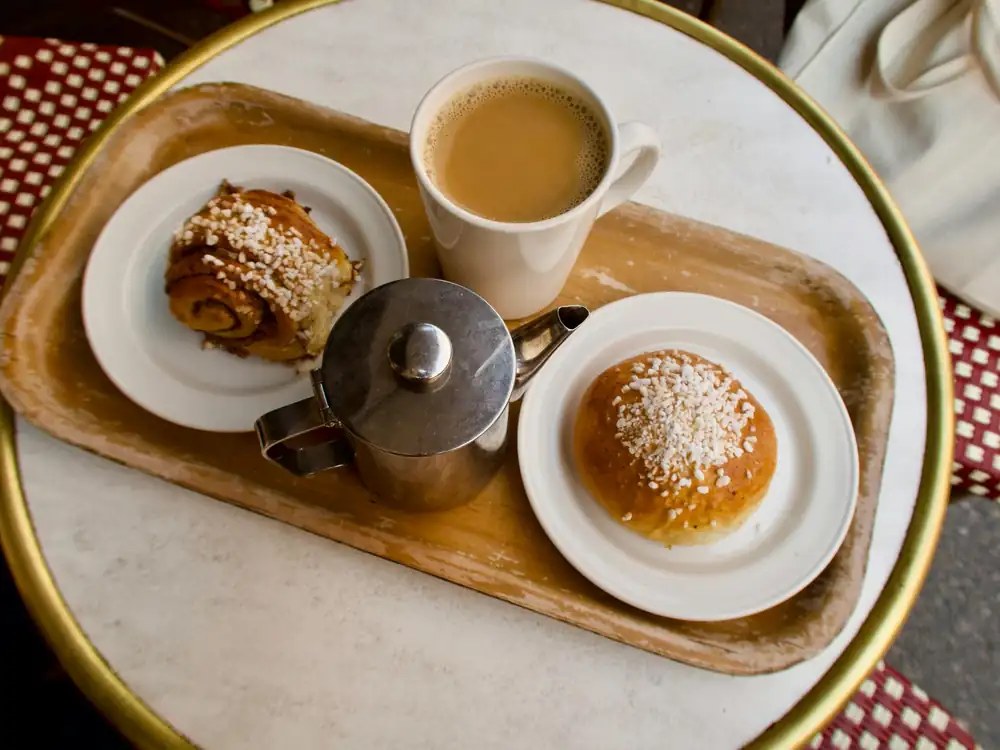
Although coffee is a central element, it rarely appears on its own. Fika is usually accompanied by some kind of sweet treat – most often a cinnamon bun (kanelbulle) or a soft, dense chocolate cake (kladdkaka), but simple pastries are also often served.
The pairing is low-key yet constant, and over time it becomes natural. However, the essence of fika is not the degree of enjoyment, but the intention: slowing down, being present, and connecting.
In the workplace, it is also seen as a real break, not just an interruption. Sweden is one of the world's largest coffee consumers, but it is not typical to order a coffee to go. Rather, they fill it up, sit down and take their time.
Despite the pace of modern life, fika has remained largely unchanged. In many workplaces, it is still a natural part of the day, often in the morning and afternoon. In private life, it marks transitions – between tasks, meetings or simply between classes.
Perhaps its simplicity is what gives it its power. It requires little: time, coffee, and the intention to take a break. In this simplicity, a broader idea emerges: that efficiency and relaxation are not mutually exclusive concepts, and that small rituals can shape everyday life.
Beyond Sweden
Although fika is most associated with Sweden, similar customs appear in other countries in the Scandinavian region. In Denmark and Norway, coffee breaks have a similar meaning, albeit in a less formal setting.
In Finland, where coffee consumption is at the forefront of the world, everyday coffee drinking also takes place at a more leisurely pace. The break, known as kahvitauko, is less ritualistic than fika, but just as essential: part of the routine, the conversation, and the quiet rebirth.
Outside of the Scandinavian region, fika often appears in translations simply as “coffee break.” In reality, however, it is a much more restrained and conscious practice: the recognition that a break – even if for a short time – has value in itself.