SHIFT CHANGE
DAX companies are more women-friendly than fine-dining kitchens.
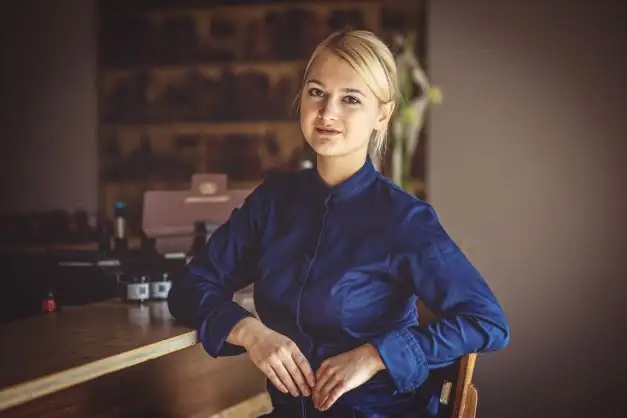
Behind the sunny yellow facade of the "Werneckhof" in Munich's Schwabing district, things are happening. Tradespeople are coming and going, wines are being delivered, cell phones are ringing – and right in the middle of it all stands Sigi Schelling, keeping a cool head. She learned this during her 14 years as sous-chef to Hans Haas at "Tantris." "My right hand. And my left," he called her. Now, after the end of the Haas era, she is opening her own restaurant, "Werneckhof bei Sigi Schelling." If all goes well, it will open in May. She wants to remain true to herself and "the boss," as she still calls him. "It will all revolve around the best products. And good taste." Don't expect any elaborate plating, but rather top quality from small producers with whom she has worked for years. Her solo venture is already considered one of the most talked-about new openings after the pandemic. And it sends a signal: It looks as if the time is ripe for more women in the kitchen. Until now, every DAX-listed company was more women-friendly than our fine-dining kitchens. But that's changing, because now committed female talents are entering the market with attractive concepts.
Sigi Schelling
"Sigi Schelling is my right hand. And my left." Hans Haas
Favorite ingredient: Fish, in all variations.
Cooking is not work, but a passion.
Sigi Schelling, who grew up with three brothers on a farm in the Bregenzerwald region, has no problem holding her own among men. And she is certain: "My style of cooking will be even more in demand after Corona." A cuisine that feels like coming home, with rich sauces, whole-roasted veal shank or lamb shoulder, and airy soufflés with homemade fruit preserves. Haas supports her as an advisor, and she has a well-coordinated team at her side. She herself is motivated to the core: "For me, cooking isn't work, it's a passion." Her unpretentious style fits well in the stylish inn with its dark wood paneling and original Art Nouveau windows, which already brought Tohru Nakamura good fortune.
Add a few more horsepower to the culinary offerings
Munich is currently providing fertile ground for a more female-led haute cuisine scene. Another sous-chef is stepping out of her mentor's shadow and making a real breakthrough after the lockdown: Nathalie Leblond, previously working alongside Jan Hartwig, is taking over the "Les Deux" kitchen at the Schäfflerhof in a dual leadership role with Gregor Goncharov. The purist-elegant restaurant, housed in the extravagantly wedge-shaped building, has long been a fixture on Munich's culinary scene, thanks to owner Fabrice Kieffer. He hopes the new duo will "bring us a few more horsepower in the culinary department." Leblond and Goncharov (previously sous-chef under Edip Sigl) not only want to further develop the style of the gourmet restaurant on the first floor, but also elevate the brasserie on the ground floor. "Really good bistro cuisine is rare in Germany," says the ever-cheerful young woman with the long blonde bangs. “We will focus on higher-quality products and refined recipes, but also emphasize the feel-good element of this type of cuisine more strongly.” More French influences are welcome in the future, for example “a really good beef bourguignon”.
A classic in a new guise
Two restaurants at once – and at just 28? She's well-prepared: she first learned top-level cuisine at Dirk Luther's "Meierei," then at Hartwig's "Atelier" in the Bayerischer Hof. In the gourmet restaurant, she wants to "push the boundaries of aromas further, really explore the interplay of sweetness, acidity, and spiciness." She intends to maintain the "Les Deux" style, based on classic French cuisine with Asian touches, but will increasingly focus on "classics with a modern twist": "For example, foie gras infused with cocoa, served with a delicate apricot broth. Or pigeon, cooked on the carcass, with oriental couscous, dates, and a light tomato broth with basil oil." Leblond considers the notion that women cook differently than men to be outdated stereotyping: "A sense of taste is highly individual and much more a matter of personality than gender."
Gentle Steiner
Douce Steiner earned 2 stars and has held them to this day.
Favorite ingredient: Espelette pepper
"We don't accept girls."
Justine Steiner, currently the only woman in Germany to receive such a prestigious award, could soon have company. When she was looking for a cook's apprenticeship in the early 1990s, she was still told: "We don't take girls." While that has changed, only about 22 percent of apprentices are women. The situation is quite different at her restaurant, the "Hirschen," in Sulzburg, where half the kitchen staff is female and Justine Steiner is doing her apprenticeship with her mother.
French influences on Berlin
Sophia Rudolph, also from Berlin, boasts an excellent career path. After graduating from high school, she studied restaurant and hotel management at the renowned Institut Paul Bocuse in Lyon. Her early career included stints at legendary establishments such as "Ousteau de Beaumanière" in Les Baux-de-Provence, with Alain Ducasse in Monaco, and with Alain Chapel. "French cuisine, with its focus on good taste, excellent products, and great sauce-making, has shaped me," she says. But she also experienced multicultural Berlin, to which she returned to cook for four years with Marco Müller at "Rutz," most recently as sous-chef, before taking on her first head chef position at "Panama."
Cooking for the guests, not for awards
The menu of her new restaurant "Lovis," which opened after the lockdown at the quieter end of Kantstrasse in a historic building complex with courtyards and gardens, unmistakably reflects French-Mediterranean influences, her preference for strong flavors, but also for vegetables. Inspired by the southern French anchovy, she plans a vegetable variation, marinated and fermented raw, with shaved fennel, artichoke chips, and a delicately spiced anchovy cream. Or an open raviolo: "Instead of pasta dough, we use wafer-thin slices of mushrooms as a casing, fill them with mushroom duxelles, warm the whole thing in sage butter, and shave cured egg yolk over it." Unlike many male colleagues, the 34-year-old is less concerned with quickly winning prestigious awards: "I don't have to prove anything to myself. It's all about the guests."
Vicki Fuchs
Style: Creative cuisine featuring game from the owner's own hunting grounds, often combined with Asian flavors.
Favorite ingredient: Venison
Dedicated female chefs bring fresh ideas
Dedicated female chefs are still a rarity, but they are already bringing fresh impetus to the scene. For example, Viki Fuchs, who runs the traditional "Spielweg" in Münstertal with her sister, spicing up Black Forest game cuisine with her penchant for Asian flavors. Or Magdalena Klein, who cleverly blends the products of her Upper Bavarian homeland with Mediterranean influences at "Fährhütte 14" in Tegernsee. Or Sonja Baumann, who founded "Neobiota" in Cologne with Erik Scheffler, where the two combine brunch with gourmet offerings and dare to create unusual aromatic combinations. Further talents are also emerging among sous-chefs, such as Julia Anna Leitner, who has been working closely with René Frank at "Coda" in Berlin since day one.
Hanna Lehmann
"I don't want to do anything just for my CV anymore."
Favorite ingredient: Butter & Lemon
Cooking for self-determination
Hanna Lehmann is also forging her own path at the "Laurus" in Hartmannsdorf near Chemnitz: She dropped out of her German studies to become a chef. And after an internship with Johannes King on Sylt, she turned down a permanent position to return to her Saxon homeland: "I don't want to do anything just for my CV anymore. I want to do it because it suits me." This conscious decision to forgo male-dominated career paths has paid off. Her light, fresh cuisine is characterized by over 50 herbs from the "Laurus garden": Chickweed adds spicy accents to the cured trout with radish sour cream, while she pairs veal tongue with airy foam made from watercress that grows by the stream in the garden. The 25-year-old doesn't cook for her own ego: "The pandemic has shown how important restaurants are for our social fabric. We will do even more for the well-being of our guests in the future."