The cake that takes time
When honey was the main source of sweetness
The history of honey cream pie actually began centuries ago, when honey was one of the most important sweeteners in Europe. Sugar was a rare and expensive ingredient for a long time, so honey gave the character of sweet pastries in households. Pastries made with honey were already present in the Middle Ages, especially in Central Europe, where a strong tradition of beekeeping and honey consumption had developed.
Early honey cakes were quite different from the honey cream cakes we know today. They were thicker, spiced doughs that could be stored for a long time and were often associated with holidays. In addition to being sweet, honey acted as a natural preservative, it also locked in moisture, gave the dough a rich aroma, and developed a deeper color during baking.
Member of a whole cake family
Honey cream is actually part of a much larger Central European tradition, as honey pastries have appeared in almost every country where beekeeping played an important role. In Germanic lands, lebkuchen and honigkuchen, in Slavic countries, medovik and medovník, and in the Carpathian Basin, numerous honey cakes preserve traces of the same confectionery thinking.
Hungarian classic with Central European roots
Many people consider honey cake to be a typical Hungarian cake, but in fact it is part of the shared gastronomic heritage of an entire region. Although it has its own role in Hungary, similar layered honey desserts have long been made in Transylvania, Slovakia, Croatia, Serbia, Romania and Poland. The recipes are of course different: in some places the cake is made of several layers, in others sour cream or caramel cream is added, and there are also versions that are enriched with milk caramel or nuts. However, the basic idea is the same everywhere: thin honey layers, cream and time. This trio gives the essence of the dessert.
The gift of bourgeois confectionery
The honey cream cake we know today took its final form in the bourgeois confectionery of the late 19th and early 20th centuries. At that time, layered cakes in which thin sheets of dough were bound together by cooked cream became increasingly popular. One of the most important techniques in home confectionery of the era was the cream cooked from milk, flour or semolina, which was whipped with butter after cooling. This gave the desserts both lightness and stability, while harmonizing well with the rich taste of the honey sheets.
Time as a raw material
Few cakes are as important as resting. Freshly baked honey cakes are hard, almost breaking under the knife, but after applying the cream, a slow transformation begins, and the cakes gradually absorb the moisture of the cream. This process is part of the preparation, and the creamy texture of a well-made honey cake is created precisely by this natural ripening process. Many confectioners say that the dessert is at its best the next day, but there are also recipes that recommend resting for at least two days.
From a festive cake to a family classic
Making honey cream cake requires patience and organization, you have to roll out and bake several sheets separately, make a cooked cream, and then wait for the dessert to set. Perhaps that is why it was so closely associated with the holidays. Before Christmas, Easter, baptisms, name days or larger family gatherings, it was often prepared a day or two in advance, so that it would reach the perfect consistency on the day of serving. This kind of foresight was a natural part of home baking for a long time, and contributed to honey cream cake becoming one of the most treasured pieces of grandmothers' recipe books. In the mid-20th century, the popularity of the cake was also strengthened by the fact that it was made from relatively simple ingredients, could be sliced easily, and retained its quality for several days, making it an ideal choice for hosting larger families.
Honey in a creamy glass, as prepared by Zsuzsanna Ötvös
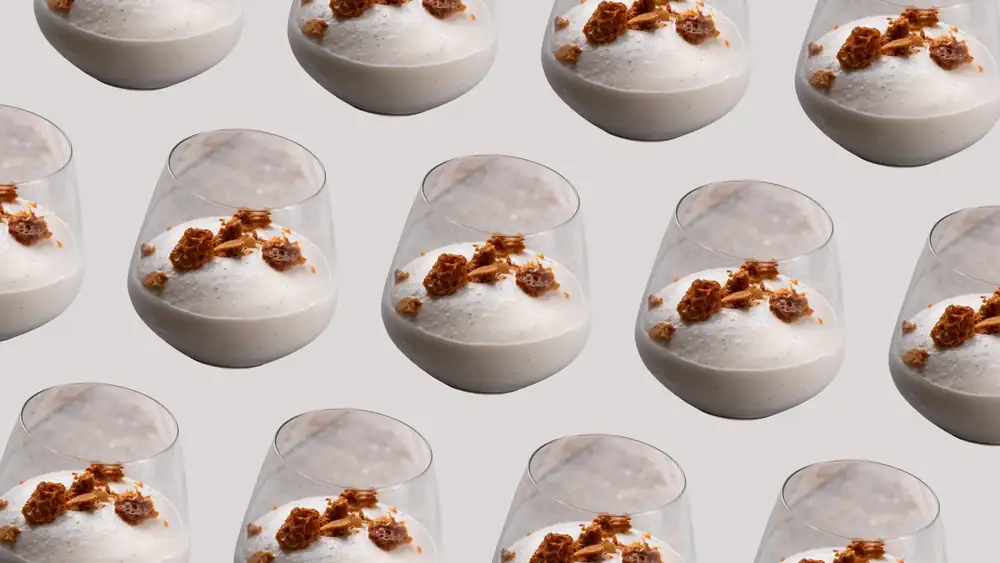
Zsuzsanna Ötvös has reimagined the classic honey cream cake while preserving all the flavors and textures that have made this dessert so beloved for generations. Instead of the traditional layer cake, she serves it as a glass dessert, where the different elements stand on their own, yet still deliver the same familiar taste experience.
Honey sheets are the base of the dessert here too, but the classic apricot jam is replaced by a fresher, more vibrant sea buckthorn jam, whose acidity balances the sweetness of the honey. The traditional semolina cream appears in the form of a light semolina foam, which is made particularly airy with the help of a siphon. The final layer is homemade Turkish honey, whose crunch brings a new dimension to the dessert and creates a contrast with the softness of the foam.