The double exterminates the cane
In an advertisement for a well-known beer, Luis Tosar reveals the secret to pouring a beer to the aspiring students of a dubious academy, who look more like captives or underworld figures than actual students. But the message is clear: everything revolves around this ritual.
I'll take this opportunity to paraphrase the five steps because I think they summarize one of the most beautiful and, at the same time, most complex acts surrounding beer. Ignoring the violent references and physical evidence shown in the advertisement, which don't contribute much to this piece on the subject, let's get started!
The first is choosing the right shape, size, and dimensions of the glass. I say glass because there's a lot of debate on the subject and a preference for the type of glass, which differs from the choice of a goblet or pitcher. Ultimately, choosing the right glass is undoubtedly a key issue.
Next comes cleanliness, of the tap and faucet, and the importance of the temperature at which the beer should be served, which will vary depending on the type and location of the planet where it is consumed.
The third point, which goes into the pouring technique itself, specifies that the process must begin with the discarding part, which is achieved through a precise tap, which allows getting rid of the foam oxidized by the atmosphere that has remained in the tap from the previous beer served.
The key to pouring the beer is to place the glass at about forty-five degrees, so that the beer falls smoothly, preventing the formation of foam.
Finally, the final opening follows, where the glass is tilted ninety degrees and the tap is gently opened to form a perfect crown of foam, so appreciated and so characteristic of good draft beers.
Reeds in ancient times
That beer, with its overflowing, cool foam, was not the one the Sumerians drank. Theirs was a low-carbonated beverage with a strong flavor accentuated by a positive temperature. However, it was served in cups (10.95 x 10.16 cm) like those found at the Tepe Sialk sites in Iran, dated between 4000 and 3600 BC, very similar to our drinking glasses (10.4 cm), although slightly smaller in diameter. So we can say that in both ancient Mesopotamia and ancient Egypt, drinking glasses was already common; poorly poured, but still good.
When we talk about a "caña" (cane), we are referring, as the RAE (Royal Spanish Academy) indicates in its two definitions, to the container: "7. f. Glass, generally cylindrical or slightly conical in shape, tall and narrow, used for drinking wine or beer." And to the contents themselves: "8. f. Liquid contained in a "caña."
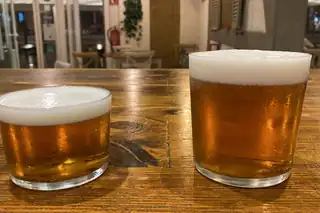
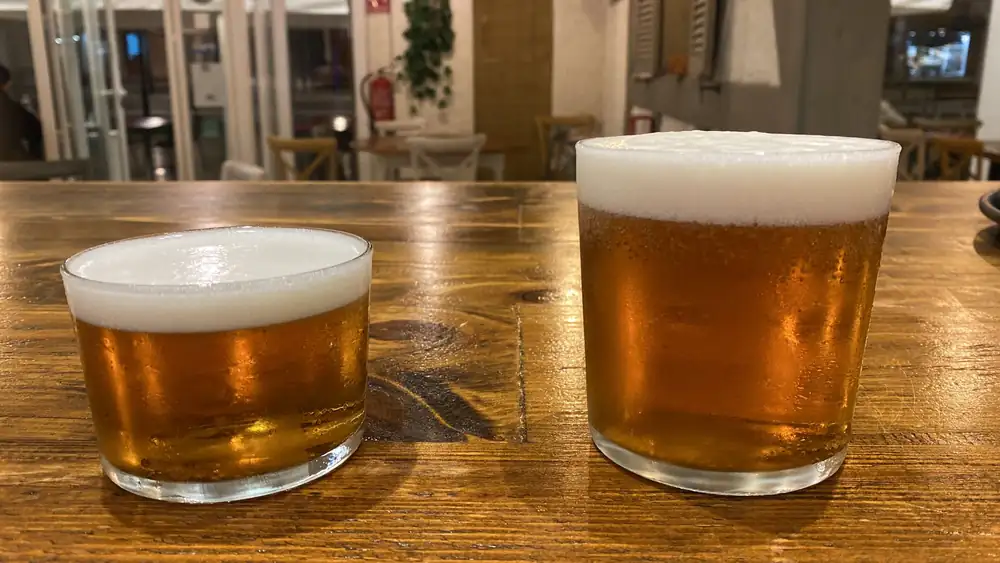
So, to "tirar una caña" is to pour a beer into a tall, narrow, conical glass, called a "zurito" or "al corto," depending on the region, with a capacity of 20 cl. This is less than a bottle, which is around 30 cl, or a can, which is 33 cl.
"Caña" refers to a specific measure of beer and has become a hallmark of bars across the Iberian Peninsula. These are places where phrases like "let's go for a few beers" or "I'll buy you some beers" have become famous, ingrained in the collective consciousness and serving as the driving force behind an after-work gathering.
Madrid has long been the capital of the traditional draft beer, with millions poured at bars like Santa Barbara, La Ardosa, La Dolores, and El Doble, to name a few. But El Doble itself has left the draft beer behind. This small, traditional draft beer is undergoing a process of extinction in the offerings of bars and terraces in 21st-century Madrid. This fact hasn't gone unnoticed by many customers who have lamented its gradual disappearance on social media and in various online forums.
Try it yourself and go to a bar and ask the waiter for a small beer, one of those that overflows with foam over the rim of the glass, and you will find that one out of every three times the friendly and/or traditional bartender emphasizes the fact that they no longer serve that small size, that the small glass is from "before", and that they have double beers and large glasses of beer to quench the thirst of the patron.
Gone are those brief sips of fresh beer, the kind that lasted until the first bit of office gossip or the VAR controversy in the last match, which you could escape by making a face and shouting, "Come on, another round of beers!" It seems that small glass, the perfect one to hold with your whole hand, has been relegated to serving tap water ("osmosis-treated or not").
The open debate invites popular opinion to point to economic factors as the main cause. But those who enjoy a good beer would surely respond that if the beer is poured correctly, it encourages the consumption of two or three in one sitting.
Even purists might argue that the Madrid double is poorly poured; you enjoy a few sips, but then the beer loses pressure and warms up, ruining the image of a refreshing drink. This ties in with the five steps we've discussed: the importance of carbonation and temperature.
Calculating prices
But let's hear the other side, the professionals in the industry, and look at the data, taking an average, of course. A keg contains 30 liters of beer. Most establishments offer rebates or discounts based on beer brands, so we could estimate the average price at around €55 per keg (with discount) plus VAT. Here, calculate the price per liter. This will yield about 150 small beers (20cl) per keg, to round things off, at an average price of €3.10 per beer. In the case of a Double (40cl), the average price is €6.30. Economic concerns or price differences are not reflected in these figures.
From a business perspective, the double-serve option is a matter of revenue. As we've seen, it doesn't affect the cost of the beer itself, which remains the same, but rather the cost of serving two small beers and a double. This implies higher staffing costs, increased cleaning (bar, glassware), and higher service costs, as well as higher prices for snacks served with each drink. And that's not even considering the time it takes to serve a small beer, given the space it occupies and the revenue generated. It's certainly an interesting topic, and one with undeniable logic.
Nor is there any need to beat ourselves up, because this decline is currently concentrated in the city center of Madrid and some very trendy areas. In these areas, revenue is very high due to rising rent and staffing costs. This problem isn't as noticeable in the outlying neighborhoods.
As we mentioned, trends can be another factor; glamour and modernity often stray from traditional icons. This might be the case with the beer can, which in this Instagram-driven world perhaps lacks the necessary glamour and photogenic appeal. Many concepts, like the porrón (a traditional Spanish wine pitcher), find themselves in this situation, belonging to an even more antiquated past, despite José Andrés's best efforts to promote it on his American cooking shows.
Let's advocate for a discourse of fair consumption, for the kind of beer that has that measured touch in a context where alcohol intake should be moderate. And if it happens to be one of those special days, let's allow ourselves to buy another round without losing our composure or our wallets.
What I know for sure is that at the bar of the neighborhood pub we can still drink some well-poured beers and that right now I know what I feel like drinking.