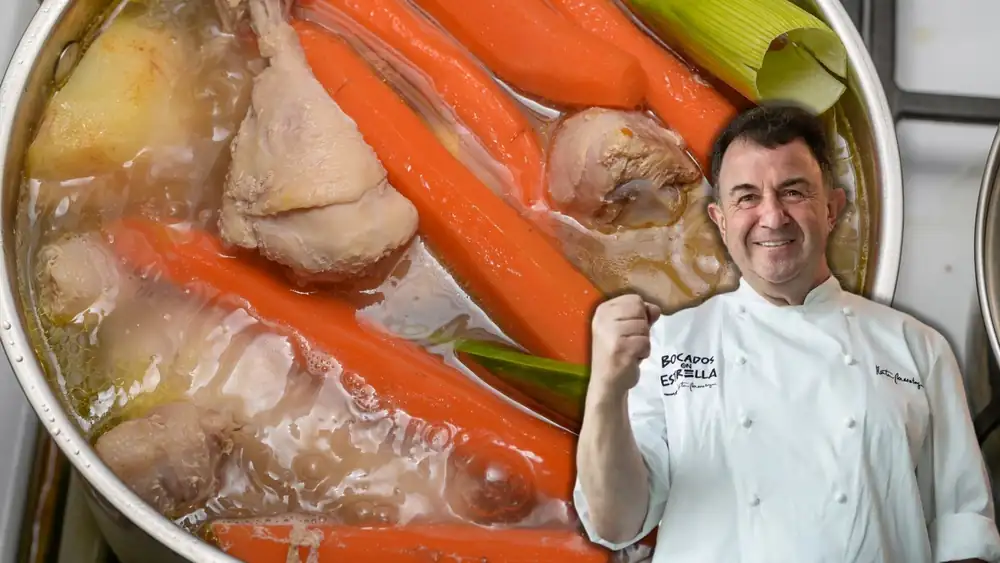
Martín Berasategui, chef: “The richest chicken broth contains 2 kg of carcasses, 1 carrot, garlic, 1 leek and 100 ml of cream”
Making broths at home is one of those customs that some of us have inherited from our mothers and grandmothers and that is worth maintaining because it allows us to get a lot out of humble ingredients.
- Chicken carcasses and trimmings, 2 kg
- Onion, 1 unit
- Leek, 1 unit
- Carrot, 1 unit
- Bouquet garni, 1 unit (thyme, parsley, bay leaf...)
- Garlic heads, 2 units
- Nata, 100 ml
- Coarse salt, 1 tablespoon
- Salt, to taste (for the garlic puree)
- Freshly ground pepper, to taste
- Step 1: Place the chicken carcasses and scraps in a large enough pot, add plenty of water, and cook for 5 minutes. Skim off any foam that forms and discard the first amount of water.
- Step 2: Return the chicken to the clean pot with 2.5 liters of clean cold water and add the peeled and chopped vegetables, the bouquet garni, and the coarse salt. Bring to a boil and simmer for 1 hour.
- Step 3 Strain the broth and reduce it over heat until you obtain a volume of one liter. Peel the garlic cloves and remove the germ.
- Step 4: Place the garlic cloves in a small saucepan, cover with water, bring to a boil, and let cook for 2 minutes. Drain and repeat this process three more times.
- Step 5 Drain the garlic cloves, discard the water, put the garlic cloves back in the saucepan, add the cream, season with salt and pepper to taste, simmer for 2 minutes and blend with a hand blender until you have a smooth and homogeneous puree.
- Step 6 Pour the garlic puree into the hot broth, stir vigorously with a whisk and adjust the salt and pepper if necessary.
Bones, chicken carcasses, vegetable scraps, or those less attractive parts that we might not use in other recipes, when turned into a tasty broth, can become other flavorful dishes.
In addition to obtaining homemade broth that we can later use in soups, rice dishes, stews, sauces and many other preparations, this way of cooking helps to make better use of food and reduce the amount of food that ends up in the trash.
And the best part is, it doesn't have to be complicated. Making a good broth is a simple task, especially when you follow some of the tricks of a chef with such a renowned career as Martín Berasategui.
The trick: two heads of garlic and a splash of cream
In his book Cooking at Home with Martín Berasategui, the chef proposes a chicken broth that starts with the ingredients that have been most used in Spanish homes to make this type of broth: chicken carcasses accompanied by different vegetables.
However, the chef adds his personal touch to improve the result.
One of these techniques is the use of a bouquet garni, a very common practice in French cuisine. It consists of tying several aromatic herbs together in a small bundle so that they release their full aroma during cooking without being loose in the broth.
When it's time to finish the recipe, remove the bunch and don't go fishing for them.
Making your own bouquet garni at home is very easy. Simply gather three sprigs of thyme, several sprigs of parsley, and a bay leaf. Then, wrap them with the green part of a leek and tie them with kitchen twine to keep everything together while it cooks.
But the most striking trick in Berasategui's recipe is the garlic. The chef uses no less than two whole heads, an amount that gives the broth intensity, flavor, and extra nutrients.
However, the garlic isn't simply added to the liquid. First, it's cooked and then pureed by blending it with a small amount of cream before being added to the broth. This step results in a much richer broth with a smooth, velvety texture that makes it more comforting, even when enjoyed on its own.