Clara Corso, a cook determined to succeed
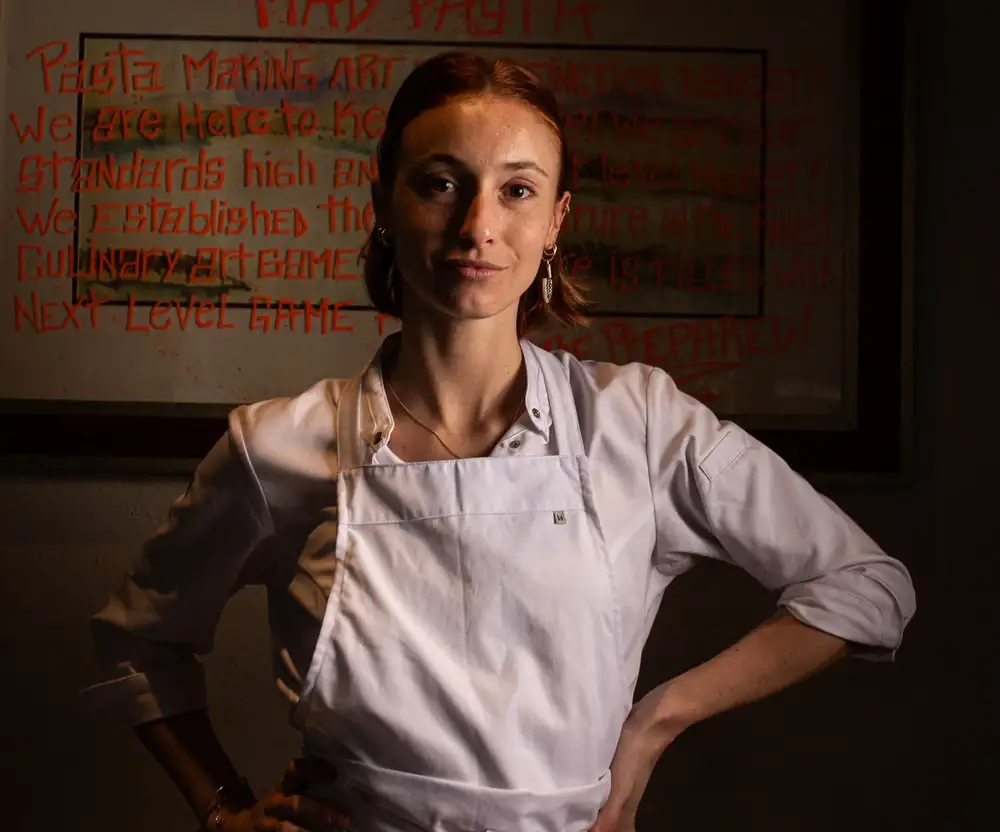
She's 27, but when people ask her age, she's often thought about lying, about saying more. "Sometimes I feel that being a woman and being young isn't always a well-received combination in the culinary world," she confirms. Her name is Clara Corso, but they call her Calu.
“At 23, I worked at a Michelin-starred restaurant in France. When I started, I had no idea what I was getting myself into. It was a huge shock: I barely had any work experience, I didn't speak a word of French, and nobody wanted to speak to me in English. I couldn't get a single order right. It was the kind of mistreatment you see in the movies: when I turned my back, they'd turn up the heat, they'd make fun of me. I was the youngest in the kitchen, and they saw me as a blonde, Latina, inexperienced girl. There was this sense of European superiority that they constantly made clear to me. Once, an Italian chef came in, and they actually spoke to him in English,” she recalls.
Decision in the face of adversity
“It was a very intense kitchen; in positions like mine, nobody lasted long, they were constantly quitting. The only reason I didn't leave was to deny them that satisfaction. I was determined to succeed, to show them I wasn't useless, that I could endure as much as anyone. I even started going in earlier, secretly, since you weren't allowed to enter before the established time; but I went earlier to at least try to finish my part on time. Once they caught me and almost fired me,” she says. “But the day they congratulated me, that's when I quit.”
Clara's culinary beginnings started with more doubts than certainties: she finished high school, she liked baking cakes, she dreamed of owning a tea house in Bariloche, and playing hockey. She wanted to study cooking, and her father, not entirely convinced, recommended that she pursue a degree in Gastronomy at the Universidad Argentina de la Empresa, a private institution that has an agreement with the Instituto Argentino de Gastronomía (IAG).
There, in addition to culinary techniques, he learned about the gastronomic business: investments, plans, finances, costs. “When I graduated, I went to Europe: I still wasn't sure I wanted to be a chef. In Barcelona, I worked in a tapas bar, with a lot of molecular gastronomy and all that nonsense; and I enjoyed it a lot. I realized that could be my path. From there, I went to France, to a Michelin-starred restaurant in Versailles; the place was beautiful, the room I rented had a view of the palace, it was a dream, but I had a terrible time. I didn't know anything, I didn't know what haute cuisine entailed. It was several months of mistreatment until one day I exploded: one day the chef, angry, hit me with a spoon, and I lost it: I started swearing at him loudly in Spanish; everyone was staring at me, service came to a standstill. From then on, my colleagues started treating me better, becoming more supportive and collaborative. And, in the midst of constant frustration, I discovered what a professional kitchen was, I fell in love with it, with the craft and the pride each of us felt for our work. What I saw in France I never saw again, a rhythm and a demand that they instilled in me.”
All of this, so distant today, happened just four years ago; in the kitchen, time moves differently. Since then, Clara has become one of the most interesting chefs in Argentina, obsessed with her work, accumulating knowledge, experience, technique, and a few breaks—worked in therapy—to allow herself time for reflection and enjoyment.
“I returned to Argentina on one of those repatriation flights in May 2020, in the middle of the pandemic. I spent 15 days in quarantine, locked in a room, learning about sourdough, with the help of a friend who taught me via video. I was desperate to get back to work: I wrote emails to chefs in France and Argentina. Without even knowing who they were, I told them all more or less the same thing: I admire you so much, I want to work with you,” she says.
A new beginning
One of those who responded was Lucas Canga, who at the time was part of the kitchen staff at Alo's (chef Alejandro Feraud's prestigious restaurant) in the northern suburbs of Buenos Aires. With the dining room closed due to the pandemic, Alo's had opened a boutique with delis, breads, and pastries. After Clara's persistence ("if necessary, don't pay me, but let me work," she begged), they ended up hiring her as a bakery assistant. "Three days later, the head baker got Covid, and I took over. I spent two months making croissants, brioche, and sourdough. That was my start at Alo's. Then I moved to the stovetop, a beautiful and creative stage, with Lucas as head chef. There was no menu: every morning we went into the walk-in cooler and put together dishes with whatever was in stock."
With Ale Feraud as my guide, I came up with my own recipes, having a lot of freedom. That's also where I met Félix; we were all crazy about cooking. We competed with each other, in a fun, healthy way, to see who could make the best, most creative, and most delicious dishes. I wanted to conquer the world: I went through appetizers, baking, pasta, and protein dishes. I'd grab one area, squeeze every last drop out of it, and then move on to another. If in France I learned rhythm and speed, at Alo's I learned to cook delicious food. And the best part of all was that I no longer felt like the sickest one, the one who couldn't stop working: I was part of that "disease" that had infected us all.
When Lucas Canga resigned from Alo's, Alejandro Feraud chose 24-year-old Clara as head chef. “Of course I said yes, but I didn't feel ready. Several members of the team, with more experience than me, had already quit. I was the youngest, a posh blonde from Bellavista who had her own car and a knife set I'd bought in France. But I'd earned everything I had by working my ass off! I was taking huge steps, growing a lot, but with physical and mental consequences. My role model was what I'd experienced in France: demanding, tough.”
It took me a while to get used to the way things were said and spoken. I needed to understand that, from France, I should take the professional rigor, but not the mistreatment. Luckily, Ale understood and gave me the time, space, and trust. It was tough; I had panic attacks, and I didn't want to be the kind of cook who one day collapses and gives up on everything. I started therapy, I went back to training, trying to balance health and work.” Today, what she has left of Alo's are not only great friends and the experience of managing teams, but also dishes that continue to fill her with pride, like the purple sweet potato churros with duck liver pâté, or the gnocchi with French velouté and vanilla oil, among others.
Unconventional pastas
During those same years, Clara joined a fledgling personal project that Lucas and Félix had conceived during the pandemic: under the name Mad Pasta, these two chefs offered unconventional frozen pasta with home delivery. “I started for free, I was interested in learning; after work we would go to Félix’s house and make the pasta in a small room.”
Over time, Clara became Lucas's partner, and later, when they decided to turn Mad Pasta into a restaurant, she joined as a partner. “Lucas was starting Piedra Pasillo, Félix was working on his restaurant in Uruguay, and I was still the head chef at Alo's. We were all working at full speed: we opened Mad in October 2022, starting work at 7:30 in the morning and continuing nonstop until the early hours. Mad quickly became a success, and that's when I decided to quit Alo's to focus on the restaurant.”
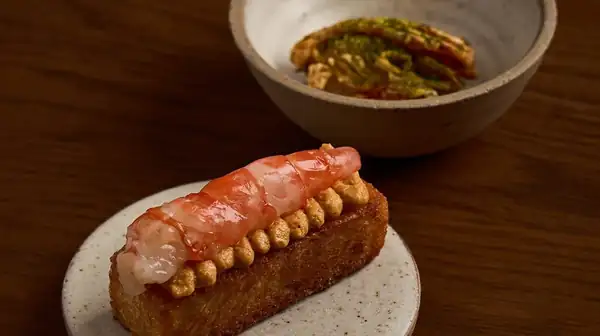
Mad is, to a large extent, a true reflection of its chefs' character: young, modern, and cool. Without being overly sophisticated, it allows for creative experimentation, sidestepping the powerful Italian tradition that has deep roots in Argentina. Among the new classics of this restaurant, which is barely two years old, is, for example, the skewer of fried potato gnocchi interspersed with pork and prawn meatballs. "When you mix all that together, you get something that's as delicious as it is fun," Clara assures us.
The same goes for the kabocha squash cappellacci with a butter and ginger sofrito, curry cream, and matcha sauce on top. Or the ricotta gnocchi with roasted garlic cream, asparagus, and fermented garlic honey with toasted chestnuts. Or the Nino Berguese, a filled ravioli that changes with the seasons. “With Mad, we're trying to showcase a new era of pasta, with an Italian foundation thoroughly researched by Félix, also with a touch of Argentinian flair, which is who we are; and with our signature style. The doughs are classic (semolina and egg or water), the shapes are Italian, the flavors are distinctly ours.” With tables always full, lunch and dinner, it's common to see Clara in the Mad Pasta kitchen, organizing the service.
Future and desire
At 27, a fact she sometimes tries to hide, Clara Corso has the world at her feet. A regular guest at conferences and pop-up restaurants in Argentina and around the world, she gains experience and expands her culinary horizons, a place she always returns to. “I try to calm down; I know I’m very impulsive. I’m still in therapy, I do a lot of meditation and anxiety management, and I have many tools for everyday life, all with the goal of getting things straight, of understanding what I want to do,” she says. And she concludes: “I love Mad Pasta, but I feel there’s another part of me, a more complex cuisine, that I left behind at Alo’s and that I want to reclaim. The next step is to open a restaurant with Lucas, without investors or partners; we’re saving up for it. We envision a place with the irreverence of Mad Pasta and aspects of fine dining—elegant and fun. We know about baking, pastry, and cooking: we like to mix everything. And it’s in that mix, in the blending, where I think we excel.”