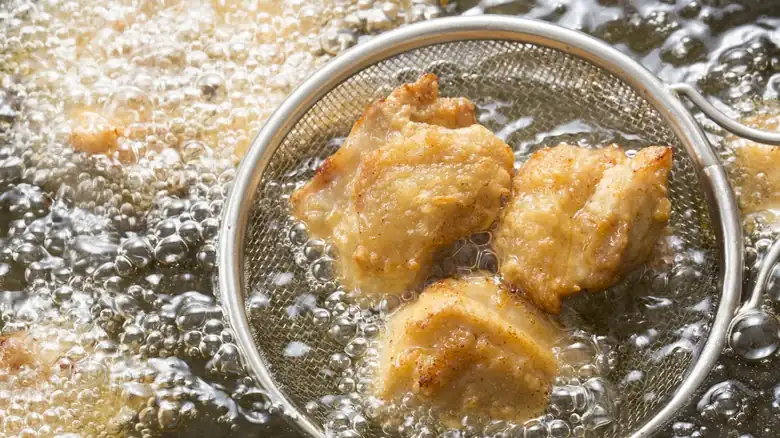
The 9 Best Oils For Deep Frying
However, it's important to consider that unsustainably sourced palm oil is highly detrimental to the environment and wildlife. Thus, be sure to go for one that comes from sustainable sources, which can be identified by a label on the oil's packaging, as Conservation International explains.
Speaking of flavor, this oil has a neutral and pleasant taste with a hint of sweetness and only a mild aroma, making it an excellent choice for cooking pretty much anything. Plus, its characteristically high smoke point of around 450 degrees Fahrenheit makes it ideal for deep-frying all kinds of foods, from fried chicken or seafood to fries or vegetables. However, while it is a perfect choice for deep-frying that may even provide a couple of health benefits, corn oil is also high in omega-6 fatty acids, which can promote inflammation. Thus, it would be best to consume it in moderation (via Healthline ).
Rice bran oil has a smoke point of 490 degrees Fahrenheit (via MasterClass ), as well as a high oxidative stability, which is why it is a suitable option for high-heat cooking methods like frying, deep-frying, and sautéing. When it comes to flavor, it has a mild yet slightly nutty taste that resembles that of peanut oil, making it ideal for preparing Asian fried dishes like tempura fish, meat, and vegetables.
Virgin coconut oil
Virgin coconut oil is an oil that is extracted from the meat of fresh coconuts without the use of heat or chemicals. It is considered to be unrefined and has a more natural, coconutty flavor than refined coconut oil, as well as a higher content of biologically active compounds, according to a study published in the Journal of Food Science and Technology. While its popularity has skyrocketed over the years as a personal care and beauty product due to its numerous potential health benefits, virgin coconut oil's nutritional profile also makes it an excellent oil for deep-frying. Virgin coconut oil is high in saturated fats, which gives it a high smoke point of 376 degrees Fahrenheit (per a study published in Acta Scientific Nutritional Health). This means that it is relatively stable at high temperatures and makes it well-suited for deep-frying. In addition, it h
Olive oil
Olive oil is touted as one of the healthiest oils out there, yet, aside from providing numerous health benefits, it is also highly versatile as well as delicious. Olive oil is made from the fruit of the olive tree, which is native to Mediterranean regions. The process of making olive oil involves harvesting the olives, then washing, crushing, and separating the oil from the water and solids. However, different processing methods yield different types of olive oils, such as regular, virgin, or extra virgin varieties. When it comes to regular olive oil, it is produced by mixing extra virgin olive oil and refined olive oil (via U.S. News & World Report ). Despite having what's considered a moderately high smoke point of 390 to 468 degrees Fahrenheit, regular olive oil is a healthy choice for cooking due to its high monounsaturated fat content. According to a study p
Avocado oil
Avocado oil is a heart-healthy oil that has gained a lot of popularity in recent years. According to a 2021 study published in Foods, it went from being primarily used as a dressing or seasoning to being an alternate oil for cooking. Avocado oil is made from the flesh of the avocado fruit. The process of making avocado oil involves removing the skin and pit from the avocado, then pureeing the flesh and extracting the oil — a process similar to that of olive oil. Like olive oil, avocado oil is rich in monounsaturated fatty acids, a nutritional quality that grants it plenty of heat stability. However, with its high smoke point of 520 degrees Fahrenheit, this oil has the highest smoke point among common cooking oils (via Michelin Guide ), making it suitable for high-heat cooking methods such as sautéing, grilling, and deep-frying. In terms of flavor, avocado oil is
Soybean oil
Soybean oil is one of the most widely used oils in the United States. In fact, between 2021 and 2022, about 13 million tons of soybean oil were produced in the U.S. (per The Soybean Processors Association of India ). It is also relatively inexpensive, which is why it is a commonly used oil in processed foods. Soybean oil is made from the seeds of the soybean plant. The process of making soybean oil typically involves cleaning and dehulling the soybeans, then using a mechanical or solvent-based method to extract the oil. While the latter is a more efficient method, it can leave a strong, undesirable flavor. In contrast, the mechanical technique produces an oil that has a mild and neutral flavor, making it suitable for use as a cooking oil (via Oil Mill Machinery ). Soybean oil has a high smoke point of around 450 degrees Fahrenheit, so you can use it for high-heat cook
Peanut oil
Peanut oil is the perfect oil to cover all your frying needs. It is an edible vegetable oil that is made by grinding peanuts and then extracting their oil. It is lighter in color compared to other traditional cooking oils and has a sweet and nutty yet predominantly neutral flavor that goes well with most foods. Furthermore, you can even use it interchangeably with other cooking oils (but it should be heated to higher temperatures than olive oil when cooking). In addition, with a high smoke point of 450 degrees Fahrenheit, it is ideal for a number of high-heat cooking techniques without the risk of burning or over-browning food. In fact, according to a study published in the Journal of Food Science and Technology, peanut oil is also rich in monounsaturated fatty acids, which makes it adequate for prolonged frying. Peanut oil's main culinary uses are deep-frying and s
Almond oil
While it gained popularity for boosting skin and hair health, almond oil also comes with culinary advantages. Almond oil is produced from almonds and has a rich, nutty flavor that works well in savory dishes. However, not all almond oils are suited for deep-frying, and it all comes down to their processing method. There are two types of almond oil: refined and unrefined, and while unrefined almond oil is made by cold press extraction to ensure that the flavor and nutrients are retained, the processing required to create refined almond oil grants it a higher heat tolerance — meaning that this is the one you should use for deep-frying purposes (via Healthline ). Refined almond oil has a smoke point of about 420 degrees Fahrenheit, making it ideal for frying at low temperatures. It works well with all kinds of fish but can be used like any other neutral-flavored o
Palm oil
Palm oil is the most used oil worldwide, seeing that it is needed for countless different products ranging from cosmetics to pet food, cleaning supplies, and, of course, your favorite foods (via Conservation International ). It is extracted from the fruit of the oil palm tree through a process that involves removing the fruit from the tree and then sterilizing it by steaming it. Then, the fruit is pressed to extract the oil, which can be further refined to remove impurities (per Oil Refinery Plant ). Like all the other vegetable oils from this list, palm oil is an excellent choice for deep-frying because of its high smoke point, around 450 degrees Fahrenheit (via Asia Palm Oil Magazine ). In fact, a study published in Antioxidants determined that there were few changes in palm oil's antioxidant properties between the first and the 20th frying cycle, meaning th
Corn oil
Corn oil (or maize oil) is a popular oil used in the United States not only for culinary purposes but for many industrial processes as well. In fact, the U.S. is the largest corn oil producer worldwide. With an average production of around 2 million tons per year, it's responsible for over 50% of the world's corn oil supply (per Atlas Big ). Corn oil is extracted from the germ of the corn kernel. The process of extracting corn oil typically involves mechanically pressing or using chemical solvents to remove the oil from the germ. After the oil is extracted, it is refined, which removes impurities and improves the flavor and color of the oil. In addition, the refining process is what allows it to withstand high cooking temperatures (via ABC Machinery ). Speaking of flavor, this oil has a neutral and pleasant taste with a hint of sweetness and only a mild aroma,
Rice bran oil
A well-known oil in countries like India, Japan, China, Thailand, and Vietnam, rice bran oil has gained popularity due to its numerous potential health benefits, in addition to being a deep-frying-friendly oil. Rice bran oil is extracted from the outer layer of the rice kernel, known as the bran, and, according to a review published in the Journal of Oleo Science, it has a fatty acid composition that falls very close to recommendations by the American Heart Association (AHA) and World Health Organization (WHO) for edible oils in terms of heart health. Furthermore, a study published in the Journal of Food Science and Technology explains that the oil contains a compound called oryzanol, which is believed to increase good cholesterol levels while lowering bad cholesterol and triglyceride levels. Rice bran oil has a smoke point of 490 degrees Fahrenheit (via MasterClass )