The most representative recipes of the new Basque cuisine
It was 1976 when a group of chefs from Gipuzkoa, led by Juan Mari Arzak and Pedro Subijana and inspired by French nouvelle cuisine, set out to recover the essence of traditional Basque cuisine and create new recipes with local ingredients.
Thus, half a century ago, the New Basque Cuisine was born, a movement that involved cooking with seasonal, market-fresh produce and reinterpreting traditional recipes with technique and creativity, while maintaining their essence and originality. It also entailed reviving forgotten dishes and establishing new ones, such as scorpionfish pudding.
50 years of the New Basque Cuisine
In 1976, the Madrid Gourmet Club, founded by Francisco López Canís, organized the first Round Table, an event considered the birthplace of the revival of Basque cuisine. Around the table gathered some of the leading figures of nouvelle cuisine, a French movement that championed lighter, product-based cooking: chefs Paul Bocuse and Raymond Oliver. Joining them were Basque chefs Juan Mari Arzak and Pedro Subijana, writer and gastronome Néstor Luján, and Rafael Ansón, president of the Royal Academy of Gastronomy.
That generation of pioneers, which also included Luis Irizar, Hilario Arbelaitz, José Juan Castillo and Karlos Arguiñano, paved the way for other chefs such as Martín Berasategui and Andoni Luis Aduriz, who took Basque cuisine to the world elite.
Apply
It's no longer just eaten in bars: it's carried around. The gilda has become a pop icon and appears on t-shirts, tote bags, mugs and a thousand decorative items, both inside and outside the Basque Country.
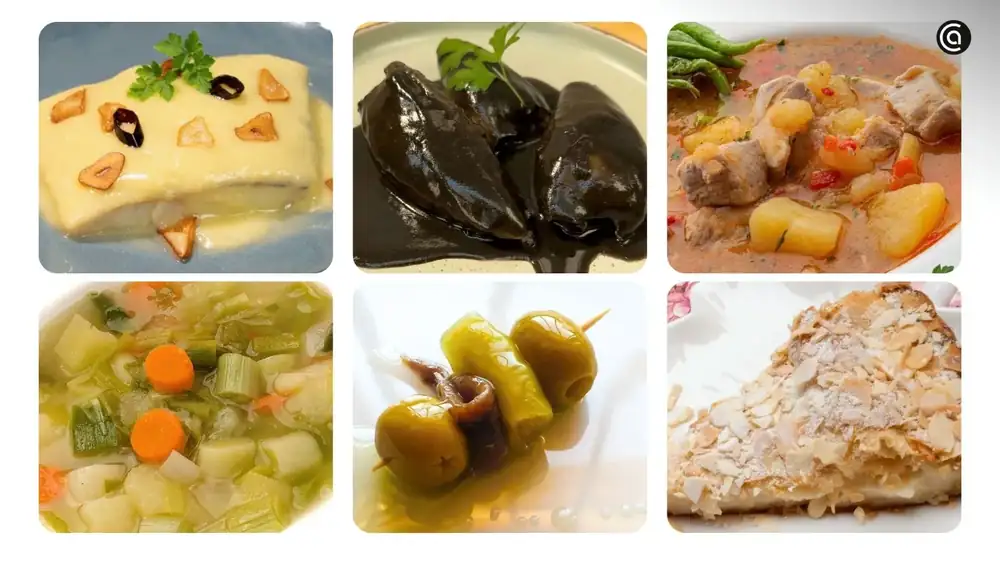
The famous pintxo of San Sebastián, the gilda is a banderilla prepared by threading anchovies, olives and piparras (guindillas) in vinegar.
Its origin dates back to the 1940s, at Casa Vallés, a bar in San Sebastián. The story goes that a customer at the time, Joaquín Aramburu, known as Txepetxa, skewered the three ingredients that the bar usually offered—piparras peppers, anchovies, and olives—on a toothpick.
Perfect as an appetizer, the gilda takes its name from the film Gilda (1946), starring Rita Hayworth. According to the most popular version, the pintxo, "green, salty and a little spicy", evoked the personality of Hayworth's character in the film.
Corn stalk
Corn tortillas (talos) are a popular dish at Basque markets and festivals. Typically filled with txistorra sausage, they are a type of corn flatbread, naturally gluten-free. Originally used as bread in farmhouses, they are now a star attraction at any traditional Basque celebration. Besides txistorra, they can be found with chorizo, cheese, bacon, or pork loin, and even with chocolate for those with a sweet tooth.
Bacalao al pil-pil
One of the most famous dishes in Basque cuisine, bacalao al pil-pil (cod in pil-pil sauce), is made with just four ingredients: cod, olive oil, garlic, and chili pepper. Thanks to its salting process, cod has fed generations for centuries.
Another famous dish in pil-pil style is kokotxas, the lower part of the chin of hake or cod.
Today, cod in pil-pil sauce can be prepared at home; the only thing needed for the pil-pil to set is to emulsify the sauce well. Here you can see how to make pil-pil sauce step by step.
Cod in Biscay style
Another classic way to prepare cod is bacalao a la vizcaína, served with a sauce made with choricero peppers and onions. Vizcaína sauce can also be used with meats and vegetables, as well as fish such as the aforementioned cod or hake.
Hake in green sauce
Hake is the undisputed star of restaurant menus. Known as merluza koskera or merluza a la vasca, hake in green sauce is prepared with spring onion, garlic, white wine, fresh parsley, and fish stock, and is usually served in an earthenware casserole dish.
Martín Berasategui reinterpreted this traditional recipe and created his hake kokotxas with clams, a dish that aligns with the New Basque Cuisine movement. Karlos Arguiñano, for his part, offers a quicker, more home-style version of hake kokotxas, which can be prepared in pil-pil sauce, green sauce, or breaded. The possibilities are endless!
Crab San Sebastian style
Txangurro a la donostiarra, a traditional dish from San Sebastián, is a spectacular seafood recipe. The txangurro, or spider crab, is emptied and its meat is used to prepare a sofrito. Then, the shell is stuffed, flambéed with brandy, and broiled.
Baby squid in its ink
So easily recognizable by its color, the dish of squid in its ink is prepared very simply, with a sofrito of vegetables, white wine and squid ink.
Baby squid can be prepared stuffed with vegetables, other seafood and fish, or with meat.
Sea bream in the Donostia style
Accompanied by a classic sofrito of oil, garlic, vinegar and chili pepper, the Donostia-style sea bream is a juicy dish and one of the main protagonists of Christmas celebrations.
Marmite
One of the most popular Basque stews, marmitako de bonito is a traditional dish made with potatoes and fish, very common among arrantzales (fishermen). The word marmitako comes from marmita, the pot in which sailors cooked on board, which literally means "from the marmitako."
Cod omelet
If you visit a Basque cider house, it's customary to start with a cod omelet as a starter. It's a simple recipe whose trick lies in keeping it juicy inside to prevent the cod from drying out.
Goat pudding
A recipe by Juan Mari Arzak, the scorpionfish pudding or pie is a perfect appetizer thanks to its smooth texture and flavor. Served with pink sauce, this dish, despite being a recent creation, has become a classic of Basque cuisine.
Tolosa beans
Legumes are important in a healthy and balanced diet, and one of the most delicious ways to prepare beans is with "sacramentos," the traditional accompaniment of cured meats and vegetables. Tolosa beans are a small, very dark, almost black, pinto bean variety, typically served with cabbage, bacon, and piparras peppers.
Porrusalda
Porrusalda, or leek soup, is a Basque classic and a typical Lenten dish. Perfect for cold days, this soup, made primarily with potatoes, leeks, and carrots, is as simple as it is delicious.
It is very common, to enrich the broth, to add pieces of desalted cod or chicken, according to the taste of each household.
Kitchen
After mentioning so many seafood dishes, sukalki is a traditional Basque beef stew, accompanied by potatoes and vegetables, a protein-rich dish with plenty of iron.
Sucked
Similar to traditional garlic soup, but with cod and stale bread, zurrukutuna is a perfect spoon dish for winter.
Born in the farmhouses as a recipe for making use of leftovers, zurrukutuna comes from zurrukutu or zurrupatu, which mean "to sip" in Basque.
Picnic table
Pantxineta is a traditional Basque pastry made with puff pastry, custard, and almonds. Typical of San Sebastián, it was created in 1915 at the Otaegui Pastry Shop, inspired by a French tart with similar ingredients, the frangipane.
Its origin dates back to a time of scarcity during the First World War, and today it is a gourmet sweet, partly due to the summer visits of Queen Maria Cristina to the Gipuzkoa capital, as the Otaegui Pastry Shop supplied sweets to the Royal Household of the time.
Pastry chefs recommend serving it warm, so that the puff pastry maintains its crisp texture and the cream inside retains its creaminess.
Walnut sauce
Walnut cream, or intxaursaltsa, is a Basque dessert typical of winter and a classic on Christmas tables. Its preparation is very simple, similar to that of custard. It also originated in Basque farmhouses, where it was traditionally enriched with hazelnuts or flaked cod, a high-protein option perfect for cold days.
Sweet
Goxua was created by Luis López de Sosoaga, a pastry chef from Vitoria, who was inspired by crema catalana to create his own Basque dessert. Goxua means "rich" or "sweet" in Basque, and it is presented in layers: whipped cream, rum-soaked sponge cake, and custard, topped with caramelized sugar.
Rice cake
Rice cake is a traditional sweet from Bilbao, which, contrary to what its name suggests, doesn't contain rice. Popular theories claim that the sweet originated in the Philippines, where it was made with rice flour, which was later replaced by wheat flour.
This cake is prepared with butter, puff pastry, milk, flour, sugar and egg.
Pastel vasco
The Basque pastry is a filled shortcrust pastry, perfect for any occasion. Traditionally, it is decorated with a lauburu, a symbol of Basque culture, and can be filled with black cherry jam, chocolate, or cream, the latter being the most popular version.