Why is it recommended to put vinegar in the pan when frying eggs, and what is its purpose?
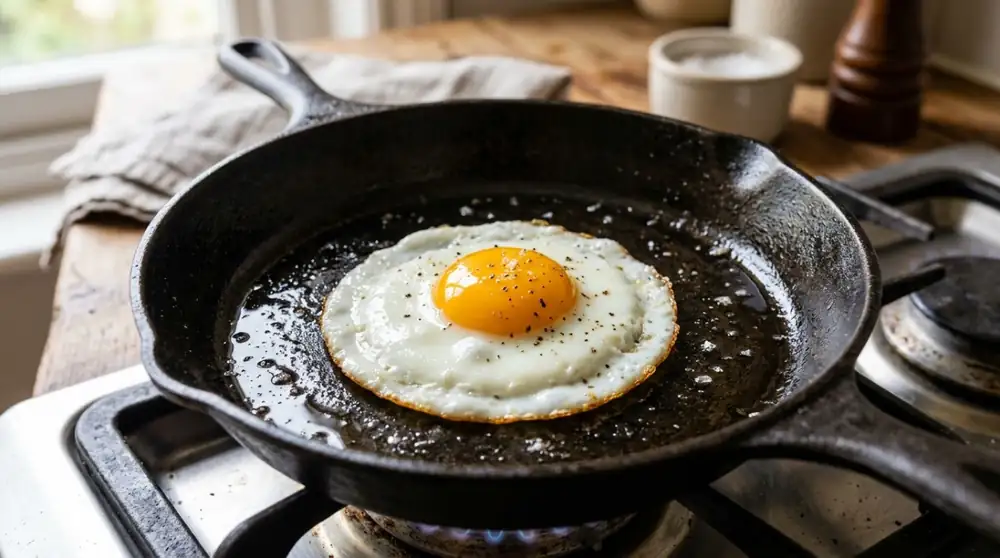
Adding a few drops of vinegar to the pan while the egg is cooking can primarily change the texture and shape of the egg white.
What happens when vinegar comes into contact with egg white?
Egg white is mainly composed of water and proteins. When heated, these proteins begin to denature and reorganize until they form the characteristic white and firm structure of a boiled egg. Acidity also favors this process. Therefore, a few drops of vinegar can help the egg white set more quickly and spread less across the pan.
It's the same principle used in preparing poached eggs, where vinegar is added to the water to promote a more cohesive egg white around the yolk. In a frying pan, the effect is applied to a different preparation, but it's still related to protein coagulation.
What changes occur in a fried egg?
According to Clarín, the technique is used to achieve an egg with a more defined shape and a more compact white. The quantity needs to be small, since the goal is not to season the egg with vinegar, but to take advantage of its acidity during cooking.
- The egg white tends to spread less across the surface;
- The edges can become more defined;
- The white part quickly sets around the yolk;
- A slight acidity can balance the greasy feel of the oil;
- The yolk can remain soft while the white finishes cooking.
How much vinegar should be put in the frying pan?
It's not necessary to pour in a large amount. The recommendation given in the publication varies between a few drops and, at most, about half a teaspoon. The vinegar should be added when the egg is already in the pan, so that it comes into contact mainly with the egg white. White vinegar, apple cider vinegar, or mild-flavored wine vinegar can be used.
Another important detail is to keep the heat medium. Excessively high temperatures can brown and harden the edges before the top of the egg white is fully cooked. To test the method for the first time, a few drops are enough. After that, the amount can be adjusted according to the desired result.
Does vinegar replace oil or prevent eggs from sticking?
No. The acid serves a different function than the fat used for frying. Oil, butter, or other fat creates a layer between the food and the surface of the pan and directly contributes to the texture and browning. Vinegar acts primarily on the proteins in the egg white. Therefore, the guidance indicates that it can be used along with oil, but not as a substitute.
To reduce sticking, it's also important to use a frying pan in good condition and control the temperature. Among the points that help with cooking are:
- Heat the pan before adding the egg;
- Use a small amount of fat suitable for the preparation;
- Crack the egg carefully to preserve the yolk;
- Add just a few drops of vinegar to the egg white;
- Cook over medium heat until it reaches the desired consistency.
Does vinegar leave a strong taste in eggs?
When used in just a few drops, the flavor tends to be subtle. The small amount can add only a mild acidic note and balance the perception of fat in the dish. However, an excessive amount can overpower the flavor, especially when using more intense or aromatic vinegars.
The trick makes more sense for those seeking a firm, well-defined egg white without overcooking the yolk. The explanation lies in the basic chemistry of proteins: heat and acidity favor changes in their structure, causing the egg white to transition from a liquid state to a solid network. Therefore, a few drops of vinegar can alter the finish of a fried egg, but they don't replace a good frying pan, the correct amount of fat, and heat control.