L'altro Laresei opens in Falcade: pizza and grilled meat at high altitude ~ Dolomiti Review
A new restaurant is opening next to the historic Rifugio Laresei, offering a distinctive menu of pizza and grilled meats. Massimo Manfroi and Mara Chenet's project focuses on sustainability, accessibility, and spaces that accommodate the growing tourism in the Dolomites.
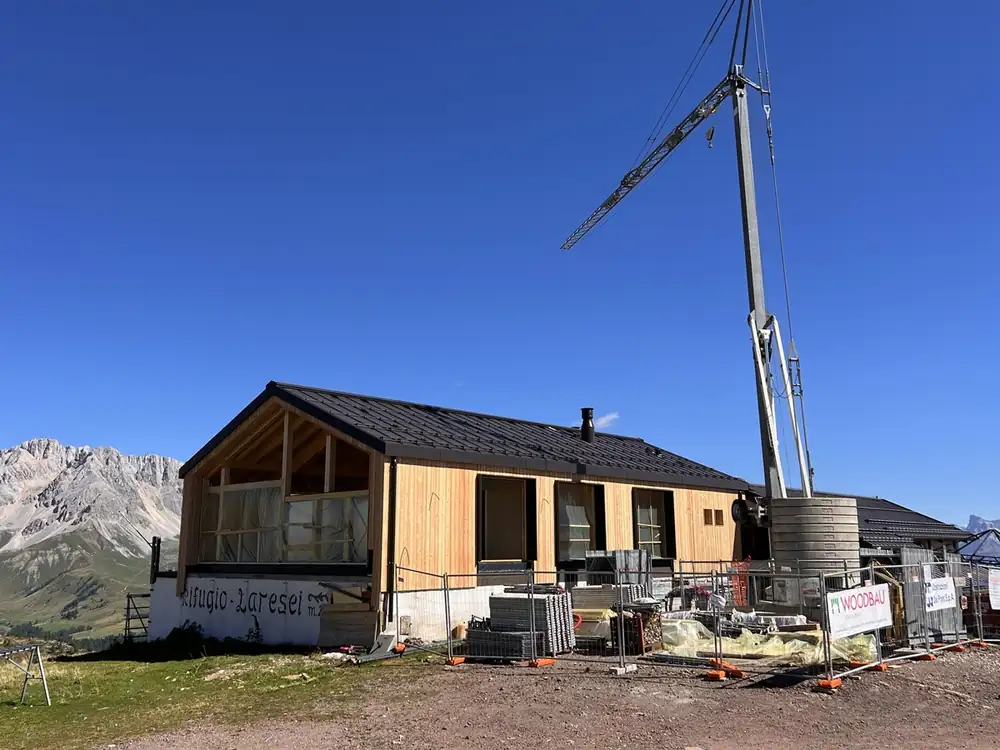
Overlooking the mountains of the San Pellegrino ski area, the Rifugio Laresei is preparing for a new chapter in its history. Massimo Manfroi and his wife Mara Chenet are completing L'altro Laresei, a new facility built next to the existing refuge, scheduled to open at the start of the winter season, approximately December 15, 2026.
It won't be a simple expansion, but a restaurant with its own identity and culinary offerings: on the one hand, the traditional Laresei cuisine will remain, on the other, pizza and grilled meat will find space.
From the cable car station to the refuge
The history of Laresei begins in the 1960s and 1970s, when the building served as the arrival station for the ski area's gondola lift. After the lift was dismantled, the space was converted into a refuge and warehouse, and was subsequently expanded several times to reflect the growth of high-altitude tourism.
A decisive step dates back to the late 1990s, when Massimo's aunt, Elena Mazzarol, wife of Antonio "Tony" Faè, carried out a major renovation. The furnishings from that period are still present, and Manfroi chose to preserve them.
"They've become a true refuge classic, and they're so unique that it wouldn't make sense to modify them even a little. I like them and want to keep them," she says.
Massimo Manfroi and Mara Chenet at Laresei since 2017
Massimo Manfroi and Mara Chenet, both originally from Cencenighe Agordino, took over the refuge in 2017 from their cousin Mirko, who had inherited it but, living in Milan and having other commitments, was unable to manage it directly.
"It was a whim, but it's what I've wanted since I was a kid. It wasn't easy, but we managed to buy everything, and it was a great satisfaction."
Manfroi had previously worked at Trattoria del Sole in Cencenighe, a very different experience from a refuge capable of handling significant workloads. His initial experience was therefore spent understanding the organization of the facility, managing the staff, and building a stable team.
"Over the years, we've managed to find great collaborators and build a relationship of mutual trust. We've refined the menu, added some special offerings, and begun organizing both winter and summer events, including weddings."
Why L'altro Laresei was born
The need for more space had already emerged several years ago. An initial response came with the closing and glazing of part of the outdoor area, initially conceived as a temporary solution but met with greater public success than expected.
The problem of available seats, however, remained, especially during the winter and on summer days when the weather changes rapidly.
"There weren't enough seats. In the summer, when you can use the outside, the situation is more manageable, but if it starts raining, everyone starts looking for a place inside. In the winter, demand is even higher, and we need to offer adequate services."
Hence the decision to build a second facility. The difficulties and time required to obtain permits allowed us to revise the project, improving it from an energy and environmental perspective.
A structure made of wood, glass and steel
The other Laresei was designed to reduce its impact on the mountain environment. The materials used are primarily wood, glass, and steel, while concrete was limited to essential parts, such as the foundations.
The goal is to create an energy-efficient structure and offer more indoor seating, while maintaining a visual connection with the landscape. For the winter opening, the focus is primarily on completing the upper floor, while some finishing touches and the final heating system will be completed the following spring.
The chosen name highlights the connection with the historic venue: the sign will feature “L'altro” in block letters and “Laresei” in italics, so that the original name remains immediately recognizable.
Two venues and two different gastronomic offerings
The project does not involve moving the existing kitchen to the new facility. Rifugio Laresei and L'altro Laresei will have two distinct offerings, designed for different audiences and needs.
The historic restaurant will continue to focus on classic mountain cuisine and local produce, with the intention of paying even more attention to the preparation and presentation of its dishes.
"Today, during peak times, we have to be very focused in the kitchen because the time to complete each dish must be minimal. With the new spaces, we hope to be able to move more agilely, always starting from tradition and the highest-quality raw materials."
Laresei will continue to offer dishes like goulash and venison stew, while the new restaurant will focus primarily on pizza and grilled meats. The menu will include select meats and appetizers like tartare, with a selection still being finalized.
Pizza also answers a specific demand from the international public. "Foreigners come to Italy and want to eat pizza. Every year someone asked me when we'd have it: finally I can say we have it now."
Keeping the two options separate will help prevent the new addition from detracting from the historic refuge. Customers will be directed to the most suitable venue: traditional cuisine at Laresei, pizza and grilled meat at L'altro Laresei.
Panoramic bathrooms for women and attention to accessibility
Among the new venue's highlights are the women's restrooms, which are larger, more refined, and offer a panoramic view compared to the current ones. This choice was made not only to reduce wait times during peak hours, but also to make the visit more pleasant for women who, on their way to the restrooms, enjoy stopping to chat with one another.
The waiting area will overlook one of the most panoramic spots in the Laresei area, transforming even a normally overlooked moment into an opportunity to admire the Dolomites. "We wanted to create a slightly larger and more welcoming space, where women can stay and chat as long as they want," explains Massimo Manfroi.
Men's facilities will also be expanded, and the facility will feature a wheelchair-accessible bathroom and a stairlift. A Braille menu for blind and visually impaired guests is also being developed.
Foreign tourists on the rise in the Dolomites
The decision to invest stems from a trend Manfroi has observed consistently since his arrival in 2017. Despite economic uncertainty, rising prices, and concerns about snow and climate change, visitor numbers continue to grow, both at the refuge and in the ski area.
"Every November, we hear about the crisis, costs, and lack of snow, but the trend continues to be positive. The Dolomites brand is now very strong worldwide, and here we meet Americans, Canadians, Dutch, and tourists from Northern and Eastern Europe."
According to Manfroi, the Italian public tends to stay for shorter periods, partly due to rising prices. These costs, he clarifies, aren't just a whim: preparing the slopes and supplying a mountain refuge are expensive, starting with fuel and the transportation of raw materials.
The origins of foreign guests have also changed. While in the past they were primarily Germans and Northern Europeans, today the audience is much broader and includes numerous visitors from North America and a growing presence from Eastern Europe.
Summer and winter, two different ways to experience the mountains
Tourist behavior changes with the seasons. In summer, guests are predominantly interested in the more natural and wild side of the mountains, hiking, and outdoor experiences. In winter, however, skiing is more closely associated with the desire to eat and drink well during their vacation.
Summer tourism has also grown, but remains highly concentrated. August sees significant peaks, while June and September still have significant room for growth.
"June could see three times as much work, and September could also deliver much more. The problem is the weather: at the end of the season, on a nice day, 300 people can arrive, while on a rainy day, only three arrive. Keeping the entire machine and staff operational becomes complicated."
Events and initiatives could help extend the season, while still taking into account the need to close the refuge to prepare for winter activities.
The mountain as a refuge from the heat
Among the reasons for the summer growth is the search for more pleasant temperatures. The effects of warming are also felt at high altitudes, but the difference compared to cities and the plains remains clear.
"Customers coming from Belluno, Treviso, Milan, Bologna, or Rome tell us that the heat has become difficult to tolerate in the plains. When they come up, they say it's easier to breathe and feel good here."
Massimo Manfroi and Mara Chenet have decided to invest in this evolution of tourism. The other Laresei was thus created to welcome more people and expand the offerings, while preserving the character of the historic refuge: two distinct souls, united by the same panoramic view of the Dolomites.