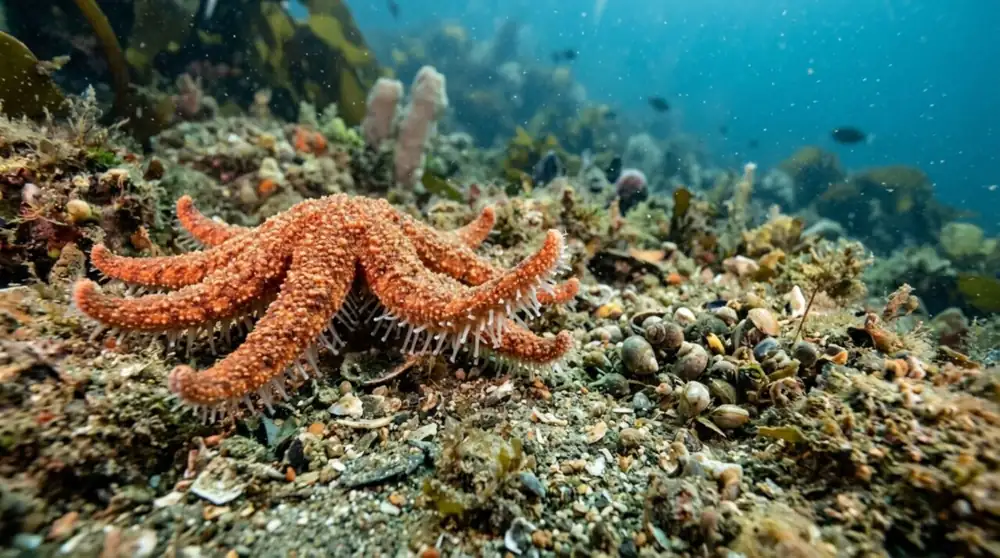
A deep-sea starfish doesn't wait for food to fall and is able to chase small animals using thousands of hydraulic feet like legs
Hundreds or thousands of appendages powered by a hydraulic system allow starfish to search for, reach, and capture prey.
- TO SHARE
At the bottom of the ocean, a starfish may appear virtually motionless while life passes by. This impression is deceiving. Hundreds or even thousands of tubular feet transform some starfish into active predators, capable of traversing the substrate, detecting chemical signals of food, and reaching small animals using a hydraulic system distributed throughout the underside of their arms.
How do tubular feet enable a starfish to walk?
On the underside of the arms are rows of small appendages called podia. Each is connected to an internal ampulla and to the water vascular system, a network of fluid-filled channels that allows control of the extension and retraction of these appendages.
When the ampulla contracts, the fluid helps extend the foot. After contact with the substrate, muscles shorten the structure and contribute to pulling the animal. Repeated by hundreds of individuals, this mechanism produces coordinated locomotion even without articulated legs like those of a crustacean.
Why doesn't this animal need to wait for food to fall from the surface?
Although organic matter that sinks from the upper layers is important in deep-sea ecosystems, starfish are not necessarily passive consumers of this material. Many species of Asteroidea are predators and may seek out mollusks, crustaceans, other echinoderms, and various invertebrates on the seabed.
Movement allows signals left by prey to be transformed into directed movement. In experimentally studied species, chemical stimuli associated with food can trigger acceleration and even a change of gait, showing that a slow appearance does not mean an absence of pursuit behavior.
- They detect chemical signals present in the water;
- They direct their arms towards the stimulus;
- They extend their pods over the substrate;
- They coordinate numerous support points;
- They bring their bodies close to their prey to begin feeding.
This Deep Look video shows in detail starfish accelerating hundreds of feet, propelled by their hydraulic system.
How do tubular feet manage to work together without a central brain?
Starfish do not possess a centralized brain comparable to that of vertebrates. Their nervous system includes a nerve ring around the central region and radial nerves that run through the arms. Much of their coordination arises from local interactions between the pods themselves.
Biomechanical experiments indicate that each unit responds to the environment and the forces produced by neighboring units. When many tubular feet begin to act in a compatible manner, the entire body follows the same direction. In some species, this coordination even produces a movement similar to small jumps or a "gallop".
Can starfish really sense where their prey is?
Podia are not only used for propelling the body. They also participate in the perception of chemical substances, contact, and other environmental information. More delicate structures near the tips of the arms may play a particularly important role in exploring the surrounding space.
The KQED Deep Look scientific report explains how these units function simultaneously as sensors and actuators. This allows the animal to search for food without relying on a single brain center individually controlling hundreds of movements.
How many tubular feet can a starfish use while hunting?
The number varies considerably between species, size, and number of arms. Some starfish have hundreds, while others may have thousands distributed along the tube bones. Not all of them need to perform exactly the same movement simultaneously to move the animal.
The system also changes depending on the substrate. Some podia have efficient adhesive structures on firm surfaces, while species adapted to sand or mud exhibit different forms. Therefore, speaking of "hydraulic legs" is a functional comparison; it does not mean they are true legs.
Why do the tubular feet make this predator so different?
The strategy shows that a predator doesn't need muscles concentrated in four legs, a quick jaw, or a centralized brain to pursue food. The starfish distributes movement and perception across hundreds of small units capable of reacting locally.
This architecture functions from the coastline to the great depths and helps explain the evolutionary success of echinoderms on the seabed. A body that appears immobile may, in reality, be constantly probing its environment and preparing hundreds of small hydraulic appendages to pounce on its next prey.