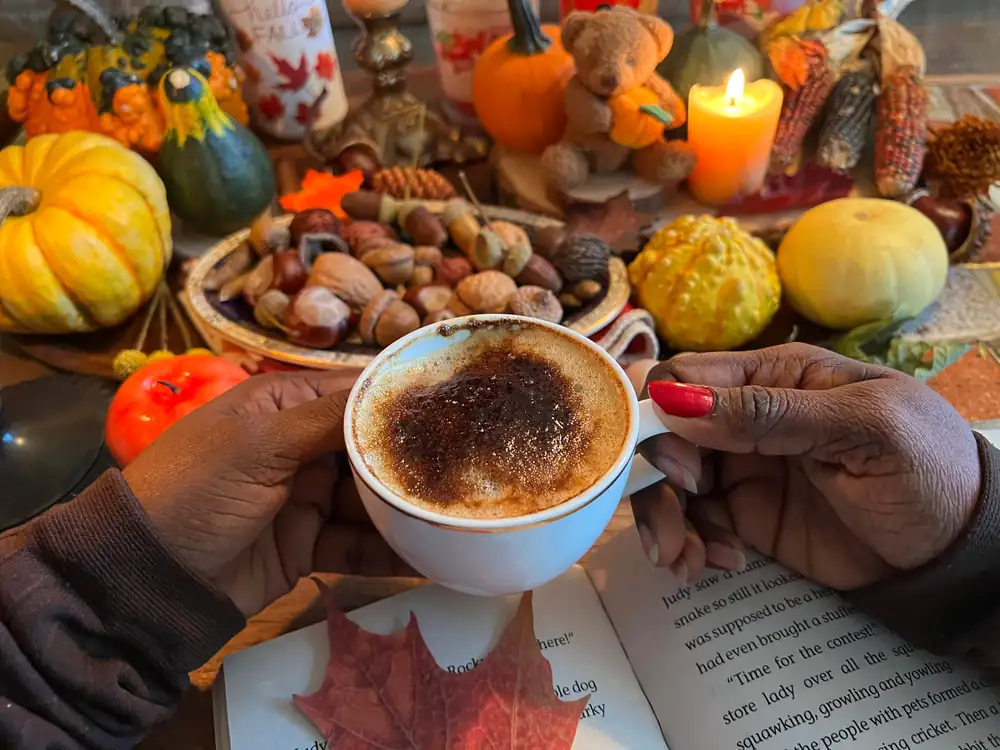
Do you feel like pumpkin spice latte belongs to autumn? That is certainly no coincidence
Pumpkin spice latte with cinnamon, cardamom, and a whole host of other spices: they belong to autumn just as much as falling leaves, rain, and storms, right?
First of all: when I’ve had to slog through wind and rain in the autumn and am finally inside, I certainly don’t say no to a hot cup of coffee or tea with a piece of spiced biscuit. Cinnamon and cardamom are definitely allowed in there. But also anise, ginger, or nutmeg. You could say everything the VOC raided for centuries ago. I love those 'autumn flavours'.
I am not the only one. Laurie Gilmore's book The Pumpkin Spice Café didn't become a bestseller for nothing, for example. But that swoon-worthy book is a trend follower, because the link between autumn and those spices has been around for a while. This was deliberately worked on, says culinary historian Christanne Muusers: 'It is a trend that has been stimulated by producers and imported from America.'
The trendsetter: Starbucks' marketing machine
Coffee chain Starbucks makes no secret of the fact that they launched their bestseller pumpkin spice latte purely as a commercial product. According to their own website, their laboratory began experimenting with autumn flavors in 2003, and espresso, whipped cream, nutmeg, cloves, and cinnamon turned out to go very well together.
That was not entirely a coincidence, because according to American culinary historians, you could already find similar drinks in small coffee shops before that. Even 'cornflake girl' Tori Amos is said to have beaten Starbucks to it. As early as 1995, the singer reportedly spoke about a coffee variant she had invented herself at a concert.
Thanks in part to effective marketing, the 'PSL' became a hit. Starbucks claims it is their best-selling drink in the fall, with over 200 million cups reportedly sold in the first ten years. Since then, smart companies have started riding this trend with their own drinks, baked goods, and even scented sticks. The rest is history.
What does that pumpkin have to do with it, then?
The pumpkin itself is NOT part of the spices in a pumpkin spice latte. So why are they called pumpkin spices anyway? Simple: just like shawarma spices or chicken seasoning, they are flavorings that pair very well with a specific dish or product. In this case, pumpkin.
To me, pumpkin is a savory ingredient that I occasionally incorporate into dinner. But Americans know it as the namesake of pumpkin pie: a type of tart in which pumpkin is mixed with sugar and eggs. The pastry is flavored with the spices we now know from the pumpkin spice latte.
And why specifically in the fall? American pumpkins are harvested in the autumn. That is why you see them a lot around Halloween, and why autumn is the season when American housewives used to bake pumpkin pies en masse. After all, you have to do something with all those enormous fruits.
Incidentally, since 2015, the Seattle coffee company has also been adding a little bit of pumpkin puree to the pumpkin spice latte: customers apparently found it misleading that the name of their favorite drink mentioned pumpkin, but that this was not listed on the ingredients list.
The scent and taste of coziness
Americans put autumnal spices in their pumpkin pie, but of course, we can do the same. Our speculaas and our gingerbread and spiced cakes in all their varieties are also full of them. And if I want to bake myself, I can easily find a jar of 'speculaas spices' in the supermarket. Almost the same as pumpkin spice.
I usually eat all that sweetness with great pleasure. I feast on Saint Martin's Day, Sinterklaas, Christmas—in short, whenever there is something to celebrate.
I started actively associating the treats with those fun moments. As a result, a kind of vicious circle has formed: I associate the holidays with delicious sweets made with those autumnal flavors, and because of that, I in turn associate those autumnal flavors with the fall holidays. Tadaa: the autumnal flavors have firmly anchored themselves in my brain. And not just in mine.
Some spices 'belong' to colder seasons
However, it is certainly no coincidence that spices like cinnamon and anise are found in all those baked goods. Culinary historian Muusers knows that for a very long time, we have particularly craved such flavorings during the colder months. Not so much because we like the taste, but because we used to think it was healthy.
'That goes all the way back to classical antiquity and the Middle Ages. People followed the so-called humoral theory back then.' This theory posited that there were four elementary humors in our bodies: blood, phlegm, black bile, and yellow bile. The ratio of these humors was believed to determine our mood and character.
For example, if someone had a lot of black bile (melaina cholè in Greek), then they were melancholic, which we now use to describe someone who is wistful. If you had a lot of phlegm (phlegma), then you were phlegmatic, or calm and quiet.
A healthy body is a body in balance.
Moreover, those juices had a combination of qualities: cold or hot, and dry or wet. And you had to create the right combination, says Muusers: 'According to the theory of humors, a healthy person had a certain balance. If that balance was lost, you could restore it by replenishing any deficiencies.'
Not by drinking blood, mucus, or bile yourself, but by consuming ingredients that would have the desired effect.
And here's the kicker: 'In humoral theory, cinnamon and anise are hot and dry,' explains Muusers. 'That's why people found them useful during the cold, wet seasons.' With those hot, dry spices, you could bring your body, which was too cold and too damp, back into balance.
Spices went from savory to sweet
Did people used to sit and eat gingerbread all winter long? Absolutely not, says Muusers: 'In the Middle Ages, cinnamon, but also ginger for example, were frequently added to meat dishes. Later, such spices were largely banished from our savory cuisine, which is why we now mainly associate them with sweet dishes.'
You don't eat those every day in the Netherlands, but you do eat them extra often during the holidays. And now we are stuck with the idea that 'hot, dry' spices belong to autumn. So all those pumpkin spice lattes, speculaas cookies, and other 'autumn treats' are the result of centuries-old quackery, psychological processes, and money-hungry coffee sellers from Seattle.