Perfect Roasted Chestnuts: Technique, Timing, and Tricks for Softening and Peeling Them
The reason is simple: they allow you to prepare tender, easy-to-peel roasted chestnuts even without a fireplace, perforated pan, or open fire.
Roasting chestnuts over the fire has a charm all its own. There's the holed pan, the open flame, the aroma wafting out onto the street, and that blackened skin that leaves your fingers dirty. Baking chestnuts in the oven, however, can come very close to that result, especially if the chestnuts are arranged carefully on the baking sheet and monitored throughout the cooking process. The heat is different: on the embers, it's more direct and uneven; in a home oven, it's more stable and evenly distributed.
The oven, for its part, offers a practical advantage: it's easier to control. You can set the temperature, avoid flare-ups, and cook several autumn chestnuts at once, perhaps on a baking sheet lined with parchment paper. The flavor will be less smoky than with traditional cooking, that's true. But the flesh can remain soft, just the right amount of dry, and easy to peel from the skin. In the kitchen, this compromise often works.
Chestnuts are also a rich source of nutrients: they contain complex carbohydrates, fiber, minerals like phosphorus and iron, as well as B vitamins. For this very reason, it's best not to overdo them, especially for those who need to watch their calories or have sensitive digestion. A few, well-cooked, and delicious: this remains the most sensible rule.
Soaking, drying, and scoring: the steps to avoid hard or burst chestnuts
To obtain tender baked chestnuts, many people start by soaking them. They're soaked in cold water for about two hours, which softens the skin and makes them cook more evenly. Some people prefer to skip this step and simply let them air dry, as too much moisture can affect the final texture. In any case, one thing remains the same: chestnuts must be thoroughly dry before baking.
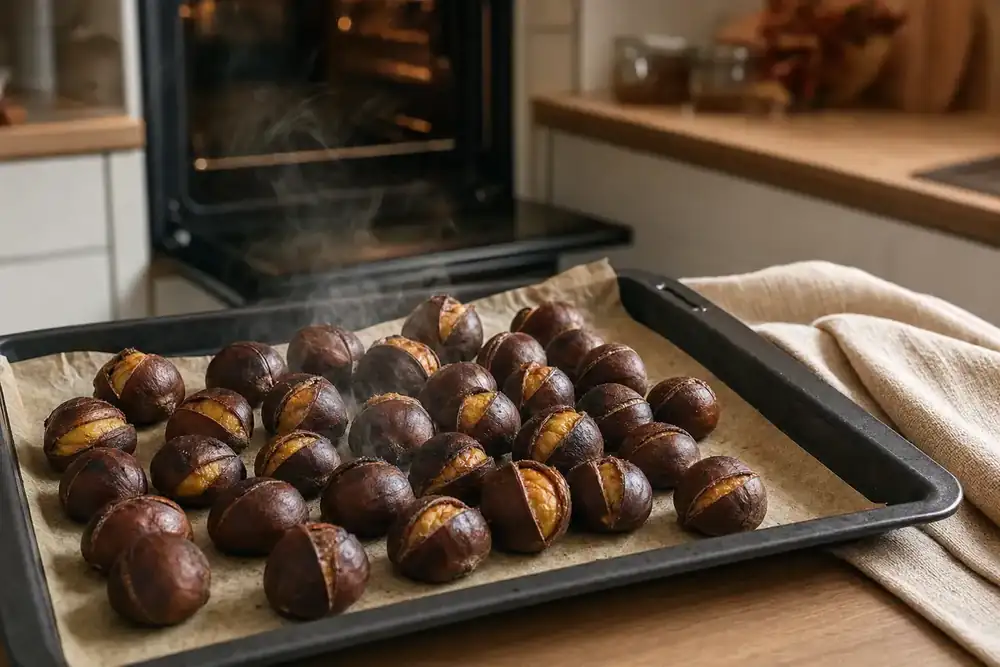
Then comes the crucial step: carving the chestnuts. Using a sharp knife, make a horizontal cut on the rounded part, or at least on the widest side, without cutting too deeply into the flesh. This helps release steam while they're cooking and prevents them from exploding in the oven. It happens more often than you might think, and that sharp thump on the baking sheet is never a good sign.
After cutting, the chestnuts should be arranged in a single layer, without crowding them. If there are many, it's best to use two baking sheets or bake several times. Hot air must circulate well between each nut; otherwise, some will remain hard and others will burn at the edges. A simple trick helps a lot: arrange them cut-side up, so the skins open better.
Cooking temperature and times: how to adjust them based on the size of the chestnuts
To roast chestnuts properly, the oven must be preheated and set to a high temperature: usually, starting at 220 degrees Celsius. Small chestnuts can be ready in about 20 minutes, medium-sized ones often take 25 minutes, while larger ones can take up to 30-35 minutes. There's no one-size-fits-all time: variety, freshness, and the amount placed on the baking sheet are key.
Visual inspection remains the most reliable method. Chestnuts are ready when the skin turns brown, lifts slightly where you scored them, and the insides are visible. Halfway through cooking, you can move them with a wooden spoon, without constantly turning them. However, if the smell becomes acrid or the skin blackens too quickly, it's best to lower the heat slightly or move the pan to a less exposed shelf.
Using a convection oven can shorten cooking times by a few minutes, but you need to pay more attention towards the end. Convection heat dries out more, so it's best not to overcook. A well-cooked chestnut peels easily, has firm flesh, and doesn't crumble as soon as you open it. That's when you know everything went well.
Resting in the cloth, preservation and sweet ideas with leftover chestnuts
Hot chestnuts shouldn't be brought straight to the table right out of the oven. The trick is to wrap them in a clean, dry cloth, preferably a thick one, for a few minutes. The heat stays inside, the skin softens a little further, and peeling becomes much easier. It's an ancient home cooking technique, but it still works.
If you have any leftover baked chestnuts, let them cool and, when possible, peel them before storing. As time passes, the inner skin sticks more tightly to the flesh, making removing it more difficult. They can be stored in a sealed container or a resealable bag and consumed within a few days. Avoid sudden changes in temperature and humidity, so the flavor remains purer.
Leftover chestnuts can also be used in a simple dessert. In a pan, with a little brown sugar, they caramelize in a few minutes; if you like, you can add a splash of Cognac, letting the alcohol evaporate thoroughly before serving. Or you can thread them onto wooden sticks, like small sweet skewers, and let them rest on parchment paper. Not much else is needed: when chestnuts are good, autumn already does half the work.