Challah: traditional recipe for the braided Jewish bread essential on Shabbat and other religious holidays
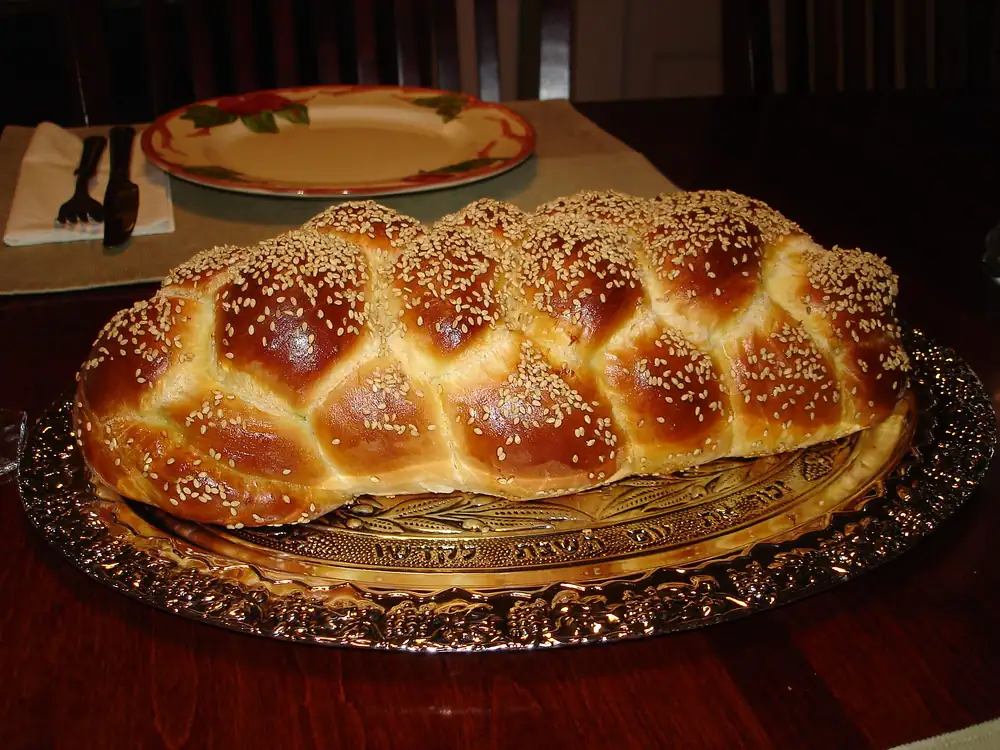
This colorful braided bread is a festive bread typical of Jewish cuisine, inherited from European tradition where it is very common on special occasions.
There it is known as Challah, the transliteration to Hebrew of English, while "jalá" is the phonetic adaptation to Spanish.
In the United States, it has crossed the boundaries of Judaism to sneak into the ovens of baking enthusiasts, and it's easy to guess why.
It looks beautiful on the table and is a real treat for lovers of rich pastries, with its lovely golden crust and soft, aromatic, and fluffy crumb. Anyone who watches American TV series or movies has surely seen it on screen countless times.
Since it's an enriched, moist bread dough, we can't claim it's easy, although it's not much more complicated than making a King Cake. Using a stand mixer makes the process much simpler, as the key is developing the gluten well without adding much more flour. Then you just need to be skillful in shaping the braid and hope it doesn't fall apart during baking.
In the bowl of a stand mixer or a large bowl, combine the flour, yeast, salt, and sugar. Separately, lightly beat the eggs with the yolks, oil, and 200 ml of water. Add this mixture to the main mixture and combine until well blended. Add more water if the dough is dry; it should be quite moist and soft.
Knead on a lightly floured surface or with a stand mixer at low speed for about 10-15 minutes. If the dough is too sticky, let it rest covered for 20-30 minutes and continue kneading until it pulls away from the sides of the bowl or the dough hook and is very elastic. Avoid adding too much flour if you want a soft loaf that lasts longer.
Form a ball, grease a large clean container with oil, place the dough inside, roll it into a ball to grease it well, cover with plastic wrap or a shower cap and let it rise for an hour.
Then degas on the oiled table, knead to remove the air, form a ball again and return to the bowl, letting it rise until it more than doubles its original size.
You can make one large braid or two small ones, and the first can be a simple three-strand braid, a four- or five-strand braid (if you have more experience), or, as in our case, a two-tiered braid. For simple braids, just weigh the dough and divide it into equal portions.
For the special party braid, first divide the dough into three equal pieces and then join two of them together. Then divide each portion into three equal pieces, so that you get three identical large pieces and three identical smaller pieces.
Line a large baking tray with parchment paper. Shape each portion into a ball, using a greased work surface and hands if necessary. Roll out the larger portions into equal strips and braid them together, sealing the ends well; place them on the tray, diagonally if needed (they will expand).
Repeat with the other small portions, forming a smaller braid, and place it directly on top of the other. Brush with the remaining beaten egg, grease a large sheet of plastic wrap, cover loosely, and let rise until more than doubled in size.
Preheat the oven to 160°C (325°F). Carefully remove the cling film, brush again with egg wash, and sprinkle with seeds as desired. Bake for 20 minutes, then rotate the tray 180° and continue baking for another 20-25 minutes. If it starts to brown too much towards the end, cover with aluminum foil. Cool completely on a wire rack.
What to serve with challah bread
Challah is perfect for festive family lunches and dinners, but it's also ideal for breakfast and afternoon tea. Its tender crumb and just-sweet flavor make it a perfect complement to all sorts of ingredients, and it's absolutely delicious spread with butter, jam, cream cheese, or honey. It keeps well for two or three days if wrapped in plastic wrap or beeswax paper, although if you're not going to eat it right away, you can slice it and freeze it. It's also perfect for toast or for making French toast, French toast, or a bread pudding.