“The recovery of Moroccan avocados depends on discipline at the start of the season.”
The 2026/27 winter avocado season could bring an unusual supply balance to Europe, as Chile, Morocco, Israel, Colombia, and Spain are all positioned to achieve significant Hass export volumes during the peak winter window.
An orderly market will be essential this season. "Between weeks 40 and 12, combined shipments from these five origins could reach approximately 500 million kg, equivalent to an average of about 5 million 4 kg boxes per week over 25 weeks," says De Oza. "The European market has demonstrated the capacity to absorb volumes of this level relatively smoothly, although actual weekly prices will continue to depend on the origin, size, quality, availability, and timing of the fruit's arrival. Therefore, an orderly market will be crucial throughout the winter."
Unlike the summer period, when Peru dominates the supply to Europe between May and September, the winter market is divided among these five major origins, De Oza points out. "The main challenge will be to avoid excessive overlap between the respective production peaks of each origin."
Latin American origins will lead the start of the campaign. According to the exporter, Chile and Colombia are best positioned at the beginning of the campaign, especially between weeks 40 and 45, when Peruvian volumes begin to decline and before Israel and Morocco enter their main sales windows. "Chile anticipates a record production of around 280,000 tons, compared to approximately 260,000 tons last season. It is estimated that around 100,000 tons will be destined for Europe. Heavy rains have generated some concern in the producing areas where significant water accumulation has been recorded, while the expected size profile is mainly concentrated between sizes 18 and 22."
Colombia has not yet published official production figures, he adds, although current forecasts point to an increase of around 25% compared to the previous season. "The main challenge for Colombia could be the size distribution, with a harvest expected to be more concentrated in medium and small sizes, especially between sizes 24 and 28, although sizes between 20 and 32 are generally expected. Quality could also be more heterogeneous, with more advanced dry matter in some areas due to weather conditions, which could bring forward part of the peak production."
De Oza also points to currency pressure on Colombian exporters as a factor likely to influence the campaign. "The sharp appreciation of the Colombian peso is increasing pressure on exporters' margins. After several years of rising production and labor costs, exporters now face even higher domestic costs, while receiving fewer pesos for each euro or dollar generated from exports. This could affect both profitability and business decisions regarding destination markets."
"Historically, Colombia has maintained a balance of approximately 45-55% between its main flowering cycle, which generally runs from October to February, and its secondary flowering harvest, between May and August," it continues. "However, this year the secondary flowering harvest has been particularly limited. A weaker secondary flowering is usually followed by a more intense main flowering, although official production figures have not yet been published."
Israel faces a very strong production campaign. Israel is also heading for a particularly good production year, notes De Oza, citing Shahar Goldberg, chairman of the Avocado Desk of the Plant Production and Marketing Board, who has indicated a record avocado production of around 300,000 tons, compared to approximately 240,000 tons last season. "Hass is expected to account for around 65% of production, while green-skinned varieties, such as Pinkerton, make up approximately 35% and continue to generate interest in several European markets."
“Israel traditionally ships its main volumes between weeks 51 and 12, which could create a significant trading window for Moroccan exporters between approximately weeks 45 and 51,” explains De Oza. “In a typical year, Israel usually exports between 125,000 and 135,000 tons of Hass and green-skinned avocados combined. This season, total exports could reach around 165,000 tons, of which approximately 100,000 tons could be Hass.”
He adds: "Traditionally, between 45% and 50% of Israeli exports go to France. One of the key questions this season will therefore be whether the additional Israeli volume will continue to be concentrated in the French market or whether a larger portion will be directed towards markets such as Germany and Italy, where green-skinned varieties and large sizes are also well received."
Moroccan exporters have a decisive advantage... Speaking about Morocco, De Oza describes a robust harvest in terms of volume, quality, and size distribution, with a wide range expected primarily between sizes 14 and 22. "This size distribution could prove particularly advantageous this season. The availability of sizes 14 and 16 appears more limited in several competing origins, which could create especially favorable opportunities for Moroccan fruit in these larger sizes. At the same time, for the mid-sizes, between 18 and 22, sales programs will need to be managed with discipline to maintain a balanced flow of trade throughout the season."
The timing of market entry will be equally important, he emphasizes. "Last season, Morocco exported relatively limited volumes during the first part of its traditional trading window, between weeks 45 and 51. This year, that period could become particularly relevant. Israeli arrivals are expected to increase from the end of December, while Colombia could bring forward part of its peak, and Spain anticipates increasing its main shipments from January onward, with its peak volumes potentially lasting through February, March, and even April. If these forecasts materialize, January and, especially, February could see considerably more overlap among the main winter origins."
But it's up to them to capitalize on it. "For Moroccan exporters, maintaining a steady sales pace from the start of the season could be more important than trying to concentrate volumes at the end," De Oza advises. "Securing sales programs from the outset, especially for sizes 18 to 22, can help maintain sales continuity and, at the same time, take advantage of Morocco's stronger position in the larger sizes. The recovery of the Moroccan avocado market, therefore, depends on discipline at the beginning of the season."
Taking stock of the outlook, De Oza states that the 2026/27 European winter campaign could ultimately be defined less by total availability than by the timing of that availability. "With Chile, Colombia, Morocco, Israel, and Spain poised to play a significant role during the winter period, disciplined harvesting, adherence to program commitments, and careful management of weekly supply will be crucial."
"Morocco faces the season with a potentially attractive combination of volume, quality, size distribution, and a significant sales window at the start of winter. Making the most of this opportunity will depend on maintaining a steady sales pace from the beginning of the season and avoiding excessive concentration of volumes during the most competitive period of January and February."
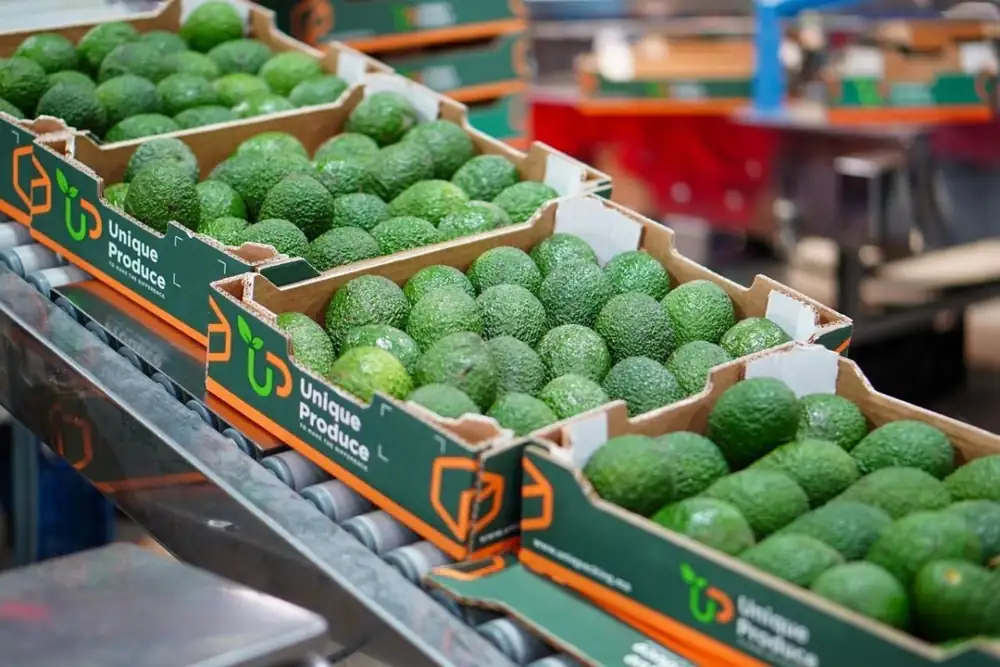
De Oza also highlights a milestone for his own company this season: the opening of Unique Group's new avocado packing facility. "The new packing warehouse will bolster our capacity by up to 70 additional trucks per week and, together with the group's existing packing facility, will significantly increase our total handling capacity. This additional infrastructure will position Unique Group among the largest exporters of avocados from Morocco, while also providing us with greater flexibility to manage larger programs and weekly volumes throughout the season."
Unique Packing will be present at Fruit Attraction, Hall 10B, Stand 17A.