Matcha is everywhere
Estimated reading time: 9 minutes
“They make matcha easy for beginners to approach. Once consumers get used to the base flavour, they naturally start looking for better options.”
Key takeaways
- Global demand for matcha creates opportunity for Japan, but the boom is confusing producers.
- Converting to tencha production is putting pressure on Japan’s tea sector.
- Costly field conversions carry real risk if demand or prices soften.
- The global matcha market is segmenting into premium Japanese products and lower-priced alternative origins.
Matcha’s rise from ceremonial tea to a global café staple has generated plenty of debate in Western markets, yet far less attention has been paid to how Japan itself views the shift. The outside narrative tends to frame the boom as a contest between dilution and authenticity.
But the view from inside Japan is more complicated, shaped by economics, generational succession, and cultural pride. Farmers, tea masters, and sourcing specialists have watched commercialisation transform an industry once defined by scarcity and slowness.
The numbers explain the urgency. Japan exported 5,092 tonnes of matcha in 2024, an 18.7% increase on the previous year, with export value reaching roughly US$185m, up 25.9%.
Additionally, the US, Germany, Malaysia, Thailand, and Taiwan together account for about 65.7% of total exports. Global demand for matcha is no longer a niche phenomenon; it has become the Japanese tea industry’s centre of gravity. But rather than being a simple success story, it represents a major structural transition, one that brings significant opportunity as well as uncertainty.
You may also like our article on the problem with matcha.
From ceremonial bowl to iced latte: Matcha goes mainstream
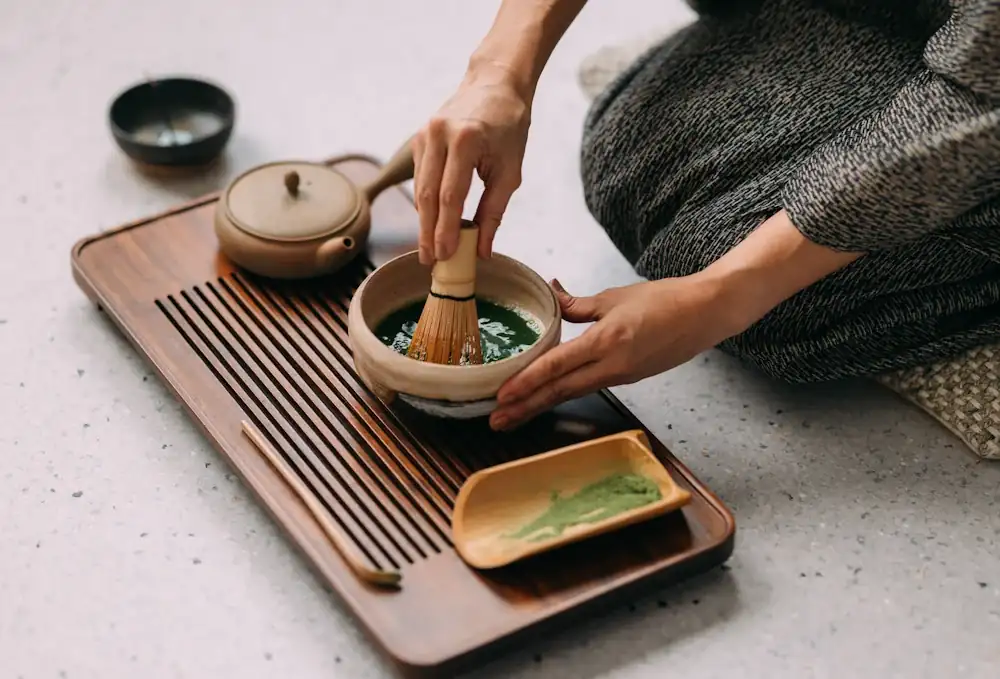
Matcha was once reserved for traditional tea ceremonies, whisked mindfully by hand. Today it appears in iced lattes, soft serve, and social media feeds worldwide, driven as much by aesthetics and customisation as by flavour.
Critics argue this strips matcha of its cultural identity, since the tea was never meant to be rushed or blended with sugar and milk. Koki Sato is an independent matcha supply chain partner. He works with more than 50 Japanese tea farmers, tea manufacturing companies, and tea factories, as well as clients in more than ten countries, including café brands, hospitality entrepreneurs, and food manufacturers, to create bespoke matcha products.
He sees a different dynamic at play: the sweetened latte is an entry rather than an endpoint. “Pre-batched drinks and sweet, heavily flavoured matcha lattes are great gateway products,” he says. “They make matcha easy for beginners to approach. Once consumers get used to the base flavour, they naturally start looking for better options.”
The parallel with specialty coffee is hard to miss. Coffee moved from pre-ground products to sugary second-wave drinks before arriving at today’s third wave culture, where consumers value terroir, processing, and varieties.
Koki expects matcha to follow the same trajectory, compressed into a much shorter window.
The economics behind matcha shortages
The matcha supply side tells its own story, and it’s one of structural constraint rather than temporary disruption.
Unusually warm, dry weather cut Japan’s spring tencha production (raw, unground tea leaves used for matcha) by an estimated 25% in some regions. Processing capacity adds a second bottleneck: even a fully staffed granite mill grinds only 30 to 40g of matcha per hour.
The price response has been dramatic. First flush tencha prices in Kyoto rose from JPY 5,500/kg in 2024 to JPY 14,333/kg in 2025.
The gap between an 18.7% rise in export volume and a 161% rise in raw material prices reveals how inelastic supply really is. Tea fields take years to mature, shading infrastructure is expensive, and milling capacity can’t scale quickly.
Producers in Shizuoka and Kagoshima are converting sencha fields into tencha fields, a shift that can require shading infrastructure, new processing equipment, factory changes, and production decisions. Many of these investments respond to today’s unusually strong demand and pricing environment, yet there is significant uncertainty within the industry about whether current demand growth and price levels will hold over the longer term. For producers, the boom creates opportunity and risk in equal measure.
The conversion wave is also reshaping the wider Japanese tea sector. As fields, raw leaf, and processing capacity move towards tencha, the economics of sencha production are shifting too.
In several producing regions, rising raw-leaf and aracha prices are creating pressure further down the domestic supply chain. The matcha boom isn’t simply expanding one category; it’s changing production decisions and resource allocation across the industry, with real trade-offs for other parts of Japan’s domestic tea business.
Impact beyond Japan
Scarcity has also pulled producers outside Japan into the market.
As Japanese matcha prices rise and supply remains constrained, some price-sensitive overseas buyers and foodservice operators are increasingly considering products from other origins. At the same time, Koki argues that scarcity may sharpen the distinction between mass-market and premium Japanese matcha. Both dynamics can occur simultaneously: high prices may reinforce the premium positioning of high-quality Japanese matcha while encouraging some volume buyers to look elsewhere.
“It’s actually helping to create a very clear difference between culinary grades and premium ceremonial grades,” he says. “The market is currently seeing a large influx of lower-priced matcha products, with significant variation in shading practices, harvest timing, raw material quality, and processing methods. As consumers become more familiar with matcha, they are also becoming better able to recognise these differences in quality.”
Reviving Japan’s tea sector? Brands like Blank Street have made matcha more visible than ever, but global supply chain volumes leave little room for the slow, deliberate ritual on which the tea was built.
Pre-batched matcha, mixed in bulk and dispensed on demand, sits at the opposite end of the spectrum from tea sieved and whisked by hand within a framework of harmony and respect. The domestic context, however, changes the calculation.
Japan’s tea market has been shrinking for years as consumers choose bottled tea over loose leaf, and the industry faces a deeper structural problem. “The reality is that Japanese tea farmers face severe ageing and a lack of successors, similar to the global agricultural sector,” Koki says. “Consequently, many tea fields are being abandoned.” Many therefore believe the export boom arrived at a critical moment.
Global demand is creating important economic opportunities for parts of Japan’s tea industry, and gives some young farmers a commercial reason to continue their family businesses. Koki, however, is careful not to describe it as a rescue.
On the ground, producers face an information gap about overseas markets, rapid price movements, major production shifts, and uncertainty about where to invest. Many feel caught up in an exceptionally fast-moving global boom rather than lifted by it. “The sentiment on the ground is actually closer to confusion than gratitude,” Koki says. “The surge in demand happened so quickly that people in rural Japan lack information about what is happening overseas and are largely bewildered by the sudden boom.”
This is the complexity the dilution narrative often misses. For rural producers facing an ageing workforce and a shrinking home market, export demand can fund succession, field conversion, and long-term investment. Yet those investments carry real risk if demand or prices soften, and the benefits are unevenly spread across the sector.
What comes next for matcha
The likely outcome is that the global matcha market will become more segmented, mirroring coffee’s split between commodity and specialty.
The mass market will continue toward convenient, flavoured formats, and lower-priced products from a wider range of origins, while a premium tier develops around single origin products, high-quality packaging, omakase-style matcha bars, and transparency about shading time, harvest, and cultivar. Koki believes storytelling, rather than resistance to commercialisation, will define this next phase of market growth. “Just like specialty coffee lovers care about coffee from specific farms in Ethiopia or Colombia, matcha consumers will start to care deeply about terroir and cultivars. Transparency will be the key.”
As lower-priced matcha products reach the market in greater volume, quality differentiation becomes a margin opportunity. Cafés who can explain grade, origin, and cultivar will capture the consumers shifting from sweetened lattes. Matcha’s global rise looks different from inside Japan.
Where Western critics see a contest between dilution and authenticity, producers are experiencing a structural transition shaped by several forces at once: strong global demand, sharp production-cost pressure, ageing and succession challenges, investment risk, and a substantial information gap between producing regions and overseas markets. For the international buyers, café operators, and brands who source from Japan, transparency matters.
The next phase of matcha’s global growth will bring further segmentation, with a premium tier built on terroir, cultivar, and traceability, but the outcome for Japan’s producers is far from settled. If you’re interested in increasing your sales & acquiring more leads, check out PDG Media, our sister marketing agency dedicated to specialty coffee.
Japanese matcha FAQs
Why has Japanese matcha become so expensive?
Warm, dry weather cut spring tencha production by around 25% in some regions, while milling capacity limits output to 30 to 40g per hour. First flush tencha prices in Kyoto rose 161% between 2024 and 2025 as a result.
Is the matcha boom good for Japanese tea farmers? It creates important economic opportunities and gives some young farmers a reason to continue family businesses.
However, producers face rapid price movements, costly multi-year investments, and an information gap about overseas markets. Will matcha produced outside Japan take market share? Partly.
As Japanese prices rise and supply stays constrained, some price-sensitive buyers and foodservice operators are considering other origins. At the same time, scarcity may strengthen the premium positioning of high-quality Japanese matcha.
- Who: Matcha
- Money: US$185
- Percentages: 18.7% · 25.9% · 65.7% · 25%
- Figures: 5,092 tonnes · 18.7% · 25.9% · 65.7%