Everlasting Feast: Food in the Republic of Georgia
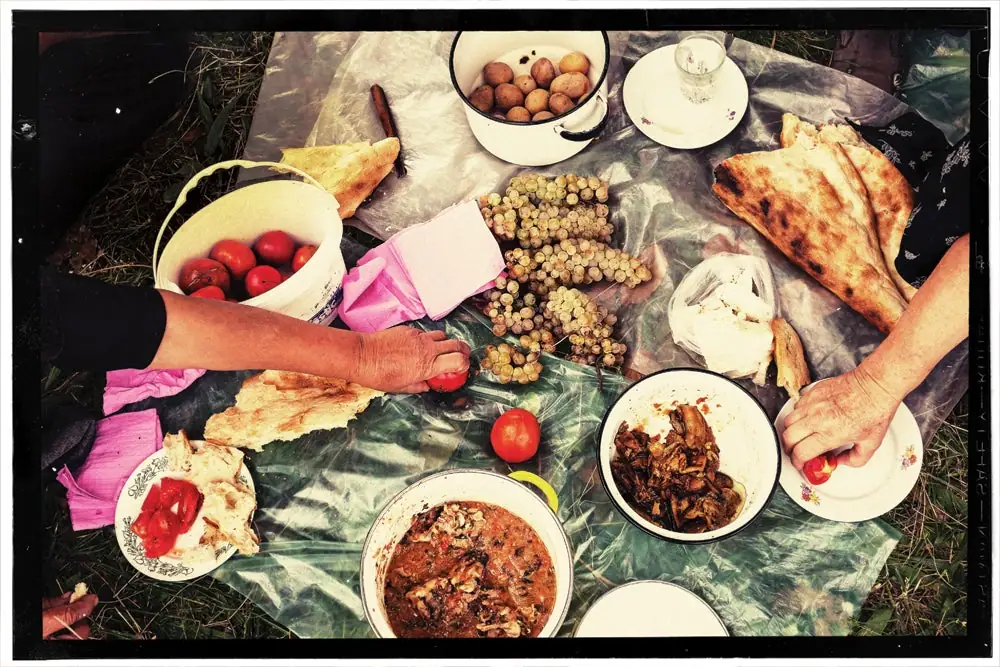
Landon Nordeman I’ve thought about this meal so many times now that the memory of it feels like a dream: I’m seated at a table whose surface I can no longer see—it has disappeared entirely underneath dozens of overlapping plates.
“May bitterness be away from us and sweetness be in our lives,”
There are only six of us, but the food laid out could easily feed 30. It’s early autumn, and I’m in a town called Bodbiskhevi in Kakheti, the easternmost region of the Republic of Georgia.
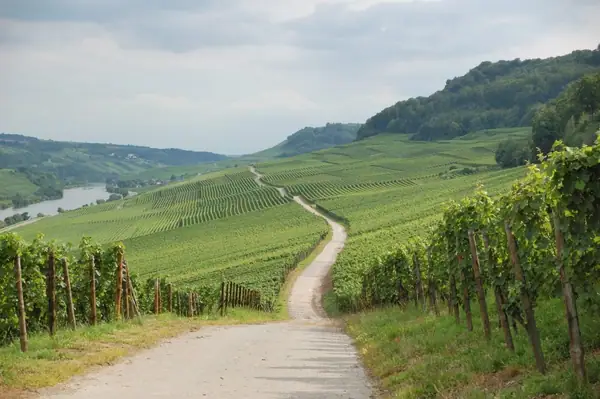
If I squint, the tawny, arid landscape, thickly planted with grapevines and dotted with pomegranate and cypress trees, reminds me of Tuscany—that is, if Tuscany were bordered by the snowcapped Caucasus Mountains and home to a 7,000-year-old winemaking tradition . After a day of helping Gela pick plums from his orchards, we’ve been invited to join him for dinner, which, as dinners tend to do in Georgia, has turned into a several-hour feast called a supra (meaning “tablecloth” for the way the food covers the table), a celebratory meal involving structured toasts, wine, song, and lots and lots of food. Between the meat, the wine, the song, and the feeling of deepening friendship, I want to freeze this moment in time forever.
I first visited the Republic of Georgia in 2002, when I was 21 years old. We entered, expecting it to be empty, and found the house lit up, full of the good smells of preparation: Her musician friends had already let themselves in, taken over the kitchen, and laid out a feast in the backyard—my first supra, though I didn’t know the word for it then.
Landon Nordeman Credit: Landon Nordeman I returned to Georgia a few times over the next several years, eventually spending ten months there in 2006 when Chris, a poet, became as obsessed with Georgia’s verse as my mother was with its music, and received a grant to translate Georgian poetry. While Chris crunched through translations, I wrote a food column for a local English-language paper that paid $12.50 a story—not quite enough to live on but more than enough to cover the cost of dinner.
It was a year of extraordinary eating: We lived on beans stewed with walnuts ; platters of khinkali , dumplings stuffed with everything from pork to growers’ cheese and mint; flatbread filled with molten cheese and topped with an egg; and pkhali , cooked vegetables seasoned with a heady blend of ground walnuts, spices, and herbs. Easy as it was to eat our way through Georgia, it was hard to feel at home there.
I spoke Georgian at the level of a two-year-old and was frustrated with my inability to communicate. When we tired of feeling like strangers, we went back to Sighnaghi, where my mother’s friends—now our friends, too—would welcome us with wine, food, and a place to relax.
Instead, John joins me at a table in the barroom for a few glasses of wine and some of Gia’s food. And the veal, infused with tarragon and accompanied by the salty-sour plums, is as astonishing as ever, with those big contrasting flavors that are the hallmarks of Georgian preparation. Her mother-in-law made it especially well and with a sense of joy that inspires Leah’s preparation to this day. “You always felt warm when you ate her food,” she explains.
While the satsivi finishes, Leah sautes some eggplant until it’s blistered, slathers it with a sauce she’s made from walnuts, fresh herbs. Spices, then scatters red onion on top—she would have preferred pomegranate seeds, she tells me, but couldn’t find any at the market this morning. When it’s ready to serve, Leah slides it from the pan and quarters it.
She shuttles it to the table and we eat it hot, balancing the scalding buttery wedges on our fingertips and trying to catch every melting drip. We sit and eat, murmuring over the creamy walnut sauce of the katmis satstivi, helping ourselves to the silken slices of eggplant, nibbling grapes from the front yard and local pears that taste of honey. “May bitterness be away from us and sweetness be in our lives,” John says, raising his glass.
I know that whatever changes come for Georgia, for my friends, and in my own life, these simple but key things—the pleasure that comes from cookery and eating with people whom I cherish so much; the sincerity and spontaneity of the supra—will endure.
- Who: Georgia
- Money: $12.50