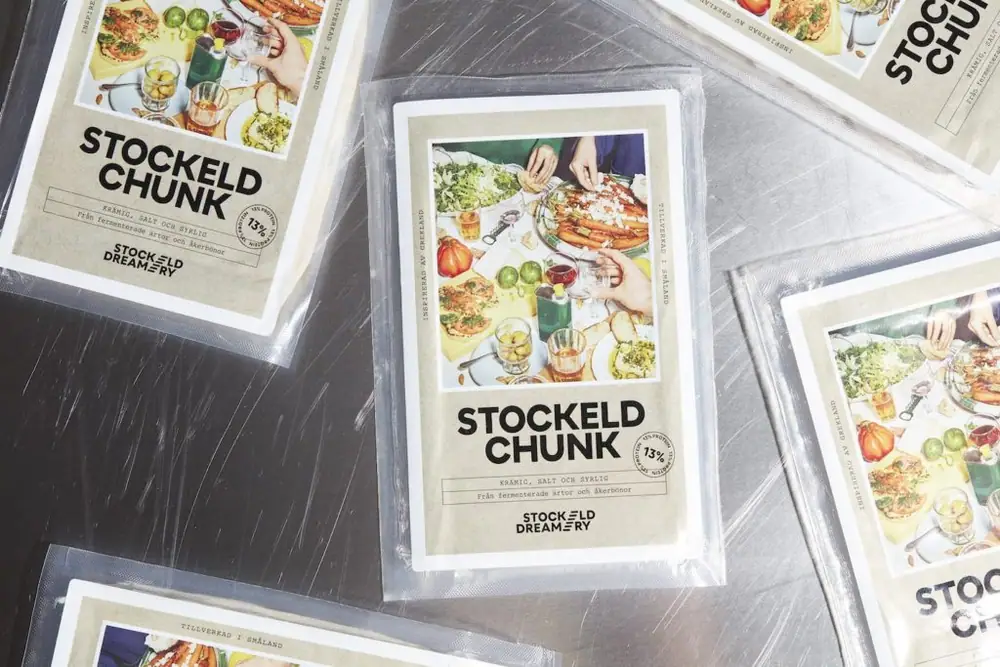
Future Food 🎙️: How Stockeld Dreamery is making 'the world's most ambitious cheese'
The vegan cheese of the early 2000s and before is one of those products that never quite lived up to expectations.
“Oh, it’s not that bad. You can just cut away the brown edges or whatever ends.”
It didn’t taste quite right; the texture was nearly always off; and it couldn’t melt in the same way as animal-derived cheeses when put under the grill. Perhaps least appealing of all was the unshakeable sense of eating something that was heavily processed; disconcertingly often ‘plastic’ was the word that came to mind as you chomped down on a piece of vegan cheese. But things are beginning to change thanks to the recent innovation explosion around plant-based protein – including ‘animal-free’ dairy alternatives.
Sweden has produced one of alt-dairy’s biggest names – the plant-based milk brand Oatly, which some pundits are now valuing at as much as $10 billion as it prepares for its New York IPO. Another Swedish startup diving into the alt-dairy game is Stockeld Dreamery.
Unlike Oatly, it’s focusing on cheese, and hahas just launched its first product, Stockeld Chunk, in retail stores and restaurants in the Nordic country. Stockeld Chunk is the result of over two years of R&D, and is manufactured through a fermentation process using peas and fava beans. “Inspired by Greece and made in Sweden,” according to the startup, the end product has “a familiar acidic and salty taste, with a rich, smooth and crumbly texture” akin to Greek feta.
Formerly known as Noquo Foods, Stockeld Dreamery was founded in Stockholm in 2019 by tech entrepreneur Sorosh Tavakoli and food scientist Anja Leissner. AFN chief editor Louisa Burwood-Taylor (LBT) recently sat down with Tavakoli (ST) to taste-test Stockeld Chunk and record the latest episode of the Future Food podcast.
You can listen to the audio below or on your favorite podcasting app. Or you can read the transcript below to find out more from Tavakoli on why he launched Stockeld, the wonders of fermentation, and the unique challenges of creating what he describes as “the world’s most ambitious cheese.”
LBT: Thank you so much for joining me today, Sorosh. So where are you right now?
How would you describe your relationship with food? Are you a big eater?
Do you eat for survival? What’s your favorite food?
ST: I am in Stockholm right now and I like food and I eat a lot of food, and I’m also the rubbish bin in my household. Every household has that one person who eats everyone else’s leftovers.
So I’m that person. I’m always innovative with whatever’s going bad. “Oh, it’s not that bad.
You can just cut away the brown edges or whatever ends.” But I really like food. LBT: Any food that you just will never eat, either for personal reasons or because you just hate it? ST: I’ve stopped eating meat a while back.
I just felt … Trying to stay away from it from an ethical perspective. I didn’t want to go fully vegetarian, but then nobody respected me for that.
So wherever I went, they were like, “Ah, but you eat meat, right?” And then there’d be a big steak. I was like, “I do.
But I don’t actually want to eat much of it,” so I felt I had to just put that vegetarian label on me. So people would adapt a bit when I go meet them. LBT: Oh, wow.
So you felt pressure for that? Or it was a direction you were going? ST: Like you go to a barbecue and all they do is meat, and there’s a bit of vegetables.
You can’t go eat all the vegetables. There’s nothing left for the rest. But now when they do a barbecue, they do a lot of vegetables so I can happily eat the vegetables.
But it’s hard. I don’t mind having a bit of meat every now and then, but it’s also then I lose my face a bit.
So I sneak doing that. Working with food, I don’t want to be handicapped. I definitely eat cheese.
I eat lots of cheese. I feel it’s important that I can eat cheese.
LBT: Well, so you’re a reduceatarian, a flexitarian, but a very hardcore reduceatarian. More on the production side than the other side. ST: For sure.
I would go that far actually. What made you come into food?
ST: Oh, wow. I was looking for a big problem to solve with my second company. So I really took my time, and then I wanted to do something good for the world.
First I had to figure out what is good and the people who do the best good, what are they doing? It was a long journey for years that took me to the food industry pretty quickly. I looked at microalgae and duckweed for about 10 months before deciding to not do that and focus on the protein shift and specifically cheese.
It’s a huge problem. 4% of global emissions come from the dairy industry, and there’s just lots of waste of resource. That’s how I ended up in cheese.
I was looking at what’s happening. We have to shift our diet towards a more plant-based diet. Everybody agrees with that.
People understand that, people are trying to shift, people are trying to reduce to various degrees. But then they’re very limited to the alternatives available to them as they’re trying to shift. Where there are good products, the shift happens, and where we don’t have good products, like cheese, we don’t bother.
We stick to the old products, animal animal-based products. But it’s kind of like we stick to them despite them being made from milk that comes from an animal. The question is just, what would it take to make better products?
No one’s really tried to make a better cheese. LBT: Yeah, it’s interesting because alternative meats have been around for ages. I live in the UK.
We’ve had a company called Quorn that’s been at it for years. Veggie burgers and stuff has been kind of in our vernacular, but a plant-based cheese is definitely something a lot more rare. I think Miyoko’s Kitchen in the US, they were everywhere.
So it’s interesting. For me, I eat a lot of cheese and feta, which is quite similar to the product we’re going to talk about today. I would never have thought to kind of replace that and do something different if I wanted to make salad with it or whatever.
So it’s definitely a new category. But did you consider alternative meats or alternative milks or anything like that?
ST: I was never interested in meat myself. As I had less and less meat, I didn’t want to have fake meat.
I was looking for other products too. I was really into tempeh. I thought it was a fantastic meat replacer, but not a meat imitator.
So I was never interested in that. But cheese, I mean, yogurt, my God, it’s terrible, plant-based yogurt.
The milks are great. I mean, lots of variety, full of flavor. The only thing with the milks is the price.
I mean, they’re still like twice the price of cow’s milk, but it seems to not be an issue. I mean, the market is growing really, really fast.
LBT: Yeah. Yeah.
So you mentioned algae and duckweed, and I’m super fascinated by this space. I think it is going to blow up at some point. But why did you not go into that?
ST: I would say it was almost like a personal decision. I realized you need to do lots of work on the growing systems, cultivation systems. You have to create mono-cultures eventually.
So you want only your, if you grow duckweed, you don’t want algae to grow in your water. You need to then take this plant, which is green, it’s a leaf basically, and you need to extract the protein and more importantly, actually extract the color out of it because nobody wants a green protein.
And then make it taste neutral, and it’s just a long journey. First figure out the cultivation, then figure out how to make it useful, and you also want the proteins to be functional for them to be useful. There’s just so many things to do.
Also duckweed is a novel food in Europe. Sweden’s a terrible place to grow food. You can grow it half of the year at best.
So there was a lot of things that I was just like, “Now I know exactly what I need to do, and I don’t want to do it.” […] And I was like, “Why limit myself to one ingredient?” I felt it was much more compelling to have access to all the tools in the world, all the ingredients and that way be able to create better products. But also I felt there’s a huge need in kind of better packaging or presentation of the product where all of the products were vegan and we’re free from, and we’re not this, and we’re not that.
Very little about what they are. I think beyond Miyoko’s there is no other brand that I think anyone give a shit about to be honest.
Like the product, one or two. LBT: Right.
So I’ve got Stockeld Chunk here, and I’ve been trying it and tasting it. It is delicious.
So as I said, it’s like a feta, but it’s not a feta. Tell me a bit about the thinking.
Why is this your first product launch? I’m going to eat some now. ST: Yes.
So excited to send you cheese. So we’re launching the product next week.
I don’t know when you’ll publish this. But yeah, we’re super, super excited.
We’ve been in R&D mode for about two-and-a-half years. We’ve developed this kind of protein technology platform that allows us to do a lot of things.
The first product coming out is the Chunk, which is a salad type cheese, a feta cheese alternative you could say, as in it should be used in a similar way to as you do with a salad or a feta. But it’s not meant to give you the full flavor experience as a feta.
So it’s kind of honest to its own flavor, but functionally in the texture and the use cases are meant that way. So we’re super, super excited about the product […] I have to say we’ve done … Confidently, we’ve done more than 1,000 iterations. I think we’ve had over 40 chefs involved in the process who’ve been trying early on spitting it out every now and then.
The chefs are very honest. They’re not out to please you.
So the feedback has been very honest and consistently improving. Even in November, December, I honestly had a lot of doubts around the product.
Is it good enough? […] Something happened in February as we really nailed the production in our facility where the feedback started to turn dramatically. We also went a bit more into launch mode, and the last 15 meetings, every single chef has said, “This is great.
I want to put it on my menu.” It’s just been like not being able to fake the feedback. So we’re very excited about the product.
Also, when you ask chefs kind of like, “What would you do with it,” it’s all over the place. They’re full of ideas of how to use it in different contexts.
LBT: What changed in February? ST: I think it was just the continuous optimization that we’ve been doing on the product, and we have some further optimization we’re doing now as well.
I realize maybe we should talk about also what the product is made of and kind of what it is. So it’s the fermented cheese made from pea and fava protein, and it’s nutritionally very equivalent to feta cheese. So it has about 13% of protein, it has almost no carbs, and it’s about 20% fat.
So we’re super excited about the nutritional composition. It’s also being fermented.
It has live microorganisms in the product as well. We have seven ingredients in total.
LBT: Tell me about your discovery process, because I think this might be… Some of the companies in the space have their secret sauce. How did you pick your ingredients?
I guess pea protein is not a crazy idea. Lots of different alternative protein companies are using it, but how many different ingredients did you trial with and what was the discovery process?
ST: Yeah, I mean, we’ve done some, let’s say, basic research while also developing the product. So we’ve screened more than 500 proteins in this process.
So we’ve really been looking at how to functionalize them, what their molecular kind of interactions are. Eventually it’s about kind of building … If we go into nerd mode … How do you create a matrix where the protein is the key component, or let’s say the scaffolding that keeps things together?
And then eventually makes a complete food system where you have fat, water, starch and other components kind of come in […] Then you want to, in our case, after creating cheese-like characteristics, we want to mimic casein behavior, but also the complete food system. The milk fat is also quite unique. So then it’s about kind of picking which cheese you’re after and what characteristics, and the key challenge is in the texture.
That’s where we’ve been spending most of our time. That’s also, frankly, what we’re the most excited about having achieved.
Now with this technology, we’re deploying it to make a cream cheese, and we have other cheeses in the pipeline coming next year as well. So the cream cheese will actually also be launched this year.
LBT: So the texture is harder than the flavor. ST: Yes. LBT: Why is that?
ST: Because you can always kind of, there’s a lot of work you can do on the flavor. The flavor is maybe you can say the flavor is dead somehow while the texture is, it’s dynamic. The functionalized ingredients and proteins that keep it together.
Maybe you can think of something like you can have dead powder of something and it won’t do anything. You mix it with water, whatever, it won’t do anything. But the whole trick is like how do you make these proteins really functional to hold, let’s say, if you think of a feta, so it can be dense enough, so it can crumble just in the right way.
You don’t want it to be like a jelly. You definitely don’t want it to be like a Nutella […] You also want that authentic crumbliness, which is dynamic and kind of a bit irregular and not homogenous. So there’s a lot of things to figure out with that.
And also you can’t fool the mouth as much as it comes to texture and the mouth feel, how it coats your mouth and all the different phases when it’s mixed with your saliva, when you swallow, all these different components. The mouth is pretty good at detecting fake. I think you have that a lot in the vegan cheeses today.
The flavor sometimes like, “Wow, this is kind of cheese,” but then it just, boom, it’s gone. It doesn’t stay in your mouth or it doesn’t continue. LBT: Well, it definitely crumbles like a feta.
So you definitely nailed that. Tell me a bit about the process then. Actually, I was going to follow up and say, I guess you want to get all that texture without putting loads of crazy other ingredients in, right?
ST: Exactly. That’s also where fermentation comes in.
So it’s a fermented product. What cultures do you use?
For example, if you try the product pre-fermentation and post, it’s like you can’t even taste it before it’s fermented. It just tastes like pea protein. Lots of off flavors.
So there’s a lot of stuff happening in that as well that is really interesting and important because that the flavor, it’s hard to make it neutrally flavored. Uou can make something with great texture, but it might have tons of off flavor, especially if you have a high protein content, as we do. 13% is unheard of in the world of plant-based cheese today. I think a big part of that is because these proteins have so much flavor that you just can’t work with, so you have to tone it down.
There’s a lot of work we’ve done in that as well, making sure that it has a really nice flavor. LBT: How have you managed to put more protein in and deal with that flavor?
Is there some secret sauce here that you want to be cagey about? ST: No, but I mean, I’m trying to stay very conceptional and say common sense things.
Obviously, we’ve just filed our first patent regarding this product as well, and obviously there’s lots of IP that goes into this technology platform. LBT: It’s IP around the process? It’s IP around how you ferment-
ST: All of it. LBT: It’s IP is around the ingredients?
ST: All of it, I would say. Yeah. LBT: Being very tight-lipped.
ST: I mean, we’re all about R&D. We’re upset about cracking this and we have an R&D team of six people now, and they’re working hard day and night.
So obviously we want to make sure that we can make the most value out of that. LBT: You’ve expanded your R&D team recently, haven’t you? ST: We have, yeah.
I mean, the whole company’s kind of exploded. We were three people in August, and we are 13 now, so in less than a year. Then we’re going to be close to 25 by the end of the year.
All cylinders are running right now. LBT: How do you prioritize which teams to expand over others?
I mean, it sounds like it’s growth on all levels, but where do you kind of have extra people? ST: Yeah, it used to be all R&D because we didn’t have a product, but then as the product was getting ready, we needed production.
He’s had 13 years of experience in food production, and he’s run a chocolate … He’s our Willy Wonka. So super fortunate to have him on board.
Then now just in the last two months, we’ve had our head of sales join, a head of marketing, and also Daniel joined us on the special projects and strategy. But then honestly, we’re also investing a lot in people operations and HR given how fast we’re recruiting.
So you also need to build the structures around the company as you’re growing so fast. All these people need a laptop and a phone. There’s all these things around it as well.
LBT: Yeah. You’ve got to look after them.
What is your go-to-market strategy? Is it restaurants?
ST: Yeah, we start with food service, and we’re trying to be really thoughtful around the brand. Also, I mean, we have to crawl before we walk and run and all that stuff because we still haven’t sold a kilo of cheese.
We were humble as it comes to production. Two weeks ago, we had a failed batch at production, which was supposed to be sold. That’s why actually the batch you got is five weeks old.
Things like that will happen. So we don’t want to go crazy from the get-go.
We’d rather go with a few restaurants. We’ve lined up now two restaurants or it’s one restaurant and a bakery that we’re launching with where they’ve made special dishes with the product […] We also have Stockholm’s best cheese store and wholesaler, which we’re really, really proud of.
They have 400 to 500 cheeses at any given point of time. They’ve had one vegan cheese three years ago that they didn’t eventually think was good enough.
They were over the moon when they got to try the Stockeld Chunk. The owner there, he said, “Well, wow, if I’d been in Asia and they would have served me this cheese, I wouldn’t have doubted one second that it was made from milk.
But obviously, flavor-wise, it’s not fully what I’m used to,” but they think it’s a great product. He also said, “I’m confident we will provoke some of our customers who will come in and say, ‘this is not cheese.'” We’re excited to have them on board and get that kind of validation, which again is … Cheese is very special. There’s 10,000 different cheeses in the world […] So there’s not this one cheese to mimic.
You also have craft that goes into cheese. We want to be respected as a real cheese, but I don’t think oat milk really wants to be respected as a real milk.” Because that definition in a way is that it comes from an animal and the same goes for meat.
I don’t think that the plant-based meats want to be respected as a real meat. But we want to be a real cheese.
We want people to think this is a new cheese and it has its own characteristics and flavor, and I really enjoy it for what it is. And that’s where not faking it, just making it comes from.
We’re not trying to fake some other cheese. We’re trying to just make great cheese products.
LBT: Interesting. I mean, I actually think Impossible Foods does want to be called a meat.
They’ve got this new ad campaign … I don’t know if you’ve seen it and it’s all some Southern accent saying, “This is meat made from plants.” Terrible impression, but they’re very much drumming home the meat phrasing, the meat word, which is interesting. That kind of gets into the whole, can you call it these things. Are there any lobbies in Sweden around using the word cheese?
Because in the US there’ve been various different states that have banned the word ‘milk,’ for instance, for marketing plant-based alternatives. ST: Yeah.
Unfortunately we have the Amendment 171. 171, which is all about trying to protect the dairy industry and what they’ve built over the many years and kind of not have us new companies that come with other ingredients infringe on their kind of IP or the brand- LBT: The brand, yeah. ST: That they’ve built.
That’s all about. I know there’s lots of lobbying going on, on both sides, obviously of this. I’ve read the draft, and it’s super vague, what it actually means.
I think it will all come down to how it will be interpreted and put in effect into law. So we’ll see how that goes.
For now, I think you can say vegan cheese or plant-based cheese. You can put that on the package, but just knowing that you might have to change your mind […] But we’re not going to use the word cheese. I mean, we use the word cheese on, I mean, I’ve said it 200 times already in this conversation, and we’re using it on the website in terms of our ambition.
Our first vision is to create the world’s most ambitious cheese, and you can’t take our ambition away from us. The way we define the world’s most ambitious cheese is something that is tastier and more nutritious, something that is preferred by top chefs and restaurants, a cheese that’s very resource efficient, constantly using less and less.
Be smarter with the resources. And a cheese that’s available for all, so not a premium product as such. That’s what gets us up in the morning.
LBT: Yeah, right. So I want to dig in a little bit more to the ingredients, in particular about the pea protein.
There are some question marks around the sourcing of some of these core ingredients, not the least because there’s been at times some scarcity and thinking in terms of pea protein, but also how that pea is grown and so on. How far up the supply chain do you go? Do you literally just purchase pea protein powder?
Or is there something you do with it before yellow pea? Just tell us more about the pea. ST: With kind of sustainability being kind of at the core of our why, we do have lots of debates internally as to what is important, what is important when, and how important is it, et cetera.
Obviously the ingredients are very important for us. The key focus that we have is to remove the milk, which is the really resource intensive ingredient […] So the second step is to create a very, very good product that people actually want to eat. That tastes good.
That has the right appearance, flavor, all these things. Then obviously the ingredients are important.
We’ve obsessed on science trying to get down the recipe to as few ingredients as possible, as simple processing as possible […] We’re using pea protein and fava protein. We buy the powder. So far we haven’t been very sophisticated as it comes to sourcing.
We’re working with suppliers, we’ve talked to plenty. We’re trying to source ingredients from Europe given that we are here, but we also have global ambitions. We’re not necessarily trying to be too Swedish.
That said, every Swedish chef and purchasers, they’re always like, “What ingredients are Swedish?” We’re kind of trying to navigate that and being clear about we do have larger ambitions than Sweden and frankly, today there is no Swedish pea protein. There is no Swedish fava protein.
There’s Swedish peas, and I think there’s some people growing fava. Even on European basis, there’s no fava that is processed in Europe. We found one tiny provider, but they can’t really offer scale.
That’s a shout out to the listeners. If you have European grown and processed fava protein, we’d be very interested in that. So the pea comes from, I think it’s both from North America and Europe, but it’s processed in Europe.
LBT: Okay. I mean, I presume a lot of that infrastructure is going to build out with demand in all the alternative space.
ST: So many things are happening in that space. So very, very excited to see where that goes. Also, as we increasingly grow food for humans and not for animals.
Hopefully farmers can also make more money doing that. So, very excited to see where that goes.
LBT: So where next after Sweden? ST: I think the second and third market, we’re debating between Germany and the US.
I love the pod you did with the woman from Eater, who’d done this long, super long article about plant-based cheese. I spent a ton of time in the US, and we’ve had cheese from all over the world. There’s just no good product anywhere […] She summarized it as the three categories.
The flavored fat as she called it, coconut oil and starch. We call that category, which is like 80% of the market. And then you have the nut based at scale, which is maybe Kite Hill and you’ll have Simply V does some of that in Germany, but then you have, obviously Miyoko’s that’s based on nuts.
And then you have the super crafty, delicious, handmade dessert cheeses that are made also almost exclusively on cashew, but also can be other nuts. We don’t fit any of those categories because we’re made from plant proteins using pulses and our protein content and our nutritional composition in total is just very, very different from all these other products.
Also, I would say from a sensory perspective, texture, flavor, et cetera, we stand out. So I’m very stressed about moving out of the 10 million inhabitant country of Sweden. LBT: It sounds like the world is your oyster.
Yeah. It sounds like the world is your oyster.
There’s lots of places you could go. ST: Yes.
But it’s also, cheese is not a global product. I mean, it’s not really used so much in Asia, for example.
So it is predominantly, the cheese market is Europe and US, even though pizza is taking over the world. LBT: There’s been some bad press in the plant-based space around the health and nutritional profile of some of the alternatives and the level of processing.
Where do you stand on that? I mean, obviously you’ve decided to go for a few ingredients.
I’m not sure about the processing element. It sounds like that’s some secret sauce.
But where do you stand? Do you think it’s a bit unfair?
Do you think it’s the meat lobby kind of thinking of something to throw at this growing industry? ST: I think it’s an intriguing topic, and I do think it’s interesting too.
We’re not eating meat, but then what are we eating? I think that question is very valid, and it deserves a proper discussion.
I’m sure also there’s lots of polarization going on in terms of the opinions that are flying around. But I mean, as it comes to cheese where I nowadays call myself an expert, having had, God, I don’t know, 100 different plant-based cheeses, I think a huge majority of those are just completely nutritionless.
I mean, it’s coconut oil and starch and usually modified starch. That’s what these products are.
Especially, if you replace, if you add it to a sandwich or wherever else you add it, usually it would make up a nice mix of nutrition where the protein is a key part of the cheese ingredient. They just have none of it […] So the Violife, for example, their Greek Block has zero protein. You have the Green Vie their also feta has zero protein.
Most of these, I think that might have 3% tops. I think that’s problematic. And also, I mean, as you think about the live microorganisms, I think that’s also something that is beneficial.
Also, when you ferment, there’s lots of other benefits coming to the product in terms of how it’s kind of pre-digesting the food for you. I do think it’s important.
For us, I mean, we want the nutrition to be built in, so you don’t have to go think about it too much. But food without nutrition, it’s not really food.
What is that really? LBT: Just quickly on the fermentation.
Are all your cheese is going to use fermentation or is it for the Chunk? Because I think feta is fermented or I guess most cheeses are fermented.
ST: Yeah. Fermentation is a great tool. We have had also work done without fermentation.
But we are big fans of fermentation, and there’s other areas where we think we’ll use fermentation as well that I won’t go more into. But yeah, that’s- LBT: So you’ll always get the live microorganisms when you use fermentation?
ST: Yes. Unless you pasteurize it, which is basically when you kill everything that’s in it.
We don’t do that with this product, at least. LBT: What is fermentation? Can you give us a layman’s description?
ST: Yeah. So fermentation is the oldest, most common food processing technique.
Basically it’s when bacteria start eating the food. Historically it’s been the bacteria that are naturally already on the food. So obviously you have chocolate is fermented, beer, any pickled kimchi or there’s just so many, or basically any cheese out there.
For us, what we do is once we have our ingredients, we basically add a starting culture, which is made up of a number of different bacteria. They like to eat sugar, they like to starch, but they also like to snack on the proteins, and they create these enzymes that go off and cut off these proteins or also bind them together in different ways.
So it’s both really as it comes to flavor, getting rid of, so as you get really sophisticated, you can design the right bacteria, the right enzymes to go off and for example, eat or break down the molecules that create the off flavor. Or you can go off and actually create molecules that make up a cheese flavor from the pea protein.
It’s really intriguing, but it’s also really, really complex because it’s billions of these things, and you can’t usually be that precise. LBT: Are you designing your own microbes and bacteria in house or are you purchasing them?
ST: I would not comment [on] that too much right now. LBT: Interesting. Well, we’ll finish off with a big question about the future food system.
Say it’s 2050, what two or three things you think are going to look pretty different from today in the way that we purchase our food, we grow our food, we eat off food. ST: For me, I think externalities have to be priced in.
Having true cost accounting will be really important to have that. That will be like a self-regulating system to make sure at least from a sustainability perspective.
Then I really wish for a food system where we have nutrition and sustainability built into the products that we eat so we don’t have to think about it, and the food system, but also the food experience can be so much more about just joy and community, connection. The campfire is like that place … I want the future food system should provide the food experience around the campfire where we don’t care about labels, the nutritional label or the ingredients.
We don’t think about our weird keto diet or the carbs we get or the BCAA that I need before my workout. So where food is just joy and pleasure and community somehow.
Love it. Well, thank you so much, Sorosh. Always great to chat, and thank you for sending the Stockeld Chunk.
It really is yummy. I’ve been nibbling on it throughout this conversation. So thank you.
Good luck with the launch.
- Money: $10 billion
- Percentages: 95% · 4% · 13% · 20%
- Figures: 10 billion · 95% · 4% · 13%