Oli's Italiano in Bratislava evokes the atmosphere of Mediterranean streets
They did not start from a specific type of restaurant, but from the everyday urban scene in which streets, cafes, balconies and doorways connect almost imperceptibly.
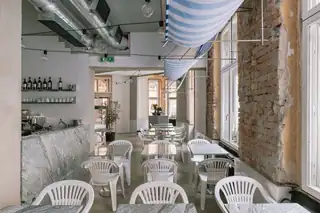
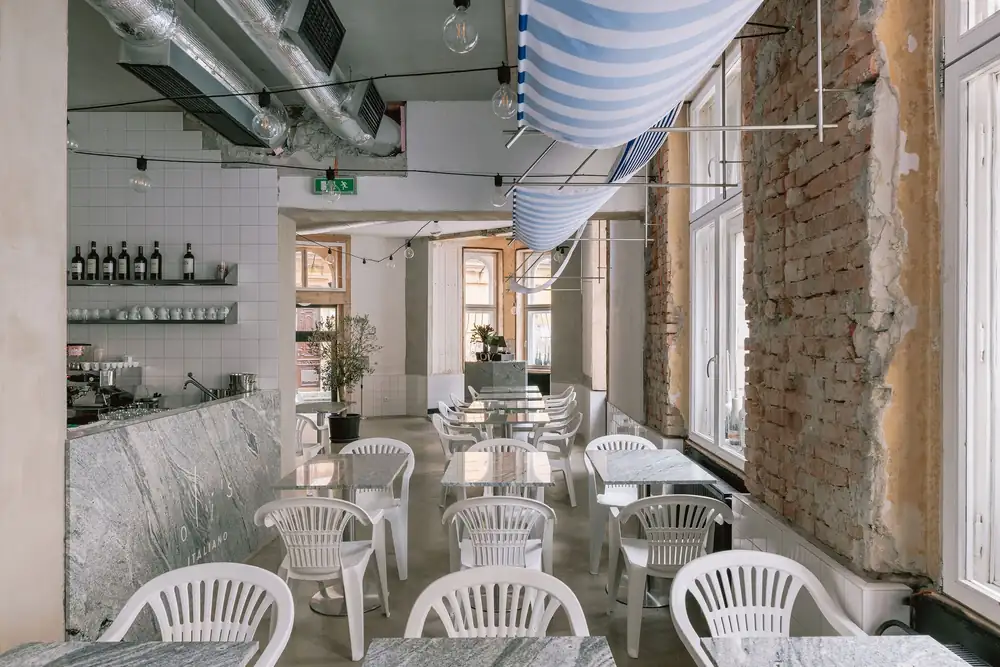
To do this, the previous interior was almost completely dismantled. The layers that had accumulated during previous uses were removed, revealing the brick walls, the raw plaster and the original spatial proportions of the building. There was no attempt to add new, decorative coverings to the existing structures, but rather to leave them for what they are: visible traces of the building's past. The new elements were placed against this restrained, somewhat raw background.
The street atmosphere is primarily brought in by the blue-and-white striped awnings mounted on the windows. The canvases, familiar from Mediterranean terraces, are held by thin stainless steel rods, so the shades almost float in front of the openings. The light constantly changes their appearance: the stripes cast shadows on the walls and tables, while redrawing the space differently throughout the day. Strings of lights strung on the ceiling, reminiscent of garden rooms, further enhance the illusion in the evening.
The furniture selection also takes its cue from the everyday Italian street scene. The white Monobloc chair is one of the most recognizable pieces: light, cheap, stackable, and in Italy it is as much a part of the image of sidewalk bars and cafes as it is of summer terraces. Oli's Italiano doesn't try to appear more than it is – that's what makes it authentic.
This simplicity is offset by marble. The fine-grained, polished stone appears on the tabletops and bar counter, giving the space a more sophisticated character. The pairing of marble and plastic chairs well sums up the interior's fundamental tension: the juxtaposition of everyday and carefully crafted materials.
The pizza oven is the most striking of the Italian gastronomic references. The Neapolitan-style wood-fired oven is covered in a bright cobalt blue mosaic that stands out as a strong splash of color among the subdued surfaces of brick, concrete and stone. The oven thus functions both as a practical kitchen element and one of the restaurant's most characteristic objects.
The blue and white stripes return in other forms. They appear on the pizza boxes and the San Marzano tomato cans stacked around the bar. The everyday packaging and ingredients are transformed into an almost graphic composition: the cans are not hidden away, but part of the interior. The recurring stripes connect the various details, while the restaurant eschews the obvious paraphernalia of Italian hospitality.
Oli's Italiano is Italian precisely because it doesn't try to show off what it means to be Italian. There's no overly decorated trattoria atmosphere, no direct Mediterranean theme. Instead, there are the familiar awnings from terraces, the white plastic chairs, the marble tables, the string lights, the pizza boxes and the cans of tomatoes. Together, they evoke an everyday street scene in which the boundary between the restaurant and the city almost completely disappears.