
“120 percent emotion”: Why aperitivo is the best time of day
Between the end of the workday and dinner lies a small gap that people in southern Europe have always known how to use. Bar expert Andreas Till explains why the aperitivo is more than just a drink before a meal – and what we often misunderstand here.
The day is slowly drawing to a close, the evening hasn't quite begun. The table is filling up: a bowl of rosemary chips, a few olives, perhaps some pieces of still-warm focaccia with fresh tomatoes. Accompanied by a glass of sparkling wine, a spritz, a small cocktail, or even a non-alcoholic beer.
For many, the aperitivo culture evokes a holiday feeling. No wonder, since it's practiced with such passion, especially in the Mediterranean region. However, the aperitivo is by no means a tradition that belongs solely to holidays. Rather, it traditionally signals the end of work and the beginning of the evening.
“The aperitivo is actually the highlight of the whole day. It marks the beginning of the more enjoyable part. And it's a turning point, one that's also emotional. Now you've arrived in the private part of the day,” says Andreas Till, founder and host of the Munich bar “Pacific Times,” who is also known as a mentor and trendsetter in the bar scene.
A space between work and evening
It's the time after work when you meet up with friends, have a drink, and a few snacks. You're not home yet, the family isn't gathered around the table. The aperitivo occupies precisely this in-between space – and opens it up to friends, acquaintances, or even the chance company you meet at the bar.
Even though we associate the aperitivo with sun, sea, and sand today, its modern history initially leads us to northern Italy, specifically to Turin and Milan. These two cities continue to celebrate aperitivo culture. It's no coincidence, then, that the wonderfully uncomplicated tramezzino—essentially the Italian sandwich—was invented in Turin. Nor is it a coincidence that Turin is known for its vermouth, and Milan for Campari. Both continue to shape aperitivo culture—and both bring a touch of bitterness to the glass.
"Bitter and wine-like drinks are ideally suited to be consumed before a meal – rather than filling up on sweets or cream," says Andreas Till. At the same time, drinks only mark the beginning of the evening – therefore, according to Till, they shouldn't be too alcoholic.
Italy in a glass
One drink that combines all of these elements quite well is the Spritz. Its history leads back to the Veneto region and the wine spritzers that were popular there under Austrian influence. Over time, numerous variations developed from wine and water, eventually incorporating bitter liqueurs.
Till also attributes its success to its simplicity: the Spritz is relatively low in alcohol, uncomplicated, and easy to prepare. Above all, it conveys a feeling: "The feeling of being in Italy for a few minutes with a single glass."
The Spritz, with its various variations, has long since arrived in this country. However, a drink alone doesn't make an aperitivo, even if some bars add a small bowl of peanuts. "In our restaurant, I always serve chips and olives as well. It's a misconception in Germany: people used to fill up on these snacks. The meal-preparation aspect has been lost."
Between glass and plate
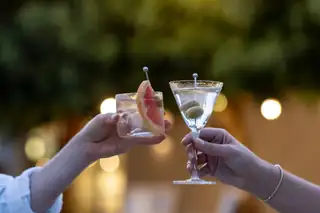
Sometimes, during an aperitivo, the lines between glass and plate even blur. A prime example: the olive in a Martini. In a Dirty Martini, olive brine adds a salty, savory note. Some gins already possess this Mediterranean spiciness: Gin Mare, for instance, is distilled with juniper, Arbequina olives, rosemary, and thyme, among other ingredients.
Originally, the Martini was mixed with a significantly higher proportion of vermouth, but over time it became increasingly drier. "It can also be done the other way around," says Till. In a Reverse Martini, the vermouth takes center stage, resulting in a drink with an alcohol content of 15 to 20 percent. After all, the aperitivo is meant to open the evening, not preempt it.
Because at its core, it's about something else entirely. The aperitivo interrupts the daily routine, creates time for others – and brings back, for a few minutes, that holiday feeling we usually associate with a bar in Italy. "The aperitif as a whole is 120 percent emotion," says Till. That's precisely what makes it the best time of day.