How long to cook beef until done: time for soup, on the bone, and in pieces
Beef can cook in 40-60 minutes if it's a small cut of veal, while a shank or large bone-in meat will take up to 3-4 hours. The cooking time depends primarily on the cut and size: the universal "cook for an hour and a half" rule doesn't always work.
How long to cook beef until done?
Cooking time in a saucepan is measured after the water boils. For a pressure cooker, it's measured after pressure is reached. The numbers in the table are approximate: young meat will cook faster, while larger cuts with more connective tissue will cook more slowly.
"The important thing here is not the recipe, but the mood with which you cut the first tomato."
This variation is no accident. Brisket, shank, and shoulder blade contain a lot of connective tissue and collagen, and they require prolonged braising to become tender.
Chefs give a guideline of 2–2.5 hours for a large piece of about 1 kg, 1–1.5 hours for small pieces and up to 3–4 hours for beef on the bone.
If the meat is sliced, it needs to be simmered for at least 1–1.5 hours to become tender. This can take up to 2 hours for a small, whole piece, and up to 4 hours for a very large piece.
Tip: Don't buy tenderloin specifically for casserole. It has little connective tissue, so it can easily dry out over a long cooking period. For broth and long cooking times, brisket, shoulder, shank, or bone-in meat are better choices.
Defrosting
First, completely defrost frozen meat in the refrigerator. For large pieces, this may take overnight or even a day, but it will then heat much more evenly.
Skip washing
Washing raw beef under the tap is unnecessary. Water doesn't make the meat safer, but splashes can spread microorganisms across the sink and countertop. Chefs don't recommend washing meat for this very reason.
What you absolutely must do
Trim away any tough membranes and especially the tough outer tendons. Small layers of fat can be left in; they will add flavor to the broth during long cooking.
Cut or leave in a piece
Whether to chop or leave whole depends on the task. Pieces weighing 300–500 grams will cook faster. For a good broth, it's best to leave the meat on the bone in a fairly large piece.
Place beef in cold or boiling water
Here's a handy rule: if you need a good broth, start with cold water; the meat itself is more important—you can put it in hot water.
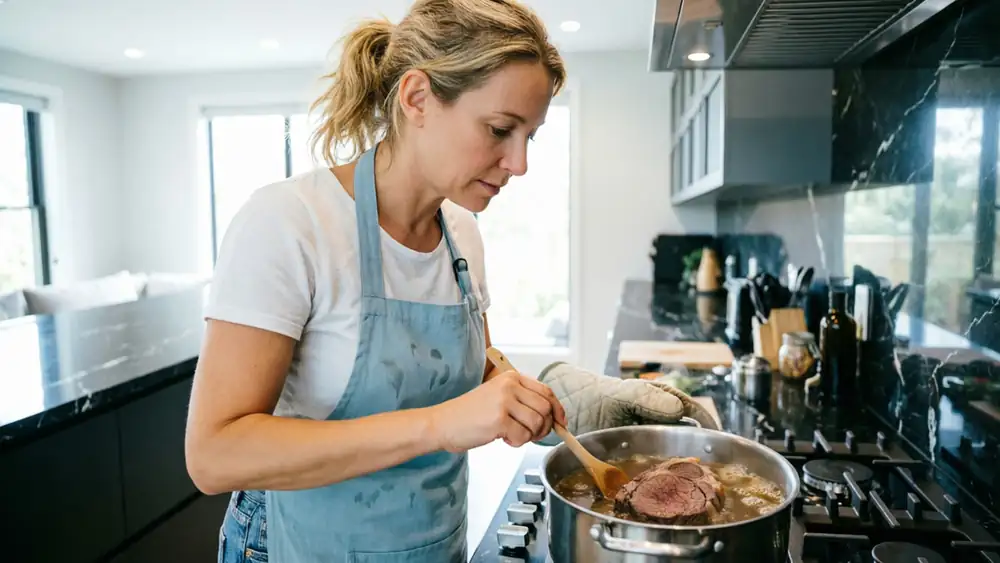
To make the soup, place the beef in a saucepan, cover with cold water, and gradually heat. This method is traditionally used when a richer broth is desired.
If the beef is needed for a salad or stuffing, the water can first be brought to a boil and then the meat can be added.
But forget the explanation that boiling water supposedly "seals the pores." No airtight seal is created on the meat. The practical difference here is more a matter of heating and what you want in the end—a rich liquid or a tasty meat.
In both cases, reduce the heat after boiling. The water should only move slightly, not bubble like beef in a hot tub.
When to salt beef
The most convenient home method is to add the salt 20–30 minutes before the end of cooking, and then strain the broth to add the final salt.
The reason is quite prosaic: after two or three hours, some of the water evaporates, so a broth that was perfectly salted at the beginning may turn out significantly saltier by the end.
Sous-chef Konstantin Krasnyuk also advises not to rush with salt precisely because its concentration changes as the liquid evaporates.
But the popular saying "salt instantly draws all the juices out of meat" shouldn't be taken literally. For a home saucepan, the amount of salt and how much the water has boiled away are far more important.
How long to cook beef on the bone?
Beef on the bone will take on average 2.5–4 hours to cook. A small cut of rib eye can sometimes take two hours, while a large shank can easily cook for four hours over low heat.
Bone-in meat is especially useful if you want a rich broth rather than just a piece of meat. Chefs interviewed by Argumenty i Fakty recommend bone-in meat, brisket, shoulder, shank, and spare ribs.
Once boiling, skim off any foam with a slotted spoon and reduce heat to low. Foam itself doesn't make the broth dangerous—it's removed primarily for a neater appearance and clarity.
Ready beef should be easily pierced with a knife or fork, and a well-cooked shank should have meat that comes off the bone without difficulty.
How long to cook beef for soup and broth
For homemade beef broth, a good guideline is about 1 kg of meat to 3 liters of water. If you're using mostly bones, you can use about 4 liters per 1 kg: some of the liquid will evaporate within a few hours. These proportions are commonly used by chefs.
Place the meat in cold water and slowly bring to a boil. Skim off any foam, reduce heat, and simmer for 2–3 hours; large bones and shanks can be simmered for up to 3–4 hours.
It's best to add onions, carrots, celery, or parsley root about an hour before the end of cooking. Add peppercorns and bay leaves 20–30 minutes beforehand: over a few hours, the bay leaf will have time to not only flavor the pot but also settle in permanently.
For a regular soup, you don't need to simmer the concentrate for four hours. A medium-sized piece of brisket, ribs, or drumstick can be cooked for 1.5–2 hours, then add the potatoes, grains, and the remaining ingredients as directed.
How to make boiled beef tender
The key to tough beef isn't baking soda or lemon. It's the right cut of meat, low heat, and cooking time.
A shoulder or shank may be perfectly cooked in terms of temperature after an hour of cooking, but still remain firm. Collagen needs time to gradually transform into gelatin, which is why tough cuts benefit from longer cooking times.
If the meat is still tough after two hours, don't increase the heat. Let it simmer for another 20-30 minutes, then test it again with a fork.
Baking soda can indeed change the surface texture of meat and is used in some techniques for quickly tenderizing small pieces, but throwing it into a pot of broth makes little sense: the taste and cooking environment will change.
Lemon juice will add acidity, but it won't turn a tough shank into tenderloin in half an hour.
Mustard is useful primarily as a marinade and seasoning. Don't expect it to provide any magical speed boost during regular, long cooking.
And one more trick: leave the cooked beef in hot broth for 15–30 minutes with the heat turned off.
How to tell if beef is done
The simplest test is to use a thin knife or fork. It should slide easily into the thickest part of the piece, without noticeable resistance. Meat on the bone has another sign: the flesh begins to separate easily.
When using a kitchen thermometer, it's important to distinguish between safety and softness.
For whole cuts of beef, the USDA specifies a minimum internal temperature of 145°F (63°C) followed by a rest of at least three minutes. For ground beef, it specifies a minimum internal temperature of 165°F (71°C).
But a shank at 63°C can be perfectly safe and yet still tough. For collagen-rich cuts, the meat's doneness is determined not only by the thermometer but also by its texture: the meat should be easily pierced and separate into fibers.
What to cook with boiled beef
Leftover boiled meat isn't a punishment for the next three dinners. Cold beef goes well with Olivier salad, Tashkent salad, and salads with fresh and pickled vegetables. For example, Edim Doma offers a cucumber and boiled beef salad and a whole selection of beef salads.
The meat can be finely chopped or minced with fried onions to make a filling for pancakes and meat pies.
Beef aspic is made from parts with bones and a large amount of connective tissue.
But classic beef stroganoff is best reserved for raw beef, sliced into thin strips: that's how the classic "Eat at Home" recipe works. It's smarter to use boiled meat in a salad, stuffing, or soup than to try to cook it a second time in a sauce.
How long does it take to cook beef until done?
Small pieces typically take 1–1.5 hours to cook, while larger pieces (about 1 kg) take 2–2.5 hours. Shoulder, shank, and bone-in meat may require 3–4 hours to achieve a truly tender texture.
How long to cook beef for soup?
Typically 1.5–2 hours on low heat. If you're making a rich bone broth first, you can increase the time to 3–4 hours.
Aim for 2.5–4 hours, depending on the size of the bone and cut. The meat should be easily removed from the bone when done.
Should I put the beef in cold or hot water?
For a rich broth, use cold water. If you prefer to have the meat cooked thoroughly for a salad or filling, you can place it in hot or boiling water.
When to salt beef broth?
It's best to do this 20–30 minutes before the end of cooking, and then strain the broth to fine-tune the flavor. This reduces the risk of oversalting the broth after some of the water has evaporated.
Why is the beef tough?
Most often, either a cut rich in connective tissue was chosen that simply didn't have enough time, or the meat was cooked at too vigorous a boil. Reduce the heat and continue simmering for another 20-30 minutes, checking periodically for tenderness. With shank, patience usually works better than any "secret ingredient."