Switzerland teaches Spain a lesson: “The easiest potato omelet doesn’t use eggs, but 100g of onion and 40g of butter”
Diners: 4
- Potato for boiling, 800 g
- Onion, 100 g
- Butter, 40 g
- Salt, 1 teaspoon
- Black pepper, to taste
- Step 1 The day before, we cook the whole potatoes with their skins on in salted water for about 15-20 minutes, until they can be pierced with a fork, but without becoming soft.
- Step 2 We drain them, let them cool and store them in the refrigerator until the next day.
- Step 3 Peel the cold potatoes and grate them using a coarse grater. Finely chop the onion as well.
- Step 4 Season the potatoes with salt and pepper and stir them carefully so they don't become mashed.
- Step 5 Melt half the butter in a non-stick frying pan over medium heat and sauté the onion until golden brown. Once cooked, mix it with the grated potato.
- Step 6 Spread the mixture over the entire surface of the pan, using any butter that remains in it, pressing lightly to form a compact cake.
- Step 7 Cook without stirring over medium-low heat for 8-10 minutes, until the base is golden brown and crispy.
- Step 8 We turn the cake over with the help of a plate, add the rest of the butter and brown the other side for another 8-10 minutes.
- Step 9 Remove, let rest for a couple of minutes and serve hot.
I'm sure you've craved a Spanish omelet at some point, only to find, upon opening the fridge, that there wasn't a single egg left. But all is not lost, because in Switzerland they have the solution.
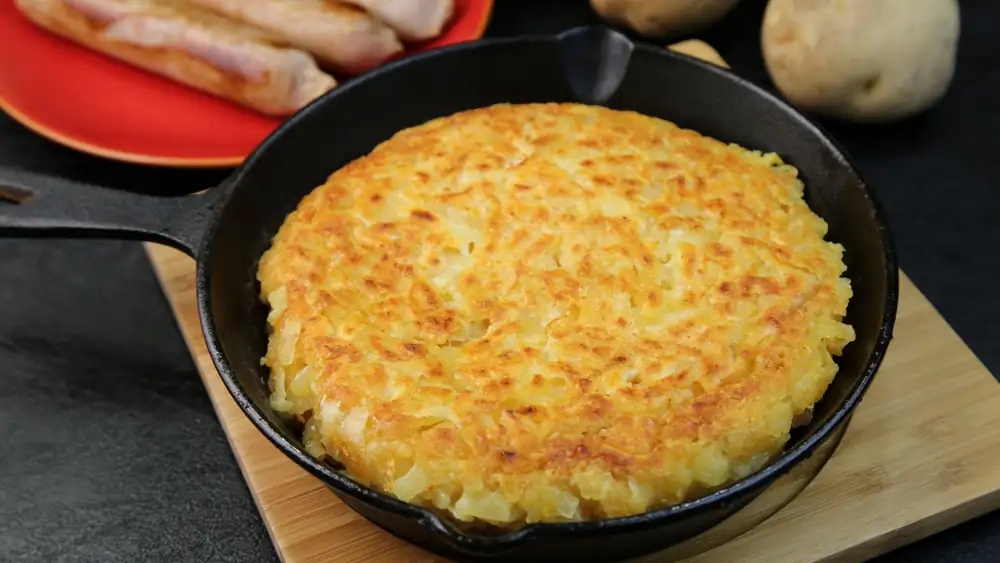
There they prepare rösti, a potato cake that is quite similar to our tortilla, although, strange as it may seem, it does not contain eggs.
The recipe basically consists of grating cooked potatoes, putting them in a pan with butter and letting them cook until they form a compact cake, golden on the outside and creamy on the inside.
Rösti is especially linked to German-speaking regions and has even given its name to Röstigraben, a little joke alluding to the cultural border between German-speaking and French-speaking Switzerland.
The term literally means something like "the rösti gap" and recalls the areas where this dish was traditionally part of everyday cooking and those where it was not.
What is rösti and how is it similar to a tortilla?
The simplest version is made with just potatoes and butter. It doesn't contain flour, eggs, or any other binding agent, because the potato starch itself performs that function during cooking.
That's also one of the differences with the Spanish omelet. The egg allows for a lot of play with the final consistency, from a completely set omelet to one that's almost runny in the middle.
In rösti, on the other hand, the texture depends almost entirely on how the potato has been cooked.
Although it can be done with raw potatoes, one of the most common methods involves cooking them beforehand, letting them cool, and then grating them once they're cold. This resting period allows the starch to change structure through a process known as retrogradation, resulting in a firmer potato.
This allows it to be grated without it falling apart or turning into a puree. It also loses some of its surface moisture, which helps the cake brown and maintain its shape during baking.
Pre-cooling also has another effect. Some of the starch is converted into resistant starch, a prebiotic that is not digested in the same way as freshly cooked starch and reaches the large intestine in greater proportion, where it can serve as food for certain bacteria in the gut microbiota.
If you prefer to make rösti with raw potatoes, grate them and remove as much excess water as possible before putting them in the pan. You'll also need to give them a little more time to cook through, making sure the surface doesn't burn.
Butter is the traditional fat and the one that provides the most recognizable flavor, although oil or a combination of both can also be used.
And, just like with the tortilla in Spain, there are versions that incorporate grated or very finely chopped onion, which is cooked along with the potato and adds a little more juiciness and a slight sweetness.
From the Bernese Rösti to the Rösti-taler
Like any popular recipe, rösti has almost as many versions as there are cooks. Here are some of the most recognizable local variations:
Bernese rösti (Berner Rösti) is probably the most famous and contains bacon and often onion, making it a much heartier dish.
Käserösti contains grated cheese, usually Gruyère or Emmental, sandwiched between the potatoes. There are local versions, such as those from Zurich or Appenzell, and also rösti-taler, small pancakes about the size of a coin.
They are usually served as a side dish with meat and fish, but they can also be served with a fried egg on top - that would be a real deconstructed potato omelet - slices of bacon, smoked salmon or sauteed vegetables.