Caru' cu Bere: Eating History in the Heart of the Romanian Capital
It's not often you get to eat well at over-hyped, famous, Instagrammable restaurants around cities. Especially in capital cities, which are overrun by tourists for a wide variety of reasons.
The story of the Beer Cart
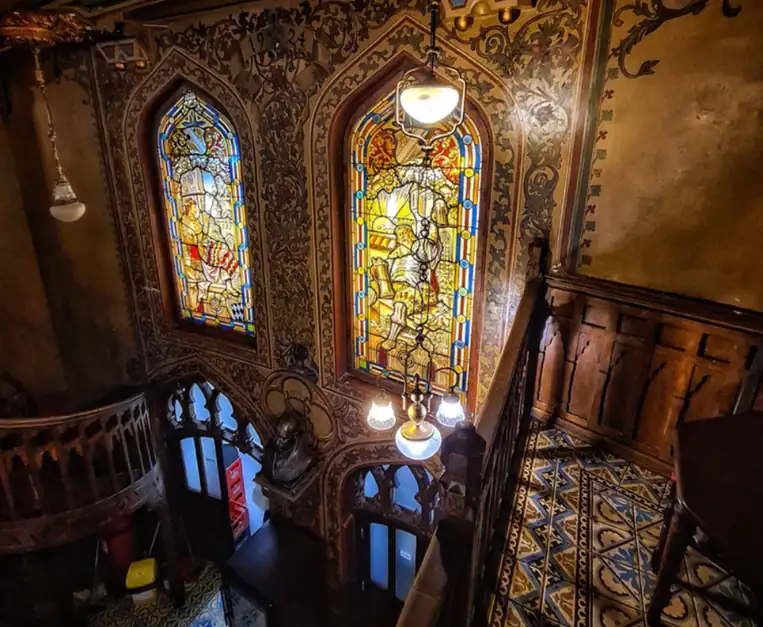
Step inside and you immediately understand that time is not a neutral variable here. Here you traverse a century and a half of Bucharest's social and gastronomic history. You're in the city center, in the Lipscani neighborhood, but the feeling is of having been transported to an imaginary Central Europe, suspended between Vienna, Prague, and an Eastern Paris that no longer exists except in architectural memory. The stained-glass windows filter the light like a secular cathedral of conviviality, the mosaics depict scenes of popular celebration, and the internal balconies seem tailor-made for observing the collective ritual of eating.
Caru' cu Bere was founded in 1879 as a brewery and became a restaurant in 1899, during the period when Bucharest was known as "Little Paris." The city was building its identity, and this establishment was one of its main gathering places, frequented by writers, politicians, artists, and the emerging bourgeoisie. It's no coincidence that it is now classified as a national historic monument, a rare achievement for a restaurant, but perfectly in keeping with its role in Romanian history.
The interior, in Neo-Gothic and Art Nouveau style, isn't just a backdrop: it's an integral part of the experience. Eating here feels like doing so inside a history book that amplifies everything, from the clinking of glasses to the perception of taste. Traditional Romanian cuisine, often hearty and rustic, finds an almost theatrical dimension in this setting. Each dish seems larger, more distinctive, more "real," because it's placed in a setting that culturally validates what you're eating.
How to eat at the Caru' with Beer
The signature dish is undoubtedly the celebrated ciolan de porc, a pork shank weighing over a kilo and a half that arrives on the table like a carnivorous relic. It's a dish that needs no explanation: succulent meat, glossy skin, soft fibers, accompanied by stewed cabbage, polenta, horseradish, and chili pepper. It's a form of gastronomic protection against winter, even when it's spring outside.
The entire alphabet of Romanian cuisine revolves around it: sarmale, cabbage rolls stuffed with meat and rice, served with sour cream and mămăligă; ciorbe, acidic soups that play on the balance between fat and freshness; mici, spicy grilled sausages; zacuscă, a creamed eggplant and pepper soup, one of the great vegetal intuitions of the local tradition. It's a cuisine steeped in tradition, but filtered through an urban context that makes it more accessible, less harsh.
Beer, the establishment's founding element, remains central, partly because it was brewed on-site. The historic recipe is guarded like a family secret, and even though it's no longer brewed on-site, it retains a recognizable identity: clear, drinkable, and straightforward, designed to complement food rather than dominate. It's a beer for socializing, not tasting, perfectly in keeping with the place's core concept: drinking together, eating together, and being together.
Caru' cu Bere has been listed by TasteAtlas among the world's legendary restaurants, and in this case, the word "legendary" is no exaggeration. Not because the food here is better than anywhere else, but because few places in Europe manage to embody the connection between gastronomy and national identity so clearly. This is a restaurant that functions as a living archive.
Eating here means understanding something about Romania without visiting a museum. It's an edible history lesson, where cuisine becomes a tool for understanding the region and its collective memory.