Mugaritz and the hair soup
Today the police didn't show up when a customer tried to leave without paying. Nor is there a TikToker filming what she'll later describe as the worst dinner of her life.
It's best to warn everyone from the start, in case anyone stumbles across this place looking for the controversies that occasionally rock Mugaritz. Andoni Luis Aduriz, who takes it all in stride, says, without meaning to: "Not even with the best screenwriters or community managers could we have prepared for what's happening to us."
The Mugaritz experience is also preceded by several warnings. After making the reservation and upon sitting down for an aperitif in the garden, for example. So it's difficult to take the first bite without being clear that this isn't a typical restaurant, nor will the experience follow the usual conventions of a tasting menu. Despite this, and after 26 years, apparently some people are surprised. Or, worse still, offended.
We discussed all of this with Aduriz in the kitchen before sitting down to eat. We also talked about the kilos of meat they use for one of the sauces, while he wondered if it would be enough to be considered a restaurant focused on quality ingredients. Or on seasonality, because, mind you, it turns out that some dishes have variations throughout the months they're open.
Cutlery and rhythm
These are almost rhetorical questions because labels are particularly complex here, although it's true that in no case would those be the most representative ones to define this place. A restaurant of ideas? A non-restaurant, as the chef argues, to prevent anyone from arriving here with their own idea of what a restaurant should be? What is clear is that in times when the concept of the gastronomic experience is somewhat disparaged, here it is championed and celebrated.
Because people don't just come to Mugaritz to eat, even though it seems that not everyone understands that after a quarter of a century. Nor do they come looking for answers, because they handle questions and reflections better within that multidisciplinary ecosystem that revolves around food.
We rub our finger across a gelled oil, which then serves to pick up leaves from another bowl in a rather literal gesture of eating the landscape. It's the first of more than twenty courses that make up this season's menu, aptly named "What You Don't See." Cutlery is neither present nor expected. It will be an almost incidental element in the experience. Nothing new. This is also noted at the beginning of the service.
A provocation? Aduriz flatly denies it. Although there are moments that seem designed to make people uncomfortable, no dish is created for that purpose, he assures. "The things that happen have to do with my way of seeing the world," he asserts.
Mugaritz is open for half the year; the other half is dedicated to creating the next menu.
A world without cutlery? It's a matter of rhythm, he explains, after confessing that he gets bored in many European restaurants where four or five courses take hours. Like it or not, whether you agree with the idea or not, at Mugaritz everything happens for a reason. And the much-discussed absence of cutlery not only challenges other ways of eating, it also speeds up service and adds rhythm to the menu.
Taste and sense
If last season one of the most talked-about dishes was Ama (warm sheep's milk served in a breast that had to be sucked), this year the navel of the world invites you to lick a juice with acidic touches in a kind of jelly that resembles a navel.
"Are you sure you're not just trying to stir things up a bit?" we insist. "It's our first taste," they muse in the kitchen, though they admit that if all two dozen dishes were like this, the dining room would be in flames. There are gentler bites (for example, two meat dishes, or a truly delicious confit piparra pepper with pepper broth), playful touches like the duck à l'orange that resembles nougat—so much for the idea that Mugaritz doesn't have desserts—and even a cod omelet, in a very free and conceptual version, of course.
“I know there are things that won’t be to everyone’s liking. If you find three that catch your eye, it’ll have been worth it,” reflects the Basque chef. The numbers add up. We’ll add another: the bread with ham and tomato, which, through fermentation, acquires the creaminess of a brie and is presented emulating a nigiri.
“It’s more important to caress a texture, even if it doesn’t have a strong flavor,” Aduriz asserts. What would be inconceivable in any other restaurant has been a creative pillar here for decades. Flavor, or that it tastes good—whatever that means—isn’t always the most important thing, nor should it necessarily dictate the dish. The key is that everything makes sense, although that doesn’t necessarily mean it will for the diner, of course.
“What’s subversive is poetry and blandness.” Talking to Aduriz is not only fascinating and the perfect complement to the menu, but also an inexhaustible source of headlines. And a reminder that, at this point, trying to explain to him what Mugaritz is or should be is not only a bit pretentious but also quite absurd. As he himself says, it’s not just that there’s a hair in the soup here, it’s that they’re serving a soup of hairs. Don’t worry, it’s not a real dish. At least not yet.
Michelin's thing
“Michelin: a fold of prejudices and praise that accumulates in the abdominal area of diners,” we read in a small booklet that accompanies the menu and that, in the style of Ambrose Bierce’s Devil’s Dictionary, proposes its own definitions for different terms and even invites diners to fill in some of them to be included in future years.
The complex relationship between the Michelin Guide and Mugaritz is such a well-worn and tired topic that it's almost surprising when Aduriz admits he still thinks about it. And that, of course, he would love to display the third Michelin star, although he acknowledges that their path "has distanced them from Michelin's codes and its way of understanding gastronomy."
But hey, he knows the rules. And he also knows that to reconcile, dessert would have to be served, and that's not going to happen. Because the sweet churro that concludes the experience isn't really dessert. A menu ending that, in reality, isn't really an ending because it's difficult to leave Mugaritz without still thinking about what you've eaten and experienced. You may like it or not, but it's hard to imagine that such a unique place could disappoint anyone.
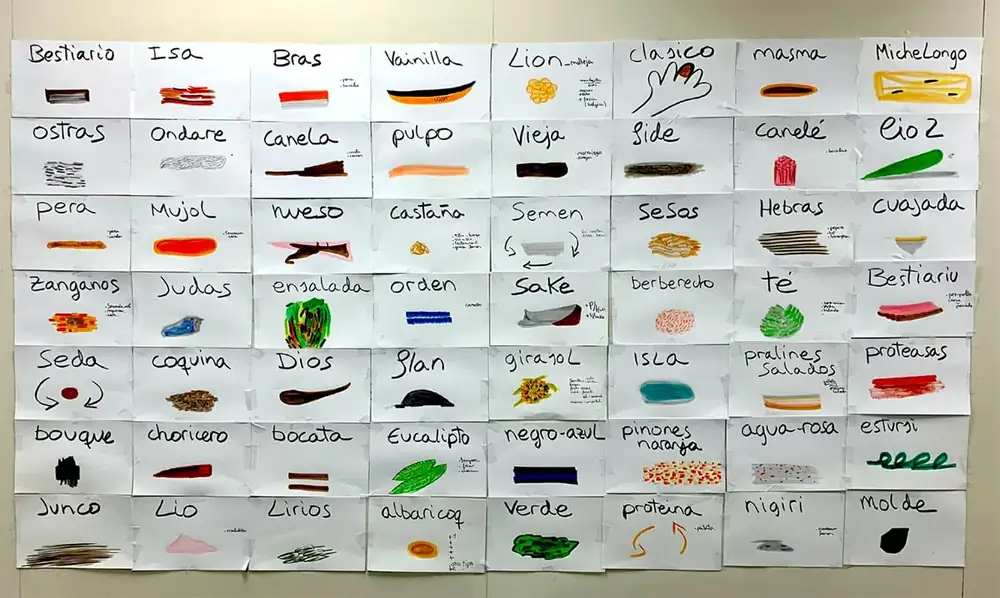
Mugaritz offers a single tasting menu this season for €253. There are several wine pairing options, both alcoholic and non-alcoholic, starting at €88. Among the different choices, the "Vis à Vis" range, featuring wines created in collaboration between various wineries and Mugaritz, is particularly interesting. For those who have come to play a game, Atlas offers a curious activity in which, through different drawings, the sommelier team will—or so they say—select the most suitable wine for the occasion.
On October 26th and 27th, the season concludes and the creative period begins. On those two dates, Mugaritz Itzgarmu hosts an experience that goes beyond the tasting menu, inviting participants to immerse themselves in the restaurant's inner workings and learn about its processes.