One-pan cooking: how to cook a complete meal using just one pot
The name can be misleading. One-pan cooking doesn't mean throwing all the ingredients in together from the start and expecting the oven or stovetop to do the rest.
That's the interesting part of the method. Washing less helps, of course, but the real advantage is learning to order the cooking process: deciding what goes in first, what can be added later, what needs space to brown, and what benefits from a little liquid. When that coordination fails, the result suffers too: watery vegetables, overcooked protein, hard potatoes, or a sauce that resembles broth.
And that logic isn't new. Shakshuka, chicken and rice, noodles cooked in a casserole dish, or chicken thighs with potatoes already solve a good part of the meal in the same pot. What's modern is the etiquette; home cooking has long made use of the same stock, the same juices, and the same heat source.
What does it really mean to cook in just one pan, pot, or tray?
To make sense of this concept, we're talking about a single main cooking vessel. We could use a cutting board, a knife, a bowl for mixing a dressing, or a plate to temporarily hold an ingredient. What we're trying to avoid is preparing three separate dishes on three different burners only to combine them at the end.
The cooking vessel can also work to our advantage. If we brown meat in a pan, the toasted bits that stick to the bottom can later become sauce when deglazing. If we make pasta in the pan itself, some of the released starch goes directly into the liquid and helps to thicken it. If we roast chicken over vegetables, the meat juices drip onto the vegetables and contribute to the cooking process.
Therefore, a good one-pan recipe isn't about saving on cookware at the expense of the result. The pan should be an integral part of the recipe, not an absurd limitation that forces us to cook worse.
The golden rule: make sure all the ingredients are ready at the same time.
This is the problem that needs to be solved before turning anything on. Each ingredient has its own cooking time. A thick potato or a carrot takes considerably longer than a zucchini; broccoli can quickly go from firm to mushy; and a delicate fish shouldn't wait in the oven for a tough vegetable to finish cooking.
We have three tools to adjust those timings. The first is to change the size of the cut: the smaller a hard ingredient is, the faster it will cook. The second is to choose ingredients with similar cooking times. And the third, usually the most useful, is to incorporate them in stages.
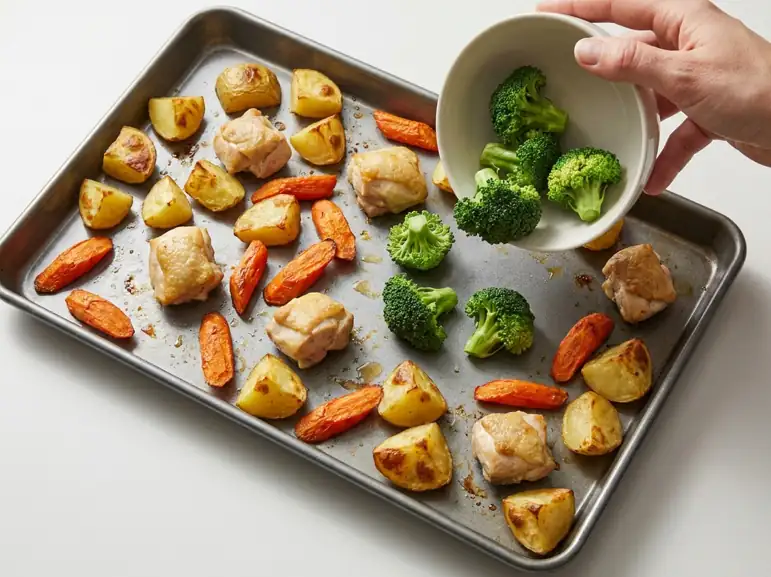
Imagine a tray with potatoes, carrots, chicken, and broccoli. We can prioritize the first two, add the chicken later, and leave the broccoli for last. We're still using a single tray, but we're no longer forcing four different foods to behave as if they were the same.
This way of thinking also applies to a frying pan. First, we can brown a protein, remove it, cook the vegetables in the same fat, and return the meat to the pan when the sauce or side dish is almost ready. Removing and returning doesn't break the method; it prevents one part of the dish from overcooking while another remains raw.
Baking tray: space for real roasting
The tray is probably the most visually appealing version of one-pan cooking. It works very well for chicken, fish, potatoes, sweet potatoes, and many roasted vegetables, but it has one non-negotiable condition: the food needs space.
When we fill the tray until the metal is barely visible, the ingredients release moisture, and that moisture gets trapped. Instead of promoting browning, we start to boil and generate steam. That's why a large tray usually works better than a small, overcrowded one, and that's why sometimes using two trays is better than ruining dinner by maintaining the fiction of "just one."
We can also take advantage of different areas of the oven. Items that need more browning can be placed in areas where the oven heats up more intensely, and delicate ingredients can be added later. The technique is the same as when preparing roasted vegetables: cut, space, oil, and time are just as important as temperature.
A very simple example is oven-baked chicken thighs with potatoes. The meat can share the dish with the side dishes, and its juices help cook and flavor the vegetables. Now that's true integration: not a dry chicken breast placed on top of potatoes cooked separately just for a photo.
Pan: brown, set aside, build and reassemble
The frying pan has another advantage: it allows us to change techniques without changing the pan. We can start with a stir-fry or a deep browning, lower the heat, add onion or other vegetables, incorporate liquid, and finish with a sauce.
Here, it's worth taking advantage of the browned bits left on the bottom. After searing meat or vegetables, caramelized bits often cling to the surface. Adding stock, water, wine, or another suitable liquid and scraping them up while the pan is still hot allows you to deglaze and reintroduce that flavor. What looked like dirt is, if it's not burnt, part of the recipe.
Shakshuka is another good example of the one-pan logic. First, a base of tomatoes and vegetables is cooked, and then the eggs finish cooking directly in it. There's no sauce on one side and eggs cooked separately: the final ingredient cooks within what's already been prepared.
The pan also forces us to control the quantity. If we add too much meat or too many cold vegetables at once, the temperature drops and water appears before we get a good browning. When we want to toast, contact, temperature, and space all go hand in hand.
One-pot: when the liquid is also part of the calculation
In a pot or casserole dish, the challenge changes. Here, we often seek precisely that: moist cooking—stews, rice dishes, legumes, noodles, or pasta. Liquid ceases to be an enemy of browning and becomes a variable that must be measured.
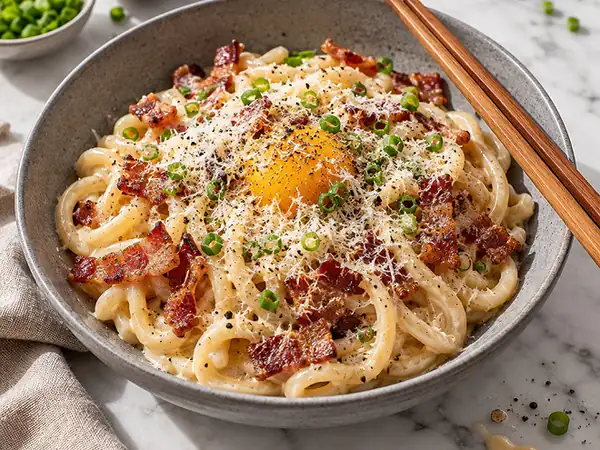
One-pot pasta demonstrates this well. Dried pasta can be cooked in the same pot with the other ingredients and a carefully measured amount of water or stock. As it cooks, it releases starch into the liquid; if the ratio is correct, you end up with a richer sauce that clings to the pasta, not a pot full of water that then needs to be drained.
This requires careful attention. If there's not enough liquid, the pasta can become hard before it's cooked; if there's too much, the sauce will be too thin. It's also a good idea to stir it in the first few minutes because the surface starch makes the pieces stick together.
The same logic applies to many familiar dishes. A fideuà or noodles with squid, for example, take advantage of the broth in the pan itself, allowing the pasta to absorb flavor as it cooks. Something similar happens with legumes when they're part of a stew: the liquid doesn't just accompany the dish, it builds it.
We'll start with what takes the longest.
Potatoes, sweet potatoes, carrots, squash, rice, or certain hard vegetables usually set the pace. If they need a ten or fifteen-minute head start, we give it to them. The slowest ingredient dictates the schedule, not the order in which we feel like emptying the bowls.
We chose a protein that can withstand cooking
Chicken thighs and drumsticks, meatballs, some sausages, or certain cuts with some fat usually have more leeway than a very thin breast. Fish also works, but it often needs to be added last. The real question is: how long can this protein stay in the container without drying out?
We decide if we want it golden brown or with sauce.
We can't expect the same area of the tray to be very moist and, at the same time, produce a deep brown. To roast, we need evaporation and space. To stew or thicken a sauce, we need enough liquid. The final texture is decided before cooking because it determines how much liquid to use and when to add it.
We saved a contrast for last
After cooking together, the dish can be greatly enhanced with something added off the heat: fresh herbs, lemon, a yogurt sauce, a vinaigrette, nuts, or a bit of cheese. There's no need to overcomplicate things. A fresh, acidic, or crunchy touch can prevent everything from tasting bland.
The mistakes that most ruin a one-pan recipe
- Add everything at the same time as a matter of course. If the timings don't match up, someone loses: either the potato ends up hard or the delicate ingredient gets overcooked.
- Overcrowding the tray or pan. Excess moisture hinders browning and leads to wetter cooking.
- Cut all the ingredients exactly the same size. The size should help us compensate for their different cooking times.
- Adding too much liquid when you want to roast is one thing. It's one thing to lubricate, and another to turn the tray into a swimming pool.
- Choosing a protein that's too delicate for the side dish. We can add it later and that's that.
- Stir continuously when you want it to brown. To brown, the food needs to spend some time in contact with the hot surface.
- We shouldn't obsess over using just one pan, even if it no longer makes sense. If we need a second tray to cook properly, we'll use it. There's no point in washing one less dish.
- Forget the finishing touch. A fresh, acidic, or crunchy element can elevate a dish that would otherwise be too bland.
Does it really save time?
Yes, but it doesn't always shorten the cooking time. We still have to peel, cut, measure, and check for doneness. A potato doesn't cook any faster just because it's in the same pan as the chicken.
The savings are primarily seen elsewhere: fewer cooking pots, fewer heat changes, fewer simultaneous cooking processes, and less cleanup. It can also reduce the attention required for dinner: a well-organized tray spends considerable time in the oven on its own, while a single casserole dish eliminates the need to have three burners open and constantly monitored.
That's the real value of one-pan cooking. It's not about cooking with one hand tied behind your back, but about designing the sequence so that a single pan does more work. If everything turns out perfectly and there's a frying pan instead of four pots waiting in the sink, the method has worked. And if one day you need two trays, it's not the end of the world.