How many flowers do we need for the perfect elderberry syrup? The ratio that guarantees success
Although almost every family has its own recipe and little secrets of preparation, the same question always comes up: How many elderflowers do we need per liter of water?
The right ratio is key
According to established practice in home syrup preparation, which is also followed by many Slovenian housewives, a simple rule applies:
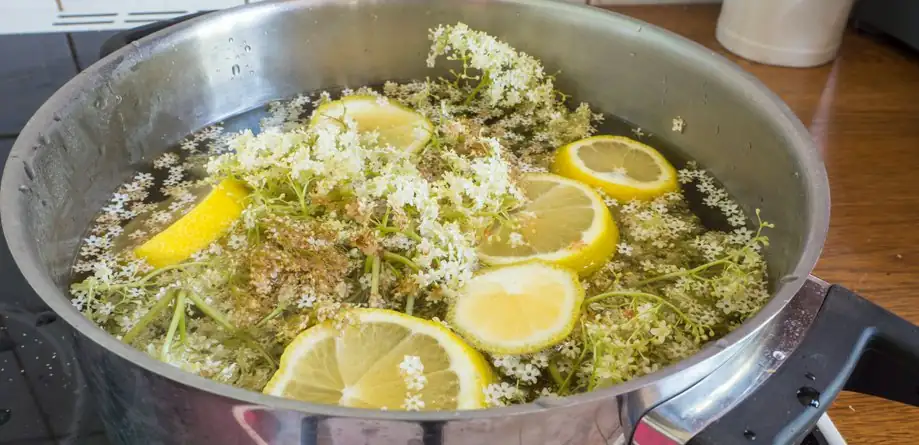
- per 1 liter of water, use approximately 10–12 elderflowers, 1 kg of sugar and 1 lemon or 20 g of citric acid.
This ratio is often used as a "golden mean" that ensures good aroma, enough sweetness, and also the stability of the syrup.
If we are preparing a larger quantity, the ratio remains the same, which means that for 5 liters of water we use approximately 60 flowers (depending on the size of the buds), 5 kg of sugar and 100 g of citric acid.
Various sources emphasize that the amount of flowers can be adjusted slightly to the intensity of the flavor – more flowers mean a stronger aroma, while fewer flowers mean a more delicate syrup.
The key is to use the right flowers
When preparing the syrup, look for flowers that are completely white, open, and have a strong sweet scent. If possible, they should also not have any signs of wilting. Above all, avoid flowers that are brown or wilted, as they are less tasty than beautiful, open flowers.
The size of the flowers also plays a role; larger and fuller flowers give a stronger aroma, but if we have smaller ones available, we simply increase their number according to the recipe.
As reported by Zadovoljna.dnevnik.hr, for the best aroma, it is important to pick the flowers:
- in dry and sunny weather, - when the pollen (yellowish coating) is still fresh and prominent.
This pollen is key to the syrup's characteristic smell and taste, as emphasized in many herbal manuals.
The location of the collection is also very important:
- avoid roads and traffic areas, - do not collect near industrial areas or sprayed fields, - the best choice is forest edges, meadows and unpolluted nature.
This reduces the presence of impurities and ensures a higher quality final product.
Can we use less sugar?
In recent years, there have been more and more "light" versions of elderberry syrup with less sugar. However, it is important to remember that sugar is not only a sweetener, but also a natural preservative. This means that using less sugar will shorten the shelf life of the syrup. In this case, it is better to store the syrup in the refrigerator and use it more quickly.
Another key trick for longer durability
A common problem that we can encounter when making homemade elderberry syrup is that it will boil over time. But this can also be avoided if we make sure to use clean and sterilized bottles and caps to store the syrup. Sterilizing the bottles is essential for the long-term shelf life of the syrup and preventing the development of unwanted microorganisms.
A simple and effective way to sterilize is in the oven. Preheat the oven to 100 degrees Celsius. While the oven is heating, arrange the clean and washed bottles (without plastic parts) on the lowest rack of the oven. Leave them in the closed oven for about 10 minutes or until no more drops of water are visible on the inside of the bottles. A dry surface indicates that the water has evaporated and that the bottles are hot enough to kill most microorganisms. Carefully remove the bottles from the oven and immediately pour the syrup into them and seal them.