Brioches and leavened products: why you need a specific flour to handle butter and sugar
In pastry making, every process requires rigor, precision, and knowledge. This means respecting the ingredients, choosing them carefully, and recognizing their characteristics, but also understanding their timing and guiding them through the transformation process.
Molino Colombo: Over a Century of Flour Culture
This is the philosophy behind Molino Colombo, a milling company that for over a century has linked its history to the culture of flour, research, and a deep connection with the local area. A story that began in 1882, on the "crest of the Paderno plateau," the place that captivated Leonardo da Vinci with the beauty of its river scenery, where the first electric-powered mill was built.
A story in which territory, experience, and innovation meet, one of whose defining elements is its milling philosophy. For Molino Colombo, the wheat transformation process is more than just a production phase: it's the moment in which to preserve and enhance the characteristics that will then be translated into the professional's work.
Grain selection and slow grinding
Selecting the right soft wheat is the first step. For more complex processes, different grains are selected, expertly calibrated so that each contributes its own characteristics to the final result. But selection is only the beginning: the way the wheat is processed also determines the characteristics of the flour. Hence the choice of a long, slow milling process, designed to guide the grain through its transformation without subjecting it to excessively aggressive processing.
A philosophy in which time is not considered a production constraint, but becomes part of the process and, therefore, of quality. Milling slowly means seeking balance and preserving the characteristics of the wheat proteins, resulting in a flour capable of consistently meeting the needs of the professional. When the raw material has been carefully selected, time becomes the tool through which it can express itself.
Leavened pastries and brioches: the importance of structure
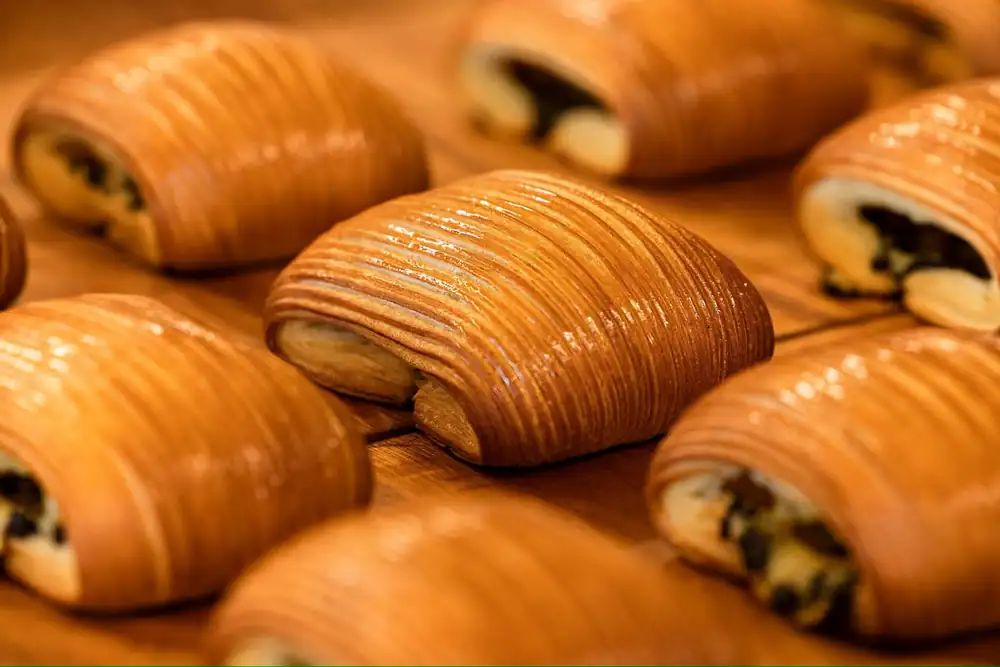
This is a particularly important principle in the world of leavened pastries, where the complexity of the process makes every decision made upfront evident. Brioche, in particular, requires precision at every stage: kneading, kneading, fermentation, and leavening must find their proper balance.
Butter, sugars, and eggs test the dough's structure. The gluten network must be strong enough to support it, yet stretchable and elastic, capable of supporting the dough's growth without offering excessive resistance.
Le Pasticcere flour for leavened pastries and brioches
It's precisely to address this complexity that Molino Colombo's Le Pasticcere flour for leavened pastries and brioches was created. This type "00" flour is designed for recipes that require structure, balance, and the ability to withstand prolonged processing. The high protein content is designed to withstand long processing times and significant amounts of added fat, while the unique extensibility of the gluten mesh promotes smooth dough handling.
Strength and elasticity, therefore, are not seen as isolated characteristics, but as elements that must interact with each other to accompany the professional's work, from kneading to leavening, up to the finished product.
The brioche as an expression of the mill's philosophy
The brioche thus also becomes a metaphor for Molino Colombo's philosophy: a seemingly simple preparation, yet capable of revealing, at every stage, the importance of raw materials, technique, and time. Because when a dough must grow, transform, and reach its proper balance, there are no shortcuts.
This is the direction Molino Colombo has pursued from its industrial and regional history: a culture of flour built through the selection of grains, knowledge of the material, and a milling philosophy in which time once again plays a central role. An approach that addresses the needs of professional pastry making and, through the Le Pasticcere line, translates milling tradition into tools designed for contemporary processes.