Cómo distinguir un croissant casero de uno congelado, en la barra
A las cinco de la mañana, en medio de la indiferencia general, una furgoneta diésel tose frente a tu cafetería habitual.
At five in the morning, amidst general indifference, a diesel van coughs in front of your local café. It's at that precise moment that the fate of your breakfast is decided. Three hours later, you enter a pre-caffeine trance, pay your dues, and stare into an artfully lit display case. The van is gone, the boxes with them, and there's no law that requires the person standing in front of you to confess that the artisanal miracle you're paying for simply came out of a freezer.
Walk into a place, perhaps one with raw wood finishes and bare-filament light bulbs that scream authenticity at €15 an hour. Well, this bar can legitimately display a chalkboard that says "artisanal" (because maybe someone is actually assembling a tart in the back room) and, at the exact same time, line up on the counter a stack of frozen industrial croissants that have nothing artisanal about them but the air they breathe.
The four types of bar croissant
To begin to understand this, we must first accept that there are at least four types of croissants. And it's not the usual Manichean tale that distinguishes between "delicious fresh" and "delicious frozen."
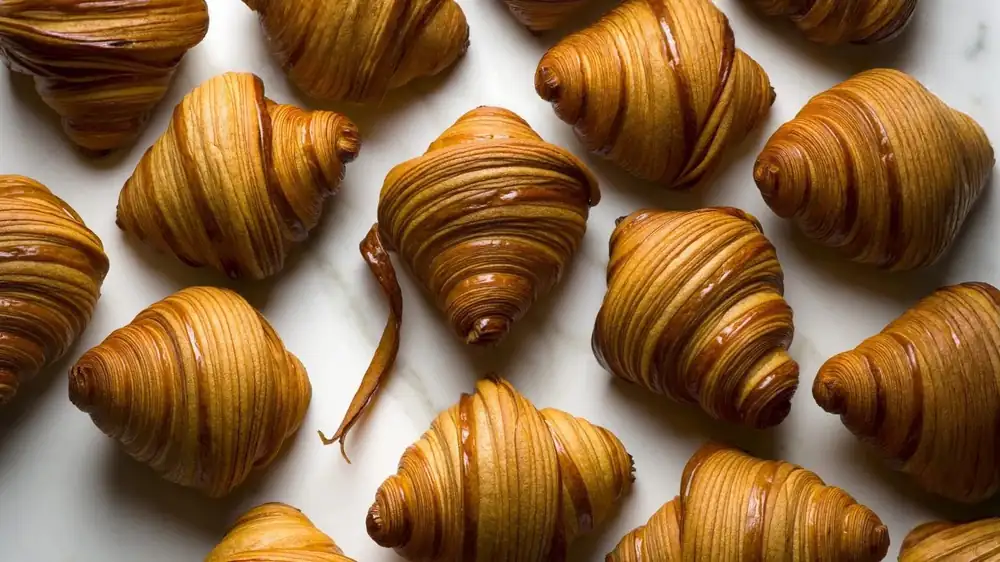
- Artisanal, made direct: the croissant is kneaded, rolled out, shaped, and baked entirely in the pastry shop's lab at the crack of dawn. It's such a rare commodity because it requires skilled labor and time management that the modern economy has practically banished. Those who truly make it don't need to shout about it: the smell of real butter fills the block and does the marketing for them.
- The artisanal blast chiller: the pastry chef does all the dirty work (kneading and rolling out dough in the lab) and then freezes the dough while it's still raw, or immediately after baking, in a professional blast chiller. If the cold chain is managed by skilled professionals, thermodynamics guarantees a result that's literally indistinguishable from fresh. It's the survival technique of the best professionals.
- The raw industrial: here we enter the realm of compromise. The café buys the raw and frozen croissants from an external company, and the barista simply has to let them rise and bake them. Quality? A lottery. There are excellent industrial lines, laminated with butter and artificial sugars; but there are also pallets of cheap junk, filled with cheap margarine and artificial flavors.
- Pre-baked and regenerated: the croissant arrives pre-baked or already baked, frozen. It doesn't rise; it's simply "regenerated" by a quick trip in the oven.
What's inside a frozen croissant?
Reading the ingredients list of a low-end frozen croissant, the kind found on most Italian shelves, is a bit of a disillusionment. Butter almost always disappears, making way for blends designed to reduce costs and withstand the temperature fluctuations of laboratories: hydrogenated vegetable fats, palm, rapeseed, or sunflower oils, stabilized with emulsifiers such as mono- and diglycerides of fatty acids.
To compensate for the flat taste of the dough, glucose-fructose syrups and the inevitable synthetic vanilla flavoring are used, without any jams or creams of any kind.
In contrast, the label of a premium frozen product tells a different story: pure cow's butter is combined with precision chemistry, strictly functional for cold management. We find technical sugars like dextrose and trehalose to lower the freezing point of water, alongside osmotolerant yeasts and specific enzymes that protect the gluten network during hibernation, resulting in an impeccable leavened product without compromising on quality.
How to recognize a frozen croissant
The first warning sign is mass-produced standardization: if you see a tray of cloned crescents, identical to the millimeter, perfect and smooth, no human hand can match them. But never trust the browning: a simple coat of egg-based mixture is enough to make even an inner tube seem crispy and fragrant.
The only truly revolutionary tool, the one that pierces the veil of Maya, is the ingredient book. Every restaurant in Italy is required by law to have one available. Don't be afraid to look pedantic and ask for it. Inside is the unauthorized biography of what you're about to ingest.
The fact that no one asks is precisely why it works. Try it tomorrow morning and look at the barista's face, open that greasy folder, read the first line. Then decide whether that €1.80 is the price of a croissant or a lie.