Cape Malay Pickled Fish
When you shop through the links in our posts, you’re helping us continue to bring you more great content—at no extra cost to you! As an Amazon Associate, we earn commission from qualifying purchases, which means we can keep sharing recipes and tips you’ll love.
- 500 grams firm fleshed white fish fillets, skin on (cut into 6.5 cm squares, approximately 2 1/2 inch squares)
- 5 ml sea salt (use more as needed)
- 80 ml fish masala (or pickled fish masala, use more as needed)
- 80 ml sunflower or vegetable oil (use more as needed)
- 400 grams onion rings, 5mm slices (approximately 2 large brown onions)
- 15 ml sea salt
- 1500 ml water (approximately 6 cups)
- 500 ml white grape vinegar (approximately 2 cups)
- 250 ml water (approximately 1 cups)
- 160 ml fine granulated sugar (approximately 2/3 cup; adjust to personal taste)
- 5 ml sea salt (adjust to personal taste)
- 3 bay leaves
- 7.5 ml cumin seeds (dry roasted)
- 7.5 ml coriander seeds (dry roasted)
- 5 ml fennel seeds (dry roasted)
- 6 peppercorns (dry roasted)
- 6 cloves (dry roasted)
- 6 all spice berries (dry roasted)
- 2.5 ml turmeric powder
- 7.5 ml fish masala
- Coriander microshoots
- Fennel blossoms
- Cut the fish into 6.5 cm (2.5 inch) squares and wipe dry with kitchen towel. You should have 12 pieces.
- Place a sheet of foil or parchment on a baking tray and arrange the fish pieces skin side up then sprinkle over half the salt and fish masala spice.
- Flip the fish pieces over and sprinkle the other side with the remaining salt and fish masala.
- Cover the fish with cling wrap and refrigerate until ready to fry when the pickling mix goes onto the stove.
- Heat a frying pan on medium-high and add enough oil to cover the base. Fry the fish on both sides until cooked through.
- Put the fried fish on to a tray lined with foil.
- Slice the onions into 5 mm wide rings and sprinkle over 15 ml sea salt.
- Rub the salt into the onions and let sit until required.
- Bring the 1500 ml water to the boil in a medium sized pot and blanch half of the onion rings for 10 seconds then remove to a colander. Repeat with the rest of the onion rings.
- Discard the onion water and rinse the pot then put it back on the stove.
- To the pot on the stove add the vinegar, water, sugar and spices and allow to simmer for 10 minutes to allow the flavors of the spices to permeate the pickling marinade
- Remove from the heat and add the onion rings to the pickling marinade.
- Lay half the fried fish into a glass casserole dish then cover with half the onion rings.
- Repeat with the rest of the fish and cover with the remaining onion rings. Pour over all the juices and oil left on the foil.
- Pour over the hot pickling marinade and allow to cool at room temperature then cover with a lid or plastic wrap and refrigerate.
- Allow the marinade to infuse the pickled fish for at least 6 hours or overnight, before eating.
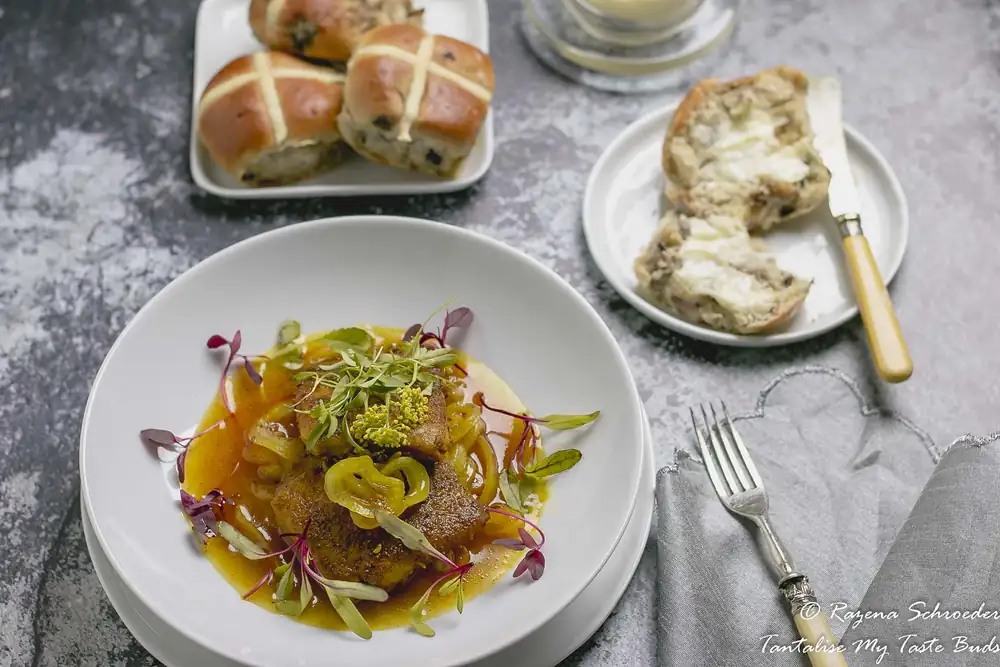
- Decorate with fennel blossoms and coriander microshoots, if using.
- Serve with buttered hot cross buns or crusty bread.
Thanks so much for your support! Cape Malay Pickled Fish is pan-fried lightly spiced white fish steeped in a sweet and sour marinade of crunchy onions, vinegar, sugar and dry roasted whole and ground spices.
It is even better when you make your own homemade fish masala powder. Pickled fish is one of the most popular traditional foods eaten in Cape Town over the holidays and it’s popularity is not limited to the Cape Malay community.
The Cape Malay method for Pickled Fish is popular on many a table of all faiths on Good Friday and eaten with buttered hot cross buns. A few years ago our neighbor, Uncle Faaiz (may Allah have mercy on his soul and grant him the highest paradise), brought me his wife’s Cape Malay Pickled Fish the day before my return to Dubai. He said that he remembered that my mother always made it for me when I visited.
When he saw the snoek vendors on the roadside he had to stop and acquire a fresh snoek, so that his wife could make the fried masala fish and pickle it before I left. Per to Uncle Faaiz passed away suddenly a few months later and the last story he, of the Cape Malay Pickled Fish. He stated that snoek was always plentiful around New Year.
In the ‘old days’ (my grandparents generation and earlier) they would make their Cape Malay Pickled fish in the first week of the year. It was a means to recover from the excesses of festive season and holiday feasting on roasted or braaied chicken and meats and corned meats. So basically, a way to detox!
What I couldn’t figure out though was how pickled fish became a staple of the Cape Malays over Easter, even those families without Christian relatives. Then I remembered all the stories I’ve heard over the years of the camping trips that the Cape Malay community made to the kramats at Faure.
Entire families would travel there to spend the four day Easter weekend camping and socializing with relatives and friends. Pickling the fish was the traditional and best way to preserve it as there were no refrigeration facilities at the camp site in the old days!
The kramat or memorial tomb itself is a mausoleum like structure built over the original burial place of Sheikh Yusuf of Makassar. After a failed uprising against Dutch occupation and colonization, he was an Indonesian royal who was exiled to Cape Town via Ceylon in 1694. Though he was not the first Muslim or the first Muslim religious leader to be exiled to this outpost colony of the Dutch East Indies Company, his home on the farm of Zandvliet is considered to have been the first organized community of muslim slaves and exiles.
Unlike the sacred places dedicated to heroes or martyrs of other faiths, the kramats of the Cape Malays do not contain idols or statues and are not places where the deceased are worshipped. The kramats are memorials for the religious leaders who taught and propagated the religion of Islam in the Cape, and a way for Cape Malays to remember our origins and history.
Every family has their own Cape Malay Pickled Fish method with some preferring it more sweet, and others preferring it more sour. There are many different South African pickled fish recipes and the Cape Malay Pickled Fish method includes powdered and whole spices as well as sugar to temper the sourness of the vinegar.
This is very different to the Scandinavian pickled herring or pickled mackerel recipes, and has more warming spices. Among my mother and aunts there were differences in the type of fish they preferred, or the amount of spices and sugar that they used on the fish or in the pickling marinade.
My dad disliked sour foods so my mum always used more sugar in dishes that had tomatoes or vinegar as a main component, and that is how we love it too. The most popular fish for this recipe are Snoek, Yellowtail or Geelbek (Cape Salmon) as they have business flesh and a flavor that can stand up to pickling.
Less popular are kingklip (too dear and with too delicate savor) and deep sea hake (delicate taste and flesh that flakes too easily). - Select a business white fish that can withstand frying, pickling and serving without disintegrating into a mush after a night in the pickling marinade.
- Do not use any flour to dredge the fish before frying as it makes the pickling marinade cloudy and viscous. The exception would be when using hake that requires the extra protection of a fried coating to prevent the fillets breaking apart.
- Do not saute the onions as this is not a stew and the onions need to have some crunch. If you do not want to blanch the onions then rinse off the salt under cold running water and cook in the hot pickling marinade for 30-60 seconds before removing from the heat.
- Dry roast the whole spices before adding to the pickling liquid to bring out the aromas and enhance the taste. - Use either white grape vinegar or light apple cider vinegar for the best result.
Do not ever use spirit vinegar in food. - You can use packaged pickle masala mix for the fried fish and pickle marinade but I prefer to make my own pickle mix. Fish masala spice blend for the fish masala fry as it ensures fresher flavors and consistency in the method.
If you love Cape Malay recipes please click on the links below for more: - 500 grams business fleshed white fish fillets, skin on cut into 6.5 cm squares, close to 2 1/2 inch squares
- 5 ml sea salt use more as needed - 80 ml fish masala or pickled fish masala, use more as needed
- 80 ml sunflower or vegetable oil use more as needed - 400 grams onion rings, 5mm slices roughly 2 large brown onions
- 1500 ml water approximately 6 cups - 500 ml white grape vinegar close to 2 cups
- 250 ml water close to 1 cups - 160 ml fine granulated sugar roughly 2/3 cup; adjust to personal taste - 5 ml sea salt adjust to personal taste
- 7.5 ml cumin seeds dry roasted - 7.5 ml coriander seeds dry roasted - 5 ml fennel seeds dry roasted
- 6 peppercorns dry roasted - 6 all spice berries dry roasted
- Cut the fish into 6.5 cm (2.5 inch) squares and wipe dry with kitchen towel. You should have 12 pieces. - Place a sheet of foil or parchment on a baking tray and arrange the fish pieces skin side up then sprinkle over half the salt and fish masala spice.
- Flip the fish pieces over and sprinkle the other side with the remaining salt and fish masala. - Cover the fish with cling wrap and refrigerate until ready to fry when the pickling mix goes onto the stove.
- Heat a frying pan on medium-high and add enough oil to cover the base. Fry the fish on both sides until cooked through.
- Put the fried fish on to a tray lined with foil. - Slice the onions into 5 mm wide rings and sprinkle over 15 ml sea salt.
- Rub the salt into the onions and let sit until required. - Bring the 1500 ml water to the boil in a medium sized pot and blanch half of the onion rings for 10 seconds then remove to a colander. Repeat with the rest of the onion rings.
- Discard the onion water and rinse the pot then put it back on the stove. - To the pot on the stove add the vinegar, water, sugar and spices and allow to simmer for 10 minutes to allow the flavors of the spices to permeate the pickling marinade
- Remove from the heat and add the onion rings to the pickling marinade. - Lay half the fried fish into a glass casserole dish then cover with half the onion rings.
- Repeat with the rest of the fish and cover with the remaining onion rings. Pour over all the juices and oil left on the foil.
- Pour over the hot pickling marinade and allow to cool at room temperature then cover with a lid or plastic wrap and refrigerate. - Allow the marinade to infuse the pickled fish for at least 6 hours or overnight, before eating.
- Decorate with fennel blossoms and coriander microshoots, if using. - Serve with buttered hot cross buns or crusty bread. - The salt removes the smell and much of the sharp taste of raw onions and you will immediately smell the strong odor of Sulphur.
- Unless you are using flaky breaky fish like hake, do not flour the fish as it makes the pickling mix cloudy and gloopy. - If you do not want to blanch the onions then rinse off the salt under cold running water and cook in the hot pickling liquid for a minute before it is removed from the heat.
- Adjust the ratio of water to vinegar per to personal taste and preference. Disclaimer: Nutritional information for the method is an approximation and varies going to the components and products used.
If you liked the method above please consider leaving a comment below. Also keep in touch on Facebook, Pinterest , TikTok and Instagram for more updates.
Don’t forget to share our recipes with your family and friends and #tantalisemytastebuds if you share any of our recipes or tips on TikTok or Instagram!